It was a tough contest to judge because all the stalls were dressed up in a vast array of materials that had taken imagination and time to construct.
The barns were not designed for that purpose or fire load.
Stall decorations are something we all come in contact with at almost every big show!
Fire-retardant coatings are not expensive and are easily applied.
If we all make a point of protecting our decorations using fire retardant fabrics and/or coatings this can be one of the best ways to prevent a catastrophe!
Making Our Show Stall Decorations Fire Safe by Laurie Loveman
The best way to make horse show stall decorations fire safe is to treat them with fire-retardant fabrics and coatings, which are inexpensive, easily applied, and keep flames from spreading if a fire breaks out. Elaborate stall frontages are highly combustible—and often toxic in a fire—which is why the Oklahoma City Fire Marshal’s Office produced a set of regulations requiring fire-retardant coatings on all stall decorations. The protection only works barn-wide, though: it helps little to treat your own decorations if the exhibitor three stalls away doesn’t.
Horse Show Stall Decorations should be made of fire retardant fabrics and/or coatings as one of the best ways to prevent a catastrophe!
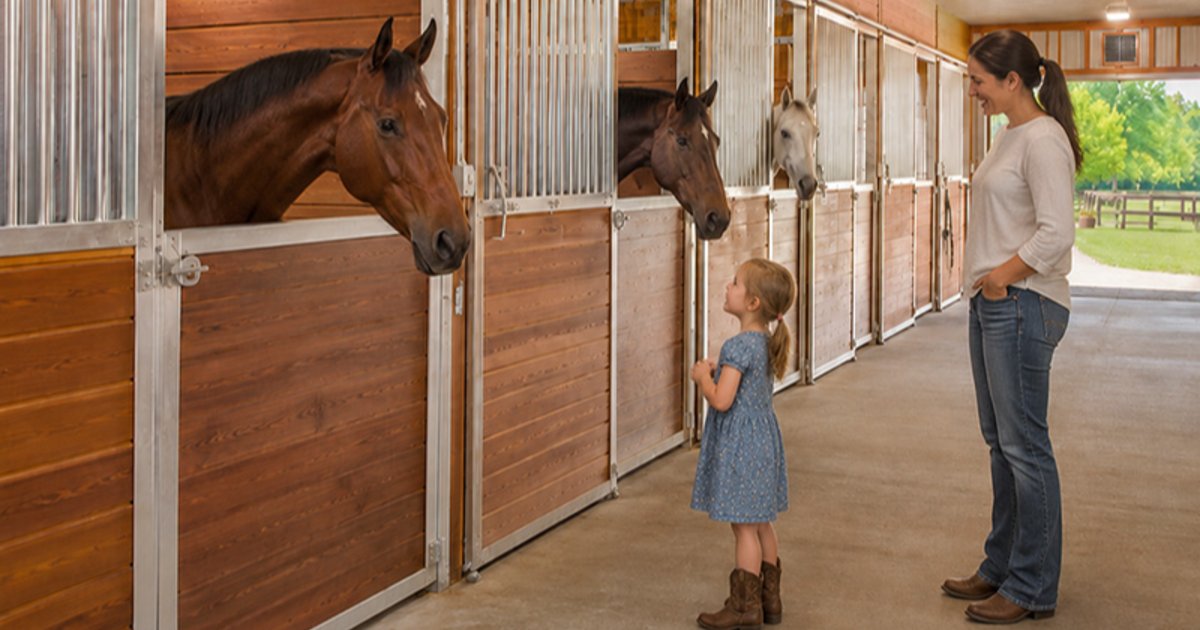
I’ve always enjoyed taking time when I’m at horse shows or equine expositions, to stroll along the exhibitor stalls and admire the stall decorations and brightly-colored flyers advertising stallions and related farm and products information. In fact, back when the Ohio Appaloosa Association was very active, one of the “events” of the very popular Youth Team Tournaments, directed by my dear friend, Sandy Shaffer, was a contest for best stall decorations.
It was a tough contest to judge because all the stalls were dressed up in a vast array of materials that had taken imagination and time to construct. But back then, in all the excitement of the show, no one—not even the Ohio State Fair board—ever considered that all those decorations created a tremendous fire safety hazard.
In fact, up until the height of the 2006 show season when Inspector William McCaine of the Oklahoma City Fire Marshal’s Office brought to my attention the problem of stall decorations, I had never considered the potential danger, and fire safety in horse barns and livestock facilities is my special interest. Inspector McCaine said, “We do many horse shows here at our state fair arena and the problem I’m having is that in the barn areas the stalls have pretty much become show places with some of them decorated with elaborate frontages and decorations, most of which are toxic [in a fire] and highly combustible, not to mention in violation of fire codes.
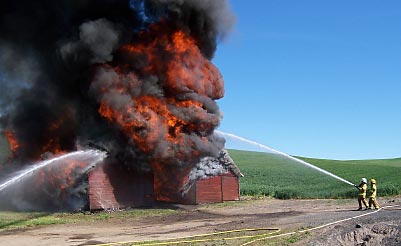
The barns were not designed for that purpose or fire load. I believe the lack of any current catastrophe has given everyone a false sense of invincibility and they do not realize the fire and life safety risks involved with this continued practice.”
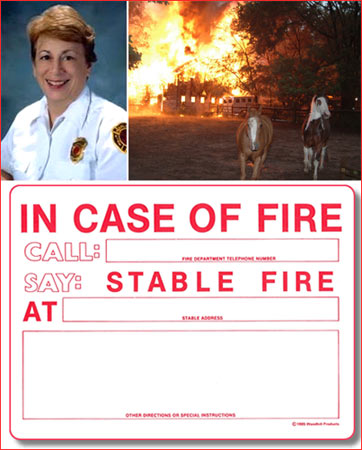
A short time later, Inspector McCaine and the Oklahoma City Fire Marshal’s Office produced a set of regulations for the use of stall decorations. The main focus of the regulations was on using fire-retardant coatings on all stall decorations so in case of a fire, the fabrics and other materials would not allow the flames to spread. Stall decorations are something we all come in contact with at almost every big show!
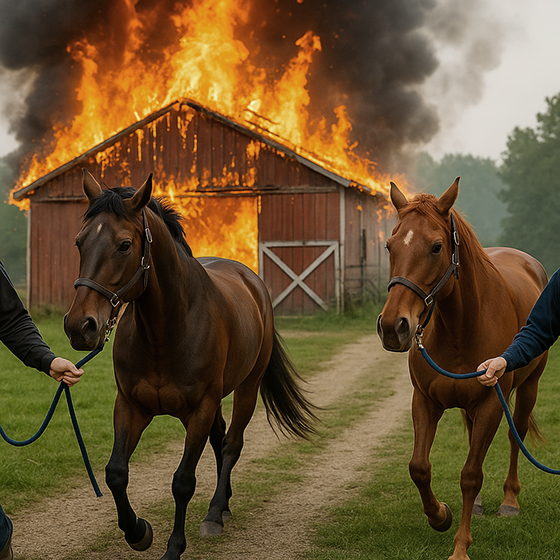
Fire-retardant coatings are not expensive and are easily applied. If we all make a point of protecting our decorations using fire retardant fabrics and/or coatings this can be one of the best ways to prevent a catastrophe! Of course, it’s extremely important that we all do it. It doesn’t help much if we protect our stall decorations with fire-retardants if the exhibitor three stalls away doesn’t. If you haven’t thought about having to evacuate a fairgrounds exhibitors barn, just take a moment to mentally picture getting your horses, kids, and pets out of an exhibitors barn when a hundred or more horses, people, children, and pets are all trying to get out at the same time. In my mind it’s a horrifying scene that I only want to imagine, not experience!
Oklahoma City has created their regulations with our safety in mind and it’s probable that their regulations will be adopted by other fire marshal’s offices and other cities. Don’t wait until the regulations are adopted in your area! I urge you to look at the actual regulations, which you can find at http://www.laurieloveman.com/ok_stall_decorations.pdf and begin promoting these regulations in your own state, province, or country. This is an easy-to-follow set of regulations that have the potential to save many lives.
Learn how to keep your horse barn and horses safe from fire at laurieloveman.com Find romance, mystery, firefighting and Appaloosa horses in the 1930s; meet the folks in my Firehouse Family novels Memories, THE Quarry, and THE Farm Fires.
How do I make my horse show stall decorations fire-safe?
Per Laurie Loveman: the structural fix is simple — use fire-retardant fabrics and/or apply fire-retardant coatings to all stall decorations before bringing them to a show. Per Loveman: "Fire-retardant coatings are not expensive and are easily applied."
The Oklahoma City Fire Marshal's Office produced a regulation set focused on exactly this — coating drapes, banners, fabric frontages, and other stall-front materials so flames can't spread across them. Loveman links the regulations directly: http://www.laurieloveman.com/ok_stall_decorations.pdf. Per Loveman: "This is an easy-to-follow set of regulations that have the potential to save many lives." Don't wait for your local fire marshal to adopt similar rules — coat your decorations now, and use the regulations as a template if you serve on a club board or show committee.
Why are show stall decorations actually a fire risk?
Per Inspector William McCaine of the Oklahoma City Fire Marshal's Office (cited by Loveman): "In the barn areas the stalls have pretty much become show places with some of them decorated with elaborate frontages and decorations, most of which are toxic [in a fire] and highly combustible, not to mention in violation of fire codes. The barns were not designed for that purpose or fire load."
The mechanism: fairgrounds and exhibitor barns are designed for animals, hay, and bedding — calculated for that fire load. Adding hundreds of decorated stall fronts (synthetic fabrics, foam letters, painted boards, hanging banners) changes the fire load the structure was engineered for. Per McCaine: "I believe the lack of any current catastrophe has given everyone a false sense of invincibility and they do not realize the fire and life safety risks involved with this continued practice." The risk isn't theoretical — it's an upgrade waiting for an ignition source.
How do I assess whether a barn's decorations are creating an unsafe fire load?
Per Laurie Loveman: there's a one-question diagnostic — can the materials catch and spread flame quickly? Untreated synthetic fabrics, foam, paper banners, and painted plywood all answer yes. Fire-retardant-coated versions of the same materials answer no.
Visual cues that a barn aisle is over its fire load: continuous fabric drapes between stalls (no fire breaks), elaborate foam or fabric letters and props hung from beams, extension cords powering decorative lights (an ignition source plus a fuel load on the same line), and materials that smell strongly of synthetic chemicals when warm. Per Loveman: take the same walk-through critically you'd take admiringly. The decorations that are most impressive visually are usually the ones with the highest fire load — that's the structural irony of the unregulated decoration culture, and what fire marshals are now beginning to address.
If I treat my own stall but my neighbors don't, am I still protecting my horse?
Per Laurie Loveman: only partially. "Of course, it's extremely important that we all do it. It doesn't help much if we protect our stall decorations with fire-retardants if the exhibitor three stalls away doesn't." A fire that starts at an untreated stall front and runs the aisle reaches your treated stall regardless of how well you coated your own decorations.
Practical implication: fire safety in show barns is a collective-action problem, not an individual one. Loveman's recommended responses:
Treat your own decorations as a baseline — it reduces the fire load you contribute.
Advocate at your club, association, or show committee for adopting Oklahoma City's regulation set as a show requirement.
Talk to fellow exhibitors — most haven't thought about it; education changes behavior faster than enforcement.
Push your local fire marshal to adopt similar regulations before a catastrophe forces the issue.
One barn's discipline matters; one barn's discipline alone isn't enough.
What does evacuating a show barn during a fire actually look like — and how do I prepare?
Per Laurie Loveman: "Just take a moment to mentally picture getting your horses, kids, and pets out of an exhibitors barn when a hundred or more horses, people, children, and pets are all trying to get out at the same time. In my mind it's a horrifying scene that I only want to imagine, not experience!"
The evacuation reality is the prevention argument made concrete. Show barns are designed for ingress, not crisis egress: long aisles, single doors, tied horses in unfamiliar stalls, distracted handlers, kids underfoot, dogs on leashes. A fire that gets going in untreated decorations doesn't give you the time to manage that complexity. Practical pre-show steps: walk your horse through the aisle to the exits before the show starts so the route is familiar, know where the nearest fire extinguisher is, keep halters and lead ropes accessible, and don't lock or tie stalls in ways that delay evacuation. Prevention is where the leverage is — once a fast-moving decoration fire starts, evacuation is no longer a plan, it's a scramble.
📋
Recommended Products
Curated picks from across InfoHorse.com — most relevant first