

Advanced “Backcountry” Horsemanship at its Finest
by Andy Lightbody
Colorado Outdoor Adventure Guide School teaches ways of the trail
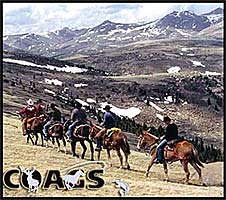
Backcountry horsemanship skills—packing horses and mules, trail riding, wilderness survival and more—are taught at the Colorado Outdoor Adventure Guide School (Coags), headquartered in the high mountains of central Colorado near the town of Cripple Creek. The basic two-week summer course delivers 120 hours of instruction covering horsemanship, trail riding and packing, orienteering with map, compass and GPS, camp cooking, first aid and CPR, with classes limited to about 20 students for one-on-one attention. Riders who want to go further can continue into the Professional Guide/Outfitter Program or the Advanced Back Country Horseman Program.
Get to the mountains of Colorado to learn to be a guide. For many, attending college and getting a degree is a big step toward launching a career. However, if you want to become a professional guide or outfitter, where do you go to learn all the necessary outdoor skills?
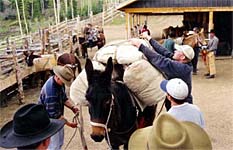
One answer is found in the high mountains of central Colorado, near the town of Cripple Creek. That's where the headquarters and training area of the Colorado Outdoor Adventure Guide School is located. Men and women come here to learn outdoor skills that are vital to becoming an accredited guide or outfitter for a host of outdoor opportunities. "We started Coags back in 1994 because we knew that there is a major shortage of well-trained guides in just about all facets of the industry," said Jeff Miner, Coags head instructor. Coags instruction includes learning the correct way to pack horses.
"We also soon discovered that not only are there a lot of people that have always wanted to become a Professional Guide, or were looking for a career change, but a lot of people, even if they didn't want to become a Professional Guide or Outfitter, wanted to improve their outdoor skills." Coags caters to people from around the country and the world, and to all abilities, whether you're a greenhorn or a seasoned outdoorsman.
Their basic course is a two-week program that runs throughout the summer. Coags is certified through the State of Colorado Department of Private Occupation Schools, Department of Higher Education, and the Veterans Affairs. And if you're a college student with a major in wildlife management, biology and others, you can even pick up college credits as part of an intern program!
School's in session
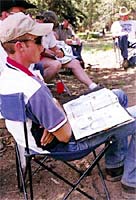
Outdoors lectures are a big part of the education. Students show up for guide school lugging in gear, clothes, sleeping bags and stuff from the recommended packing list. They then settle into rustic cabins on the property where for the next two weeks, they'll go through an extensive 120 hours of instruction, exercises and tests — both on paper and in the field — on a wide variety of outdoor skills.
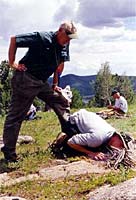
Wake-up calls and breakfast come early, and classes run Monday through Saturday from 7:00 a.m. to around 6:30 in the evening. Meals are hearty, buffet style and all you can eat. Classes are usually limited to about 20 students at a time, with the idea being to provide a lot of one-on-one instruction. "The instructors are top of their fields and enjoy what they teach," said Stephanie Samuels of Minnesota. Instruction includes learning to build a fire from scratch.
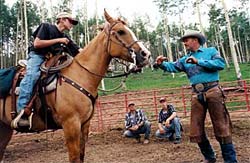
Advanced offerings The course even covers how to take trophy photos.
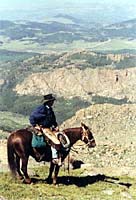
At the end of the two-week basic program, some students pack up and head back home with an experience that will stay with them for a lifetime. Others who are are looking for even more instruction will stay on for the advanced programs that are offered. For those wanting to be big game guides, there's the Professional Guide/Outfitter Program. It's also a two-week course with 120 additional hours of training.
Classes include guide responsibilities, professional big game guiding techniques, horsemanship and packing, setting up a pack trip, professional guide equipment, field judging and scoring big game trophies, trophy and field care of game, advanced leadership skills and how to start your own business. "Upon graduating, I felt ready to begin work as a big game guide at a wilderness spike camp, using horses and mules," said Nate Dwyer of Illinois.
"In fact, myself and some of my newfound friends were offered jobs before we left — another great plus." Graduate Ryan Sturgis put his knowledge to good use after downing his big bull. He now runs a shop called the Horse & Hunter in his home state, selling hunting, fishing and horse packing equipment. Another course offering is designed for those who want to become professional fly fishing guides.
Students clock another 120 hours of training with emphasis on more advanced outdoor skills such as horsemanship, packing, camps and equipment. But the bonus is the classes on flyfishing, stream and river basics.
And finally, if you are real horse lover, you'll be interested in their Advanced Back Country Horseman Program. "I hoped to come away with an overall education about guiding and packing in the West," said Ryan Sturgis of Pennsylvania. He works for his father in the construction business, and saved his own money to go to the Coags program. On a recent archery elk hunt, skills the 19-year-old young man learned paid off big time!
"After not having any luck with the outfitter, I was on my own again. The ultimate goal for some Coags students is to lead hunters into the wilderness. With the help of Jeff's teaching, I was able to coax an awesome bull to within archery range. I had never felt the extraordinary feeling of a bull bugling within a stones throw away. I have to admit, without the school's teaching, I wouldn't have had the advantage of taking this bull."
At the end of each two-week course comes graduation. Here's where students get their diplomas to hang on the wall, but more than anything the tired but happy grads take home with them a host of newly learned outdoor skills that many of us will likely never learn. And they are likely never to forget.
More information Interested in becoming a guide or taking a few courses at Coags? Here's how to get more info: To get a full calendar of courses for the 2004 season, along with a complete breakdown on the various programs and details on all the classes, go to the Coags Web site (guideschool.com), write to PO Box 60248, Colorado Springs, CO 80960 or call (800) 714-4864.
Contact : Gary Jordan P.O. Box 60248 Colorado Springs, Colorado 80960 Phone: 1-800-714-4864 Email: [email protected] Website: www.guideschool.com/