

How to Plan Your Horse Trip
Article by: Nick Godfrey for Equalizer Systems Hydraulic Jack For Horse Trailers
Planning a successful trip with your horse starts days before you leave: keep vaccinations current—the AAEP recommends at minimum the EHV and EIV vaccines—make any feed changes gradually, and consider starting an electrolyte program a week or more ahead to build thirst and aid hydration. Prepare the trailer too: charge the batteries, fill the LP tanks, set the refrigerator to travel mode, and check tire pressure before hitting the road. Along the way, plan rest stops for both yourself and your horses.
Preparation – Clearly, preparation for the next event begins well before the day you plan to ride! Steps to ensure a successful trip start days ahead of time, and it all begins with proper care of your horse. One step that must be taken, whether you plan to compete or just ride for pleasure, is to maintain a healthy vaccination schedule. The AAEP recommends, at the bare minimum, keeping up with the EHV and EIV vaccines to prevent Equine Herpesvirus, and Equine Influenza.
In addition to medical treatment, consistent diet will help to ensure peak performance. If changes must be made due to availability, make them gradually; even weeks ahead of time. Also consider supplements, and discuss them with your vet. Proper hydration is the root of good health and show readiness. On long trips, and especially in hot climates, trailers can get very hot and cause dehydration and weakness. Many experts suggest starting an electrolyte program a week or more ahead of the scheduled trip to help build thirst days before traveling, aiding in hydration.
Trailer preparation is also critical to a successful trip. If your rig has a living quarters you’ll be staying in, that certainly adds to your checklist. Have you stocked food and drinks for the trip? If your refrigerator runs on both LP and electric, be certain it’s set to travel mode to ensure your cold and frozen items don’t spoil! That said, make sure those LP tanks are filled as well!
If you don’t keep your trailers batteries on a tender, you’ll want to get them on the charger ahead of time. The trickle charge on your 7-way most likely won’t give you enough to bring a dead battery back to life. After that, it’s basic supplies: Sheets, blankets and pillows? Riding gear, saddles; extra water? Definitely all things you don’t want to have to scramble for once you arrive!
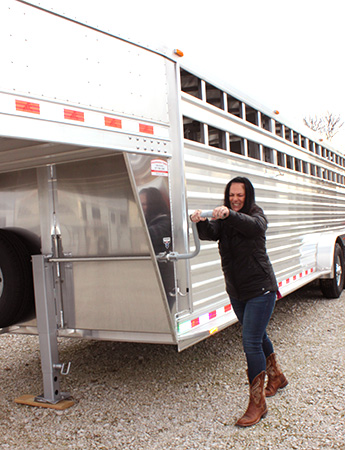
Be sure to plan rest stops along the way; both for yourself AND your horses! If you haven’t already, it’s time to hook up to the truck. Make sure you stretch well and don’t cramp up, it’s time to Crank That Trailer Jack!
At the Event – Whether you’re riding, racing, or showing; certain steps should always be part of the routine. Above anything else, know your horse! Every animal is different in regards to how much time it needs to get comfortable in a new location. For some, it can be as little as a day. For others, it can take a week or more to get acclimated to new surroundings. Knowing the tendencies and needs of the animal must be main focus of your preparation.
Set up your (and your horses) temporary home as similarly to home as possible. Make the adjustment as smooth as possible and you’ll both be ready to ride that much sooner! Focus on the routine. Keep the feed AND feeding times and close to your home schedule as you can. Keep the daily routine of casual riding throughout your trip.
If you choose to go the route of electrolytes and flavored waters to help with hydration, start that well ahead of time so as to not cause it to be a surprise in a new environment. And to prepare yourself…are they going to let you keep your truck and trailer together, or is there a storage yard it must be kept in? Will you need the truck to get around during the week? Well, then it’s time to Crank That Trailer Jack!
Heading Home – Hopefully all went well! One big key to a safe trip home is to continue to encourage hydration before loading up, especially in a warmer climate. Do you have a sufficient supply of feed and water to make the trip if it’s a long one? Be sure to stock up! If your trailer is a living quarter’s model, be sure to dump your holding tanks before hitting the road. Also, if you’ve got food or drinks left in the refrigerator, make sure you switch it over to the LP travel setting.
Be sure to check the air pressure in your tires before you leave as well. You never know what you can pick up in a tire that can absolutely ruin a trip. Many times a tire can be low or even leaking, and you won’t notice it right away because the one next to it is still holding the trailer up. Unfortunately, you’ll know it once you get going down the road and have a blowout.
Oh, the site made you unhook your trailer and store it during the event? Well, you know what’s next at this point. Crank That Trailer Jack!
Once you get home, it’s time to relax (almost). Once you get your horses back in the stable, unload all the personal items from the trailer, and clean out the refrigerator, it’s time to park it all and put your feet up. But. You’re going to need that truck tomorrow morning, and you can’t exactly keep pulling that trailer around when you don’t need it, so let’s go unhook that thing one more time. You know what that means!? One more time…Crank That Trailer Jack!!!
A Solution – As you’ve certainly noticed, we’ve keyed on one of the more unpleasant parts of trailering your horses. If you have a single or even a dual leg manual jack system, you’ve struggled at some point to hook or unhook from your truck. It’s hot, it’s been a long day, your arms are sore; whatever the situation is, you just don’t want to deal with that tired old crank jack. Luckily enough, Equalizer Systems has the solution to this exact problem.
Whether you’ve got a small bumper pull trailer, the biggest baddest living quarters rig on the property, or something in between, there’s a hydraulic jack solution that will take all that hassle out of loading and unloading from the truck. With the push of a button, you can effortlessly raise or lower your trailer in seconds; rather than cranking for minutes…so many minutes.
Equalizer Systems has hydraulic jack combinations for gooseneck/fifth wheel trailers that range from a single leg 7.5k or 12k option, to a dual leg system giving you 15k – 24k of lifting capacity, at any stroke length you could ever need, and universal mounting brackets to fit just about every manufactures front wall. If you have a smaller bumper pull unit, they even have a hydraulic tongue jack option! If you’re ready to stop cranking and start riding, get a hold of Equalizer Systems today, and get a new hydraulic jack system for your horse trailer!
Equalizer Systems | www.equalizersystems.com 800-846-9659 | 55169 County Road 3, Elkhart, Indiana 46514