

Getting Started with the Right Nutrition for Horses
Horses require four basic nutrient groups—carbohydrates, protein, minerals, and vitamins—in proportions that shift with each animal’s age and lifestyle. Younger horses need a larger share of protein to build muscle, bone, and other developing tissues, while race horses and lactating mares require more carbohydrates. Salt, calcium, and phosphorus are the major minerals required, and the National Research Council provides the nutritional guidelines that many universities rely on when balancing a ration.
There’s a reason Nascar and F1 teams use something other than 87 unleaded in their cars . What you fuel your horse with directly affects your horse’s growth, performance, and lifespan. If you are a horse owner or trainer you can use helpful, credible information regarding the fundamental basics of nutrition for horses. By Missing Link Products
Introduction to Nutrition for Horses The four basic nutrient groups of nutrition for horses are: 'Carbohydrates 'Protein 'Minerals 'Vitamins
The portions of these four groups as part of the overall makeup of a horse’s daily diet will change, as will the total sum of feed they consume on a regular basis. Other factors like their lifestyle and age also affect how much a horse should eat every day. For example, younger horses require a larger portion of protein in their daily diet to build muscle, bone, and other developing tissues, while race horses and lactating mares require more carbohydrates.
Nutrition for Horses Terminology Before formulating your own feed and ration regimen, it’s important to know the lingo of the process. Here are some of those terms, their meanings, and relevance as defined by University of Minnesota (UMN (** Indicates our own additions to UMN’s original list)
Dry Matter Most grains and hays contain 88-90 percent dry matter. If a horse receives insufficient dry matter, it may become bored and chew on its stall and/or eat bedding. However, if the feed has too much bulk (excessive amounts of fiber or water), the horse might not be able to eat enough to satisfy his nutritional requirements (carbohydrates, protein, minerals, and vitamins).
DE (Digestible Energy) See “Energy Value” below.
Energy Value Total Digestible Nutrients (TDN) and Digestible Energy (DE) are means of measuring the energy value of a feed. TDN is what keeps the horse going and puts the fat on its back. Most often, energy is the element lacking in horse rations. Grains and good quality roughages are the usual sources of energy. Digestible Energy (DE) is measured in kilocalories (Mcal), and 1 lb TDN = 2 Mcal DE.
IU (International unit)** The standardized way to properly measure biologically relevant substances like vitamins and minerals. Daily requirements of vitamins are actually very small amounts (basically on the scale of micrograms) compared to things like hay.
Mcal (kilocalorie)** 1,000 calories, usually used alongside TDN and/or DE (see “Energy Value”).
Minerals Salt, calcium and phosphorus are the major minerals required by horses. Salt requirements increase with perspiration, and the loss may amount to one to two ounces of salt a day. Calcium and phosphorus should be provided in a ratio of 1:1. The quantity of phosphorus should not exceed the quantity of calcium. According to Cornell University data, when phosphorus levels exceed calcium levels, abnormal bone development and hormone imbalance occur.
However, research at UMN indicates calcium levels may exceed phosphorus levels by as much as 4-6:1 with no apparent harm. Required trace minerals are normally supplied in adequate amounts in a good horse ration. Commercial mineral blocks or a mixture of equal parts of trace-mineralized salt with selenium and bone meal or dicalcium phosphate are the usual sources of supplemental minerals.
Mixing salt with bone meal (which alone is unpalatable) will assure adequate intake.
Omega Fatty Acids** One branch of several Essential Fatty Acids (EFA), Omega-3 and Omega-6 fatty acids are critical nutrients that must be added to a diet because the body doesn’t produce them on its own. Along with protein and carbohydrates, fatty acids help supply energy and help maintain healthy intercellular membranes.
Protein Protein is necessary for all life processes. Horses need a quantity of protein, but the quality is also important, particularly for young horses. Legume hays, pasture, soybean meal, linseed meal, and commercial protein supplements are the usual sources of protein. Legumes and soybean meal both provide protein that contains a good balance of the essential amino acids. Lysine is the amino acid that is usually first lacking. Weanlings definitely need a diet that provides a good balance of amino acids in sufficient quantity to attain maximum growth.
TDN (Total Digestible Nutrients)** The measure of a horse’s recommended daily caloric intake (see “Energy value” above).
Vitamins Vitamins A and D are both fat-soluble. Vitamin A must be supplied in the ration, but exposure to sunlight will usually supply adequate vitamin D. Feed that ordinarily contains vitamin A can have the vitamin A destroyed by oxidation. For instance, year-old hay has lost most of its vitamin A value. The various B vitamins are usually present in adequate amounts in good quality forage. Furthermore, synthesis in the horse's cecum provides adequate quantities of these vitamins under most circumstances. Vitamin E supplementation of 50 IU/lb of diet may also be beneficial. Under certain circumstances, though, it is possible for a horse to suffer from B vitamin deficiency (usually thiamine).
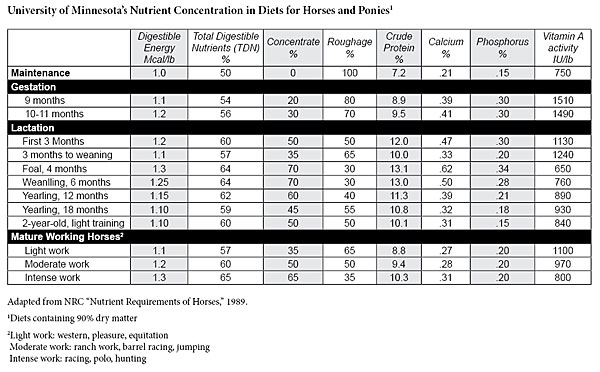
Helpful Charts for Nutrition for Horses Nutrition for horses today is far more sophisticated than mixing the right ratio of Timothy Hay and Alfalfa Hay or using oats versus corn. The authority on nutrition for horses is the National Research Council (NRC), a government-chartered organization researching all fields of science. Many universities rely on NRC research for their own animal science programs.
The NRC analyzes every aspect of nutrition for horses to obtain precise nutritional guidelines. UMN adapted the gist of NRC’s recommendations in this handy chart
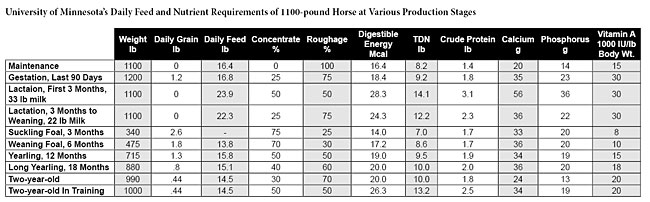
The numbers in this second chart are based on an average adult 1100-pound breed at all stages of production. The Ohio State University (OSU) link to provides a more general TDN chart broken down by varying sizes of horses.
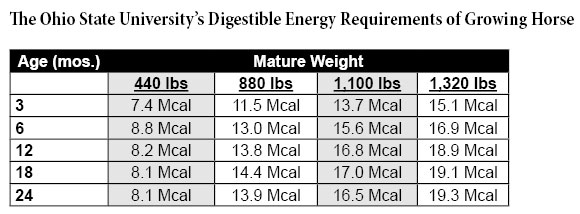
[This photo is attached – please place feeding chart 3.jpg here]
To get started developing your own rations, visit OSU’s website for more advanced analyses and charted guidelines.
Note: These charts are to be used in tandem—one informs the other. You cannot determine the proper amount of additional vitamin supplementation without knowing the horse’s proper TDN, and vice versa.
External Factors Affecting Nutrition for Horses The University of Minnesota suggests the following factors should be evaluated before horse owners or trainers adjust recommended nutrition for horses to an individual equine: 1)Size
3)Work, gestation, lactation, rate of growth
a)Temperament (the nutritional needs of Arabians may be greater due to their more active nature)
b)Hair coat (the abundant hair of Shetlands provides excellent insulation, thus reducing energy needs)
6)External parasites (mange and lice that affect hair coat and drain the horse’s strength) 7)Environment (heat, moisture, wind)
8)Internal parasites (blood suckers, bots)
9)Sharp teeth (these result in slobbered grain, reduced mastication, and undigested feed)
10)Vices (stall weaving or walking or cribbing increases nutrient requirements)
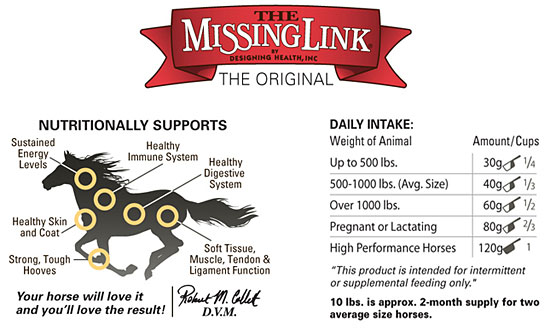
Getting the Most Nutrition for Horses with the Missing Link The Missing Link is a veterinarian-formulated feed supplement rich in vitamins, minerals, and Omega fatty acids designed to put everything back into your horse’s diet that might be left out by processed feeds, degrading roughage, or imbalanced nutrition. The Missing Link uses whole, natural ingredients inherently dense in good nutrition for horses—things like molasses, flaxseed, and alfalfa–and keeps them in as raw a state as possible to maximize their effectiveness.
The Missing Link comes in an easy-to-handle, easier-to-store powder form in a resealable package. Each recommended scoop of The Missing Link contains the proper Omega-6 to Omega-3 ratio plus high doses of fiber, protein, vitamins, and minerals for the best horse nutrition.
With maximum nutrition comes maximum performance, but other benefits come along with a healthy diet. Your horse’s immune system, skin, coat, joints, even the digestion process itself, all benefit from having as much of all the essential building blocks at their disposal as possible.
Behavior is affected by poor nutrition as well: cribbing, weaving, and other stall vices can all be rooted in poor nutrition. Lactating mares and foals are especially vulnerable to poor nutrition since both require amplified supplies of high quality feed for the young horse’s developing body structure and tissues, all the while making sure that the foal doesn’t drain mama of everything she needs to stay healthy too.
While adding The Missing Link helps bring peace of mind that you’re doing everything possible for your horse , also rest assured that The Missing Link does everything possible to make sure its horse supplements are safe . Each ingredient is carefully sourced and rigorously scrutinized by The Missing Link team (headed up by Dr. Robert M. Collett, a veterinarian with over 40 years of experience alone) to make sure that what you feed your equine is healthy, safe nutrition for horses compliant with standards set by the FDA, USDA, and NASC.