

Preventing Heat Stress in Horses article from BIG ASS Fans Horse Barn Products are Here
Modern horses evolved in some of the worlds hottest areas, but over the centuries they’ve been bred to survive and excel in colder climates, while our intensive management strategies have simultaneously removed their natural coping mechanisms.
Whereas a horse will independently seek water when it’s hot, it can’t refill an empty bucket or remove a dominant herdmate from blocking access to a shared trough; nor can it access shade in a bare paddock. A working horse can’t tell you when its workout is becoming too much. Therefore, it is imperative that horse managers pay special attention to their horses’ needs when the temperature rises.
Most healthy adult horses in light to moderate work can tolerate hot conditions with simple good management, including access to shade and clean water. But other types of horses, including foals, older horses, those with a long haircoat (particularly horses with Cushings) and animals affected by anhidrosis can have a harder time coping and require special attention. A horse’s body condition can also play a role in how well it handles extreme temperatures. Fit, healthy animals in good condition can handle heat better than those at the extremes of the body condition scale.
An Ounce of Prevention Water is crucial to maintaining a healthy horse year-round. A horse’s usual requirement of five to seven gallons of fresh, clean water per day can rise to 20 gallons or more when the weather is hot. Horses that seem reluctant to drink sufficient amounts of water can be encouraged with the addition of an electrolyte supplement to their feed. In extreme cases, wetting the feed to make a thin, watery gruel can also help to get fluid into the horse.
Salt should be available at all times. Many stable managers choose to turn horses out at night during the summer and keep them in during the day. While this practice keeps horses out of the direct sun, stables can heat up quickly. Maintaining sufficient ventilation and airflow throughout the barn will help to keep animals and people inside cool. In fact, merely adding airflow can make a person feel 10 F cooler.
Be cautious, however, in utilizing box fans designed for indoor, residential use. While they’re certainly the cheapest option, these fans are not designed to withstand a barn environment. Dust collecting in the motor can cause it to overheat, posing a fire risk. Look for fans designed for outdoor use (UL damp or wet rated), and ensure that their cords are well out of curious horses’ reach.
The most energy-efficient option to provide airflow in horse barns, which also removes the risk of electrical cords underfoot and overhead, is a large diameter, low speed overhead fan. Most horses can tolerate moderate exercise during hot weather, but preparation is essential. A fit horse can handle heat better than an unfit one, so the peak of a heat wave isn’t the best time to initiate your pasture potato’s new fitness regimen.
Gradual conditioning and acclimation to hot conditions will help your horse to handle the heat.
Tailor your riding plan to the conditions and pay careful attention to your horse’s responsiveness and behavior during exercise. Warm up and cool down periods become even more important during hot weather, so be prepared to take the time to properly acclimate the horse to the heat and cool it back down thoroughly following exercise.
Generations of horsemen have avoided offering water to hot horses, but research has shown that thirsty horses should be allowed to drink regardless of their temperature, and especially immediately following exercise. During a longer session, take breaks to offer the horse water.
When the going gets hot So how hot is too hot? Knowing your horse’s normal physiologic status will tell you when they’re coping with the heat, and when they’re heading into a dangerous zone. You should know your horse’s normal temperature, heart rate and recovery range. Pay careful attention to your horses’ behavior when the weather is hot. If you notice a horse is lethargic with a rapid pulse and/or heavy breathing, check its internal temperature.
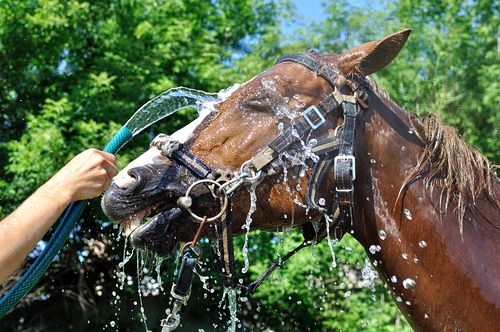
Any animal with a temperature over 105'F should be seen by a veterinarian. Immediate action can help to keep an overheated horse from serious stress. Get the horse into a shady area and remove tack or other coverings (fly sheets, etc.) promptly to allow air to contact the horse’s skin. Hose the animal down with cold water, scraping it constantly to remove the water warmed by the animal’s body.
A 50/50 mixture of water and rubbing alcohol will evaporate even more quickly to speed cooling.
Additional air movement, particularly in the form of misting fans, can help to quickly decrease a horse’s temperature. Thoroughly researched and utilized heavily at the 1996 Olympic Games in Atlanta, misting fans have become a staple in cooling tents at hot-weather equestrian events worldwide.
Cooling Breeze
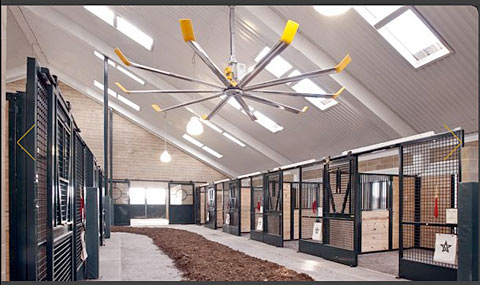
During hot weather, getting the air moving is one of the simplest and most effective ways to keep horses, riders and barn employees cool. Air movement across the skin speeds both evaporative and latent cooling, making people feel up to 10 F cooler.
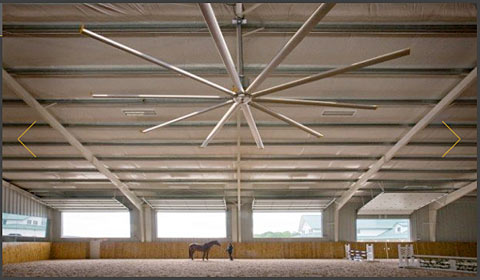
Large diameter, low speed overhead fans are ideal for barns and riding arenas. Using their immense size, not speed, to move a massive amount of air, these Big Ass Fans® come in diameters ranging from 6 to 24 feet. The benefits of large fans include extreme energy efficiency and silent operation. Industrial fans from Big Ass Fans are also certified for agricultural use, making them a safe, durable option for equine facilities.
Powerfoil®X2.0 is the most durable, versatile overhead fan ever made. Backed by a 15-year nonprorated warranty, it’s ideal for use in stables and arenas. Powerfoil X2.0 works all year long, cooling in the summer, recirculating heat in the winter, and reducing condensation in between.
One 24-ft. diameter PowerfoilX 2.0 produces the same amount of airflow as 52 26-inch pedestal fans—using only a fraction of the energy and removing the trip and chew hazards of 52 cords!
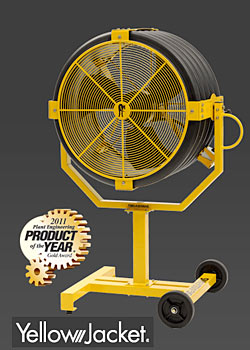
If you’re limited on ceiling space, the 6-ft. Pivot® or the mountable or portable Yellow Jacket® both come with optional oscillators. Need to move your airflow around the farm? The 8-ft. vertical AirGo® takes large diameter, low speed efficiency on the move. Add the optional misting package, and you’ve got the same cooling effect as 22 tons of air conditioning, right at ringside.