As you read this article keep in mind that all horses are different. Their jobs and environment are all different. There is no one-way to shoe a horse. But what I would like to do is to get people (owners, shoers, veterinarians and farriers) to slow down and look at the foot. Allow the horse to tell us what they want. Instead of us telling them what we think they need.
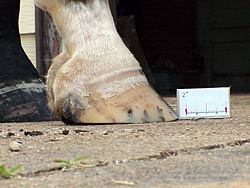
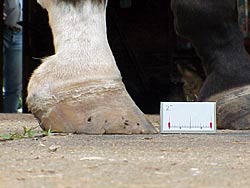
The idea that long heels increase the angle of the foot is a myth. This way of thinking came from years ago when quarter horses were still pure. The confirmation of the older breeds had the kind of foot that you could leave more heel. But past a certain point it was not doing what we thought. Heels grow at an angle, not straight down. When the heels get too long they grow under the foot. New customers have told me that their horses have no heels or the foot is to low. They couldn’t see that the heels where two to three times too long. The heels were growing parallel to the bottom of the foot, causing him to be standing on the back of his heels.
As the heel grows under the foot, the weight bearing changes. The back of the leg is left with little or no support. The back of the foot actually supports the bulbs, fetlock and flexor tendons. Some of the problems this can cause are over flexing of the fetlock, corns, broken bars, contracted heels, and navicular syndrome, just to name a few. That is why it is important to keep the heels under the bone column and not to let them run forward. The hoof reacts to forces placed upon it just like we do. The hoof is very similar to the human nail. If you let your finger nails grow long, past the nail bed, what happens? The nail curves and rolls under on the sides, just like the hoof will. The reason for this is because they have nothing to hold them in place.
Various methods have been employed to help correct the heel/hoof angle problem from changing break-over (square toes) to using wedge pads and shoes. While these techniques solve the angle “problem”, they do not address the heel problem. Just working on the front of the foot, will not change the back of the foot. The heels are already bent and distorted, so they have to be shortened. The heels need to be trimmed back to allow them to grow down, not forward. Over time they will straighten.
One method employed to speed up this process is to support the sole, thereby distributing some of the weight off the wall laminae and allowing the heels to grow in a normal pattern. This also has the side benefit of helping to grow thicker sole and walls. The best thing I have found is to trim the heels back to the widest part of the frog. Then shoe the foot with good length and expansion and pour Equi-Pack or Equi-Build to take the weight off the heels and distribute it across the hole foot frog and sole. More like the way a horse should be naturally.
Sponsored Content — Contact information provided by the sponsor
💬Questions Readers Commonly Ask (FAQ)
What's the long-heels myth?
Per Vettec: the myth that long heels increase foot angle and provide more support. In reality, heels grow at an angle and migrate under the foot once they exceed correct length. The horse ends up standing on the back of his heels, which is the opposite of support.
Why do owners and trimmers misread heel length?
Per Vettec: the heel material is still there, but it's grown forward under the foot rather than upward. To the casual eye, the foot looks short or low; in reality, the heels are 2–3× too long and migrating in the wrong direction. Trained eyes catch it; untrained eyes miss it consistently.
What problems does this cause?
Per Vettec: over-flexing of the fetlock, corns, broken bars, contracted heels, and navicular syndrome. The back of the foot (which supports the bulbs, fetlock, and flexor tendons) loses structural integrity, cascading into soft-tissue problems above the hoof.
How do I know if my horse has this problem?
Per Vettec: have a trained farrier evaluate. If you suspect issues, get a second opinion from a different farrier. Photos comparing current shape to ideal hoof angles can also reveal what daily eyes miss.
Can long heels be corrected?
Per Vettec: yes, with skilled farrier work over multiple trim cycles. Aggressive correction in one trim risks soreness; gradual rebalancing across 3–6 cycles allows the foot to adapt. Pair with appropriate supportive shoeing or pads if needed.
📋
Recommended Products
Curated picks from across InfoHorse.com — most relevant first