

The best dressage warm-up is not a fixed list of movements.
It is a short decision system that answers three questions: What horse did I bring out of the stall today? What does this test require? How do I reach A with the horse attentive, supple, confident, and still in possession of some fuel?
That sounds obvious until the show clock starts. Then riders borrow a famous trainer’s 42-minute routine, follow yesterday’s plan in today’s heat, or keep schooling because one canter transition did not feel like the one at home. By the time the steward calls them, the best trot has already happened, the horse is either flat or boiling, and the rider is trying to recover both with bigger aids.
I have a simpler standard: the warm-up has to show up in the ring. If the horse was spectacular beside the trailer and unavailable after the bell, the warm-up did not do its job.
The Bridleway rule: Do not win the warm-up. Arrive at A with the horse listening, the rider thinking, and enough physical and emotional reserve to complete the test.
Why no single warm-up recipe works
Read enough rider discussions and a useful pattern emerges. One horse needs ten minutes and becomes dull at twenty. Another benefits from a long walk before any collected question. An older horse may need more time for the body to feel loose. A young horse may need more time to decide that flower boxes, loudspeakers, and ponies traveling sideways are not a coup.
Weather changes the equation. So do footing, travel, stabling, fitness, the previous day’s work, the class level, and whether the horse has been standing since dawn. The rider changes it too. A clenched rider can spend 30 minutes asking the horse to relax while demonstrating the opposite with every breath.
| Variable | Question to ask | Likely adjustment |
|---|---|---|
| Age and fitness | How long until the body feels loose, and when does it tire? | More progressive walk; fewer repeated hard efforts |
| Temperament | Does novelty create tension, distraction, or sleepiness? | Acclimation, simple work, or a sharper response check |
| Weather | Is the horse coping with heat, humidity, cold, or wind? | Shorten intensity, protect walk time, monitor recovery |
| Footing and traffic | Is the surface deep, slick, hard, or crowded? | Choose safer lines, reduce drilling, allow navigation time |
| Test demands | Which two aids must be unquestioned today? | Touch those buttons without riding the whole test |
The plan therefore needs a stable skeleton and flexible contents. You should know the phases before leaving home. You should not pretend to know exactly how many shoulder-ins the horse will need before you have sat on it.
The five-phase warm-up
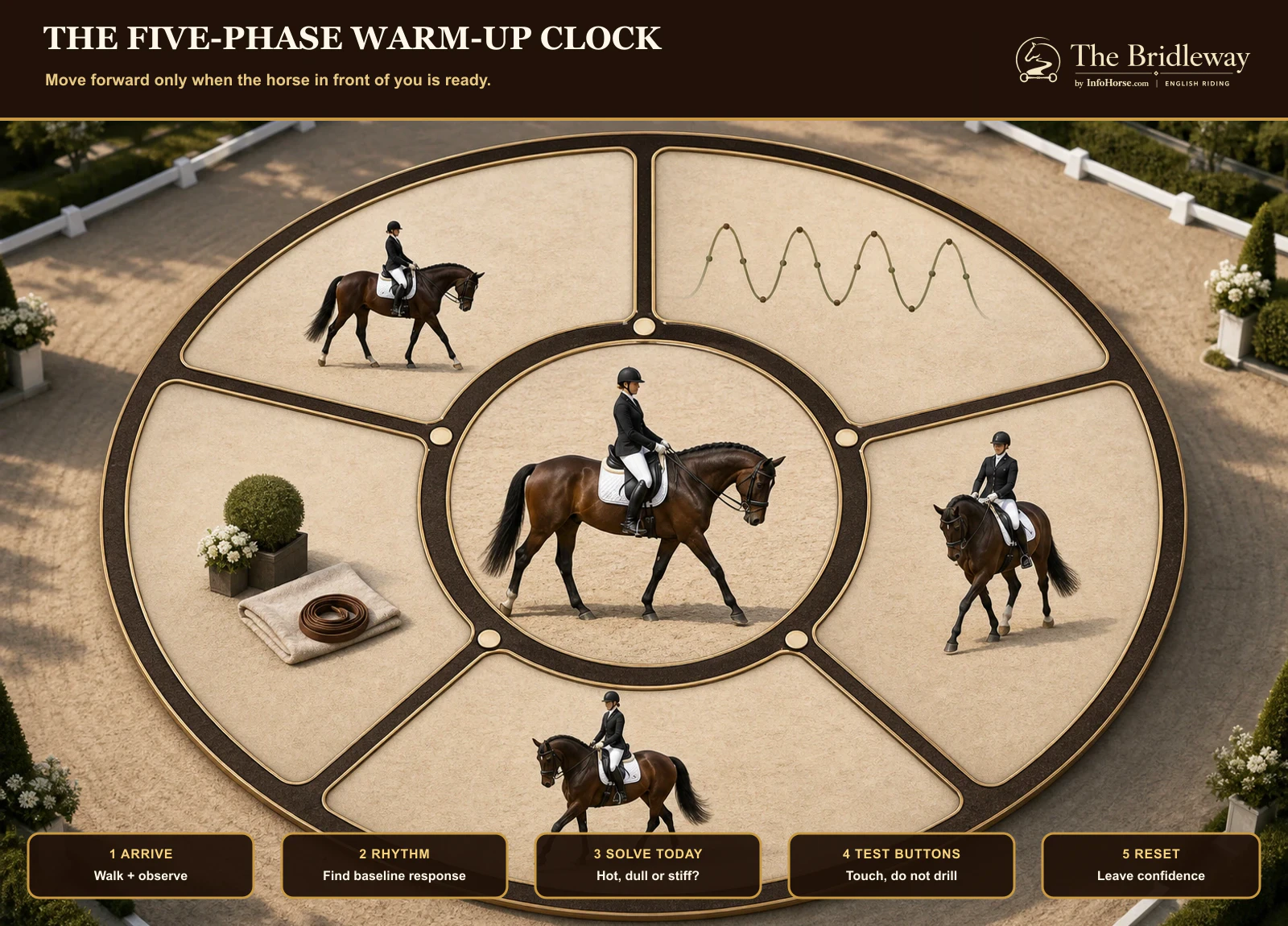
1. Arrive, walk, and let the show become ordinary
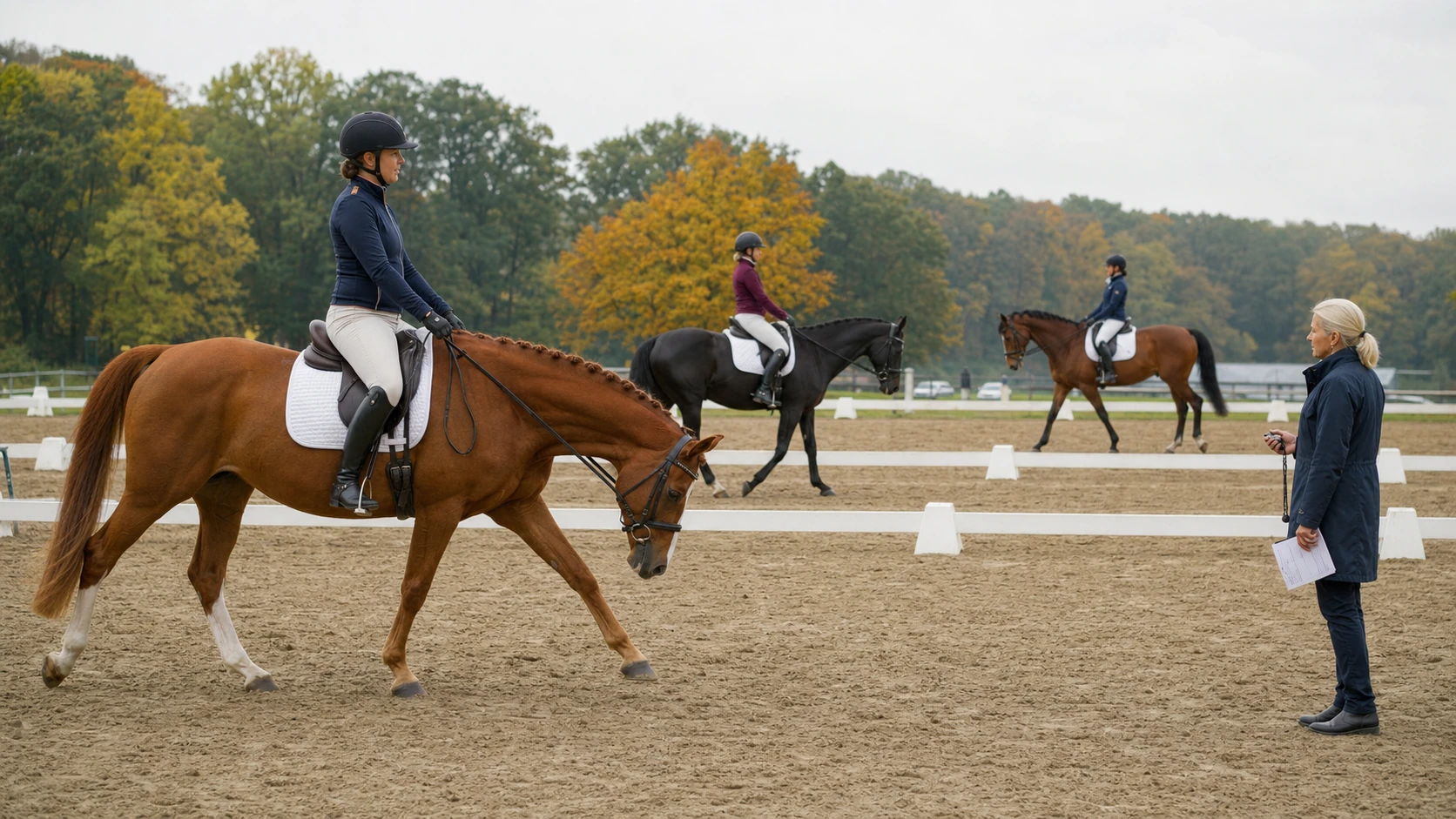
Long walk is not dead time. It lets the horse see the ring, hear the announcer, feel the footing, and bring the body gradually into work. It gives you time to notice whether the walk is regular, whether the horse feels unusually tight or tired, and whether the tack still sits correctly after transport.
Walk with purpose, not captivity. A horse who wants to look can often be allowed to look without being allowed to leave. Breathe out. Soften the thighs. Change direction. Use large, safe lines and stay aware of traffic. If the venue permits hand-walking or earlier familiarization, verify number and access rules before assuming you can use the competition area.
2. Establish rhythm and a baseline response
Begin in the posture that helps this horse use its body. For many horses that means a forward, stretching outline before the frame becomes more organized. For others, too much freedom in a crowded show ring invites them to look after everybody else’s business. The goal is not a fashionable silhouette. It is a regular gait, comfortable contact, and an answer to ordinary aids.
Check forward, back, left, and right. Does the horse go from a light leg? Can it return without bracing? Does it bend both directions? Are the shoulders where you think they are? This is the diagnostic phase. Do not turn the first imperfect answer into a crisis.
3. Solve today’s main state
Choose the largest problem that would follow you into the test. Do not chase five. The horse may be hot or tense, behind the leg, stiff, or genuinely settled. Each state asks for a different response.
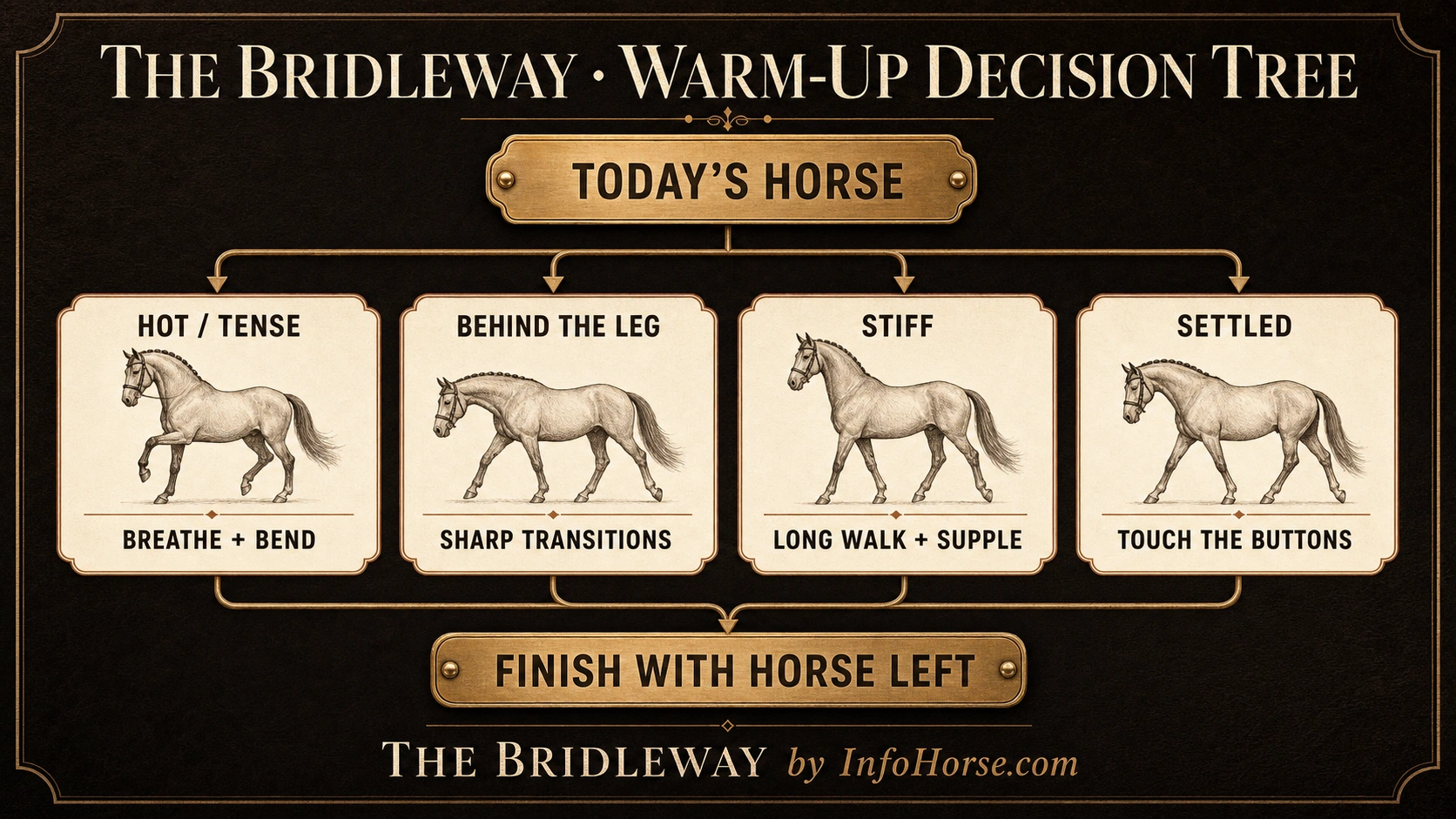
4. Touch the test buttons
Once the basic horse is available, confirm the aids the test needs. That might mean one square halt, a prompt canter depart each direction, a few steps of leg-yield, the transition after a lengthening, or the change of bend through a serpentine. Ride the movement well enough to establish understanding. Then reward and move on.
The warm-up is not the place to install a missing movement. If the horse does not understand it today, 12 urgent repetitions beside the loudspeaker are unlikely to create confidence. Find the simplest version, make the best possible plan for the test, and save training for home.
5. Return to confidence, rhythm, and breath
Finish with work the horse can own. Confirm the gait for the entry. Take a walk if time and temperature allow. Let the horse breathe. Let yourself stop auditioning. The final minutes should make the pair quieter and clearer, not more ambitious.
Decision branch: the hot or tense horse
A tense horse does not necessarily need more exhaustion. It needs enough movement to use the body, enough clarity to trust the rider, and few enough surprises that the nervous system can come down. Begin with space. Use large figures, predictable changes of direction, and a tempo you can maintain without holding every stride together.
Keep the hands receiving rather than trapping. A rider who shortens the neck to contain energy often creates more vertical tension and less steering. Ask for a few familiar transitions, reward the response, and return to something simple. If lateral work genuinely helps this horse breathe and listen, use the easy version. If it raises pressure, do not insist because it appears in somebody else’s routine.
- Useful: long walk, large curves, steady posting trot, changes of direction, familiar transitions, quiet voice where rules permit in warm-up.
- Often unhelpful: endless small circles, holding the horse in, chasing fatigue, repeated difficult movements, confronting every distraction.
- Safety first: tell the steward or trainer if you need space; leave a dangerous traffic situation rather than prove a point.
For a horse with a history of severe show tension, build a progressive exposure plan with your trainer before the important date. School off-property. Attend a low-pressure outing. Practice leaving companion horses. Recreate the pause between warm-up and test. Show-day heroics are a poor substitute for familiarization.
Decision branch: the horse behind the leg
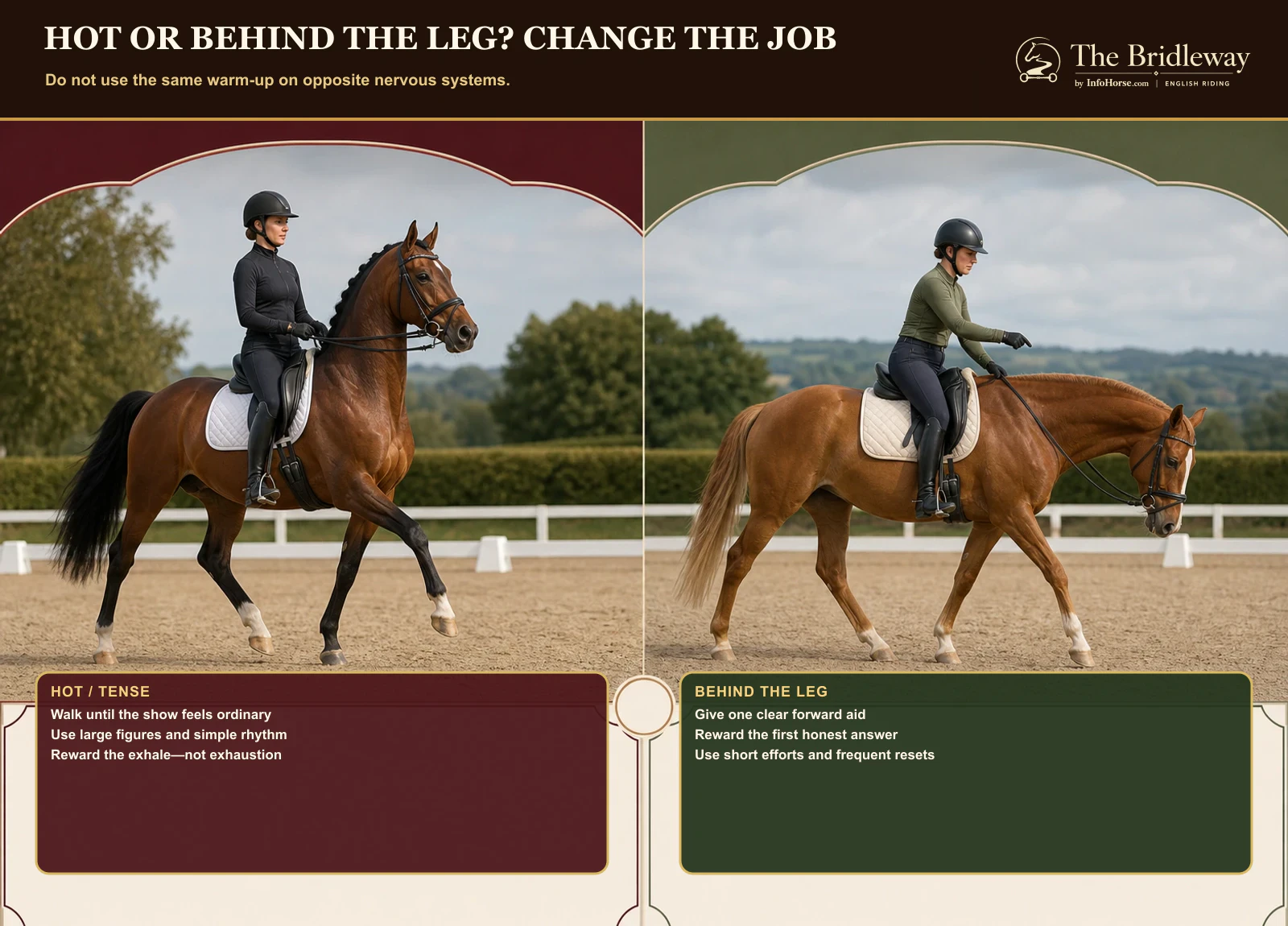
A dull-feeling horse usually does not need the rider to squeeze harder for longer. It needs a fair question and a clear answer. Ask lightly. If the response is absent, reinforce the aid appropriately under your trainer’s system. The instant the horse goes, soften and let forward mean forward.
Use a handful of crisp transitions. Change tempo within the gait. Ride a brief forward line, rebalance, and reward. Then stop testing every three strides. Nagging is not responsiveness; it is an agreement that neither party must take the first aid seriously.
Unusual dullness is information.
A horse who is normally willing but feels weak, painful, overheated, uncoordinated, or markedly unlike itself should not be bullied into “waking up.” Stop, assess, and involve the appropriate veterinarian, trainer, or official.
Decision branch: the stiff horse
Stiffness calls for progression, not leverage. Walk. Let the back move. Use shallow loops, large circles, frequent changes of direction, transitions, and changes of posture appropriate to the horse. Seek equal willingness both ways without trying to manufacture identical bend in five minutes.
Leg-yield, shoulder-fore, or other suppling work may help when horse and rider understand it. The purpose is to improve access to the body, not to collect movements like stamps. Keep checking rhythm. If the horse becomes slower, shorter, or more resistant with each exercise, your “suppling” work is not producing suppleness.
Decision branch: the horse who feels settled
This is the dangerous one for perfectionists. The horse comes out feeling good, so the rider keeps polishing until it does not. If rhythm, response, bend, contact, and confidence are available, touch the test buttons and quit looking for a problem grand enough to justify the remaining 22 minutes.
A shorter warm-up is not laziness when the horse is genuinely ready. Walk, stay warm, and preserve the feeling. Your trainer may have you repeat one transition to confirm it. Confirmation is different from interrogation.
Build the schedule backward
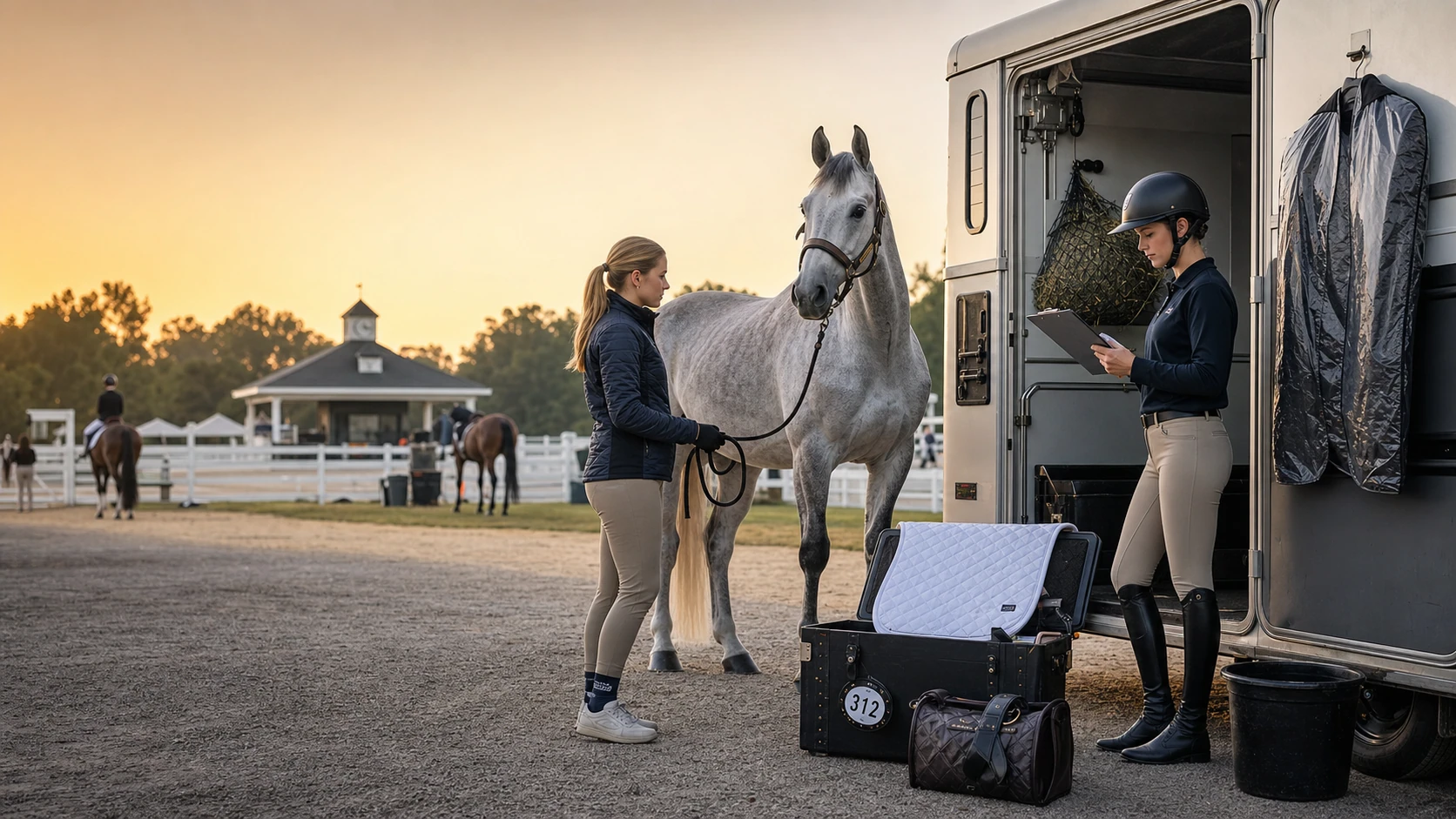
Start at the ride time and move backward. Include the ready ring, final walk, working phase, initial walk, mounting, tack check, number, check-in, and a buffer. A nominal 30-minute warm-up can require 65 minutes between “start getting ready” and “enter at A.”
| Before ride time | Planning question | Do not forget |
|---|---|---|
| 90–75 minutes | Have check-in and number requirements been handled? | Ride-time changes, restroom, water, horse inspection |
| 60–45 minutes | When must tacking and mounting begin? | Boot, girth, bridle, legal equipment, helper roles |
| 45–20 minutes | What is this horse’s likely walk and work window? | Weather, footing, traffic, trainer access |
| 15–5 minutes | Where is the steward expecting the pair? | Final response, breathing, no last-minute invention |
Do not marry the sample numbers. Some horses need less working time and more walking. Some need an earlier acclimation visit followed by a quieter mounted phase. Track your own evidence.
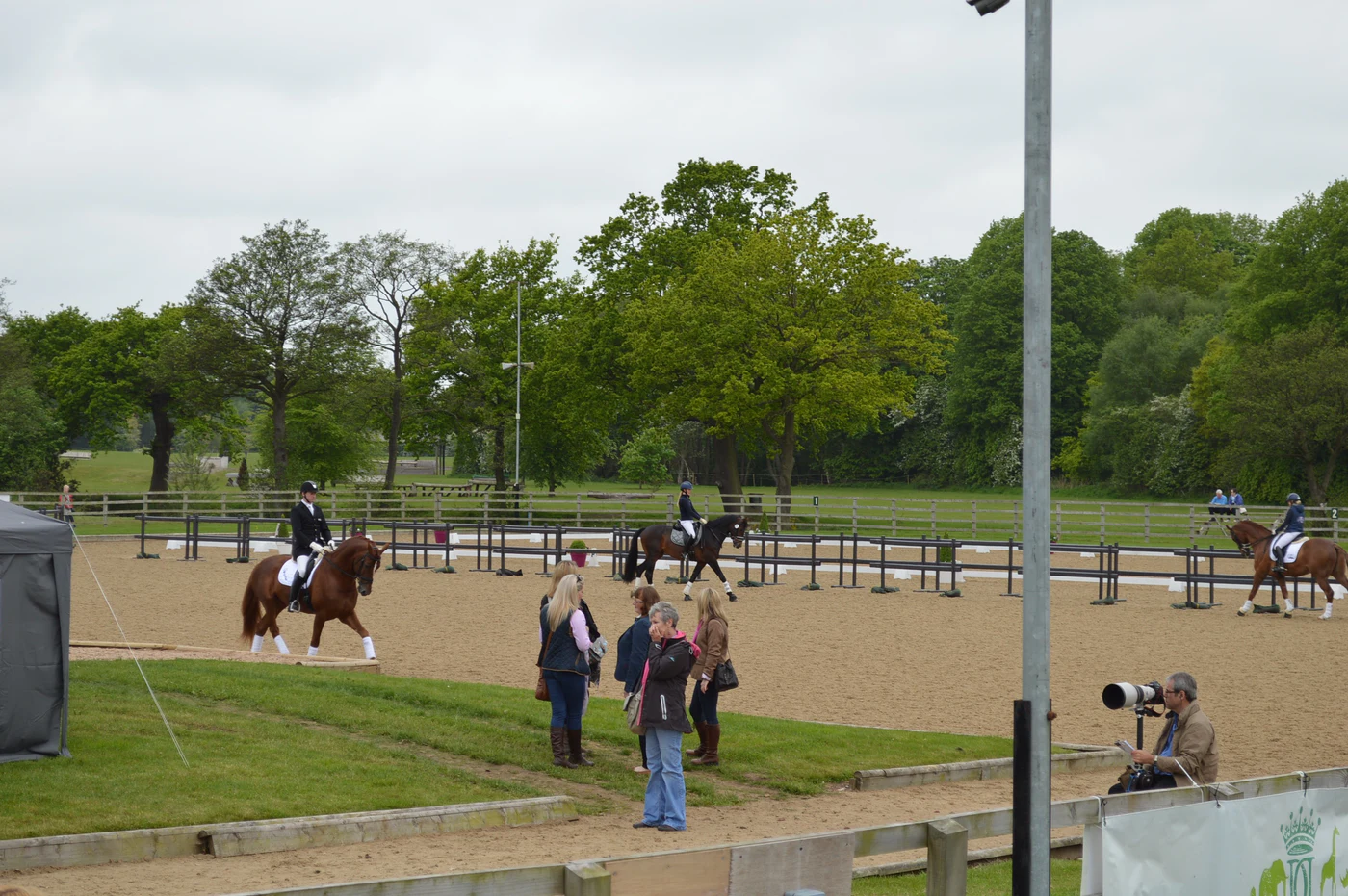
Warm-up ring etiquette is part of performance
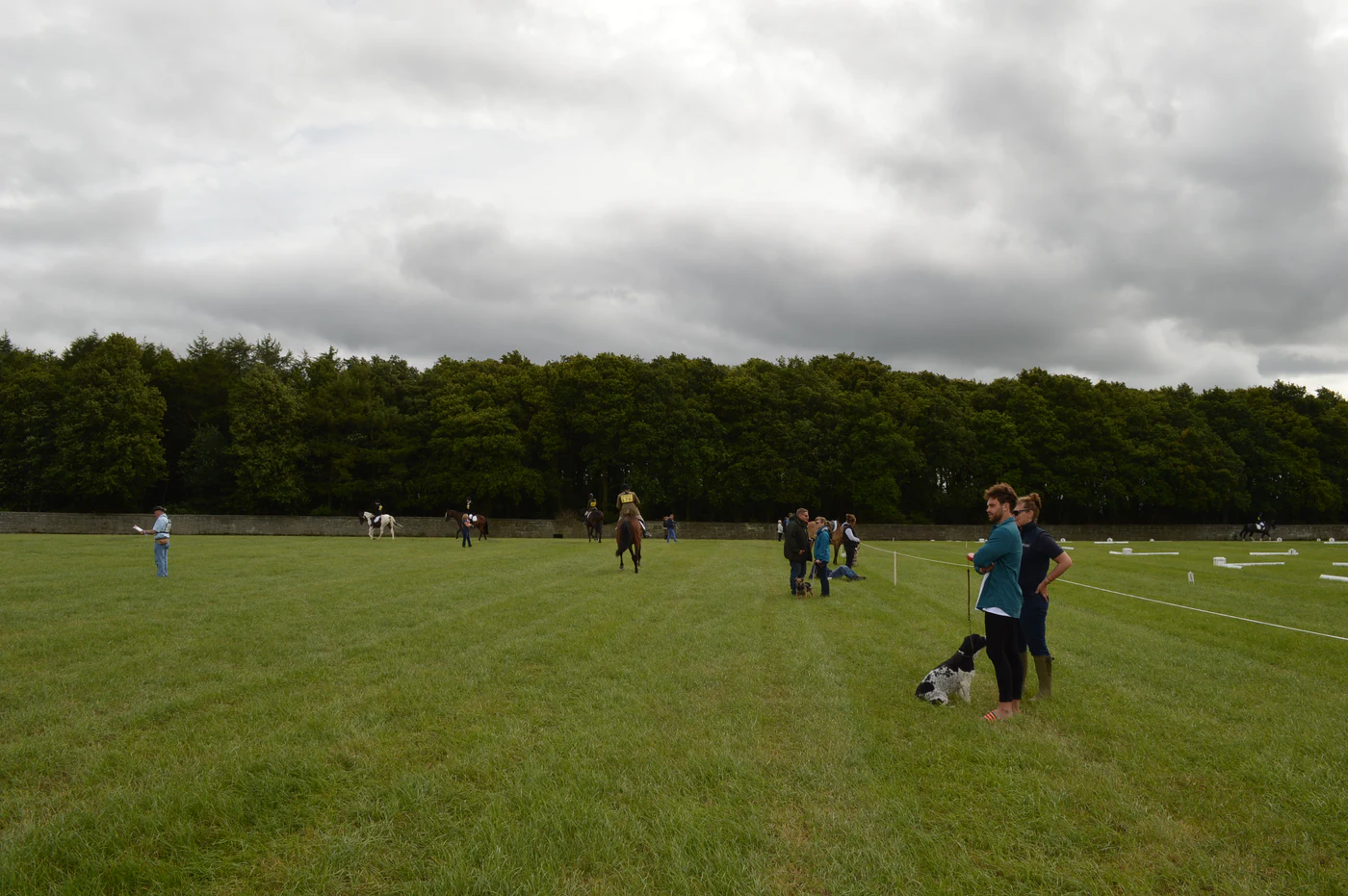
Look where you are going. Pass left shoulder to left shoulder where that convention applies, but follow posted venue instructions and steward direction. Slower traffic generally keeps an appropriate track; faster work uses room thoughtfully. Do not halt on the rail, cut blindly across, or park at the gate. Call your line when necessary without barking at the entire population.
Give kicking horses and green horses room. Coaches should work from permitted areas rather than form a human wall. Earbuds, phones, loose dogs, and helpers stepping into traffic have no place in a busy ring. Courtesy is not merely manners—it preserves the rhythm and confidence you came to build.
Why the good warm-up disappears after the bell
Sometimes the horse is physically tired. Sometimes the warm-up depended on nonstop input, and the rider freezes in the quiet arena. Sometimes the horse relied on companion horses or the trainer’s voice. Often the rider’s body changes: breath stops, knees grip, hands shorten, eyes drop, and the entry becomes a separate emergency.
Practice the transfer at home. Warm up, walk for two minutes, leave the group, enter a different space, and ride without coaching. Ask somebody to ring a bell. Ride the centerline while your trainer says nothing. The gap between warm-up and test is a skill, and skills can be rehearsed.
One useful rider cue: At the ready ring, name only the first three jobs: breathe out, establish the entry gait, look through C. The entire test does not need to live in your shoulders at once.
The warm-up log that earns its keep
After the test, write six lines: total walk minutes, working minutes, today’s horse state, weather and footing, when the horse felt best, and when the quality faded. Add the test result later. After three shows, you will have better evidence than “I think we usually warm up about half an hour.”
Do not use the score alone. A lower score in a stronger class or under a different judge does not prove the warm-up failed. Look at the video, comments, horse’s recovery, rider feel, and whether the planned responses were available in the ring.
Bob’s conclusion: leave something in the tank
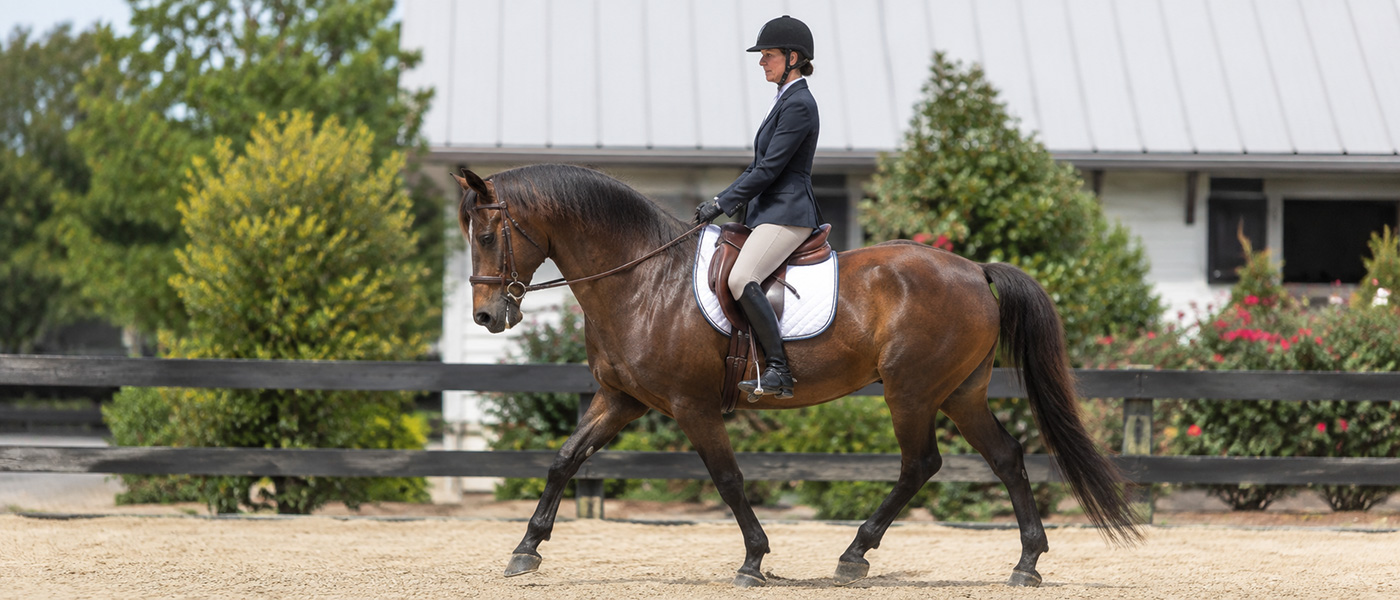
A good warm-up is not impressive from the rail. It may contain a long walk, three ordinary transitions, one beautiful answer, and a rider with the sense to stop asking. It fits the horse, the weather, the footing, the schedule, and the questions in the test.
Build the skeleton at home. Decide at the show. Solve the state you have with the smallest useful intervention. Then enter the arena with horse left.
Continue the Bridleway dressage show series:
Research and welfare note: The decision model was shaped by recurring rider questions in Chronicle of the Horse warm-up discussions and checked against current competition information, including British Dressage exercise and warm-up guidance and the 2026 USEF Dressage Division rules. Forum posts identified real rider problems; they were not used as medical or rule authority. Follow venue instructions and stop for pain, illness, unsafe behavior, or abnormal recovery.
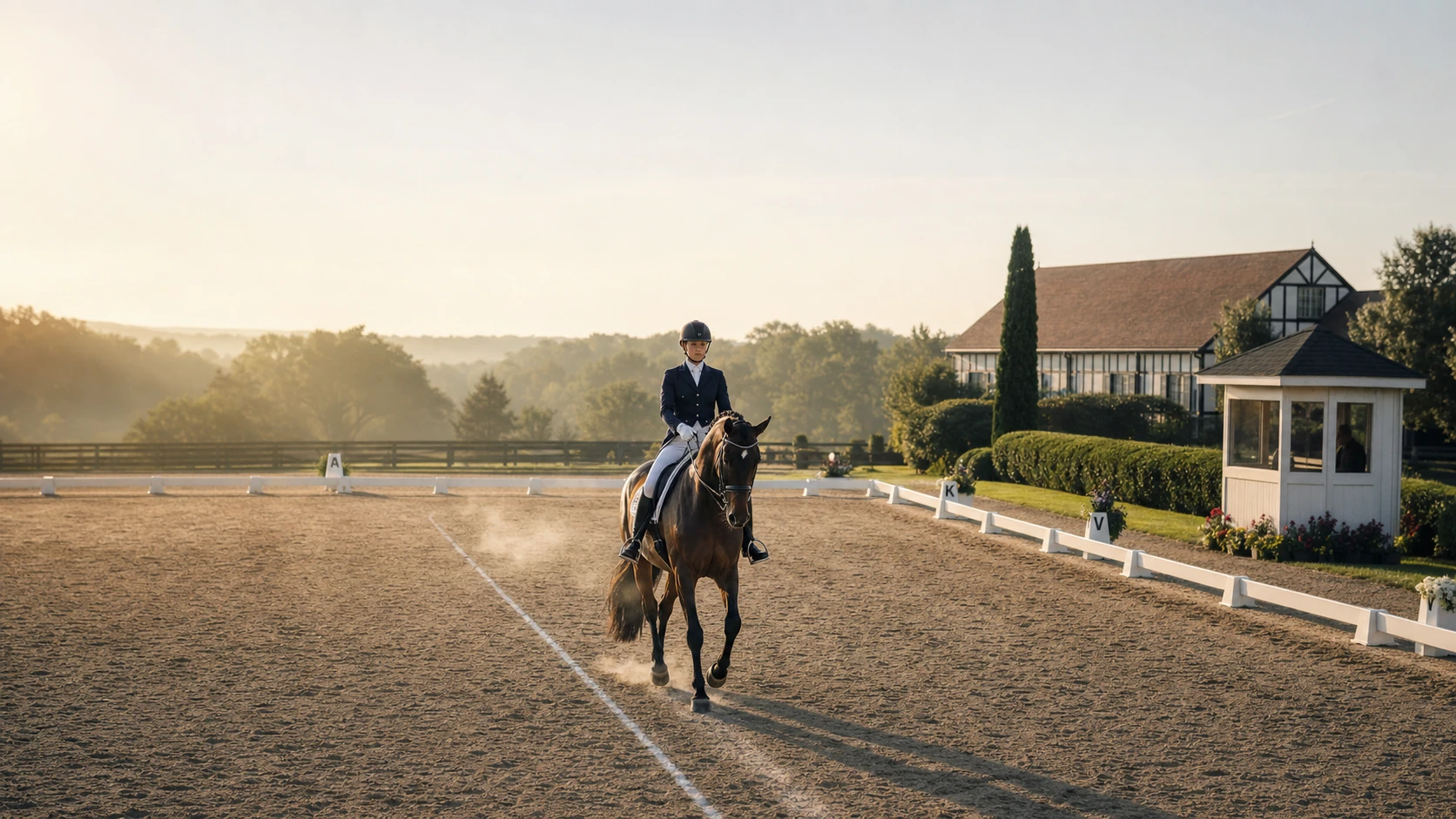
Visual note: The hero is an original Bridleway AI-assisted editorial illustration, not documentary photography. The educational infographics use AI-assisted visual foundations with human-set wording and Bridleway branding; they are not documentary photographs. Documentary photographs are licence-verified and credited at the image.