

How do you know whether to lease, trial, or buy your first English sport horse?
The barn-aisle version.
Moving from lesson horses to a horse of your own is exciting, but it is also where the decisions become more expensive and the consequences become more personal.
Here are the five things I would want you to remember:
- Shop for the job, temperament, and training you need—not a color, breed, height, or impressive video.
- For many first-time horse families, a partial or full lease is the smartest next step.
- Take your trainer, ride the horse more than once, and watch someone else ride first.
- Use an independent equine veterinarian for a pre-purchase examination tailored to your intended use. It is information for a decision, not a simple pass-or-fail test.
- The least expensive suitable horse is often cheaper than the wrong horse at any purchase price.
That last point matters. A horse who frightens the rider, needs training the rider cannot provide, or requires care the family cannot sustain is not a bargain. The right first horse is the one who helps the rider become safer, more confident, and more capable while receiving the care and work he deserves.
The First Question Is Not “Which Horse?”
After more than fifty years around horses, I have learned that people often begin in the wrong place.
They start with the advertisements.
They look at the pretty face, the big jump, the floating trot, the breed, the color, and the words “amateur friendly.” Then they try to fit that horse into their life.
Start with your life instead.
What do you honestly want to do during the next twelve to twenty-four months? Weekly lessons? Local hunter shows? Lower-level dressage? Eventing clinics? Trail riding and hacking with friends? Does the rider need confidence, competition mileage, or a horse who can tolerate the ordinary mistakes that come with learning?
Then ask the less glamorous questions:
- How many days a week can the rider get to the barn?
- Who will school the horse when the rider is sick, busy, or away?
- Is the rider confident handling a horse from the ground?
- Can the family carry the regular expenses and an unexpected veterinary bill?
- Is there a trainer who knows both the rider and the horse?
- Is the current barn suitable for the kind of horse being considered?
The horse’s job should be clear before the search begins. “A nice horse” is not a job description.
Are You Ready to Move Beyond the Lesson Horse?
A good school horse is one of the greatest teachers a rider will ever have. There is no prize for leaving the lesson program too early.
You may be ready for a lease or purchase when you can ride several different lesson horses safely, accept coaching under pressure, handle the ordinary work before and after a ride, and recognize when a horse does not feel right. You should also understand that a horse of your own does not arrive ready only on lesson day. He needs care, exercise, planning, and decisions every day.
The rider does not have to be advanced. The support system does.
A beginner can succeed with the right horse, trainer, barn, veterinarian, farrier, and realistic family. An inexperienced rider paired with an inexperienced horse and little professional help is a much harder combination.
I have seen people buy potential when what they needed was experience. Potential belongs to the future. The rider has to safely ride the horse who exists today.
Partial Lease, Full Lease, Trial, or Purchase?
There is no single correct path. The right choice depends on the rider’s experience, goals, budget, and support.
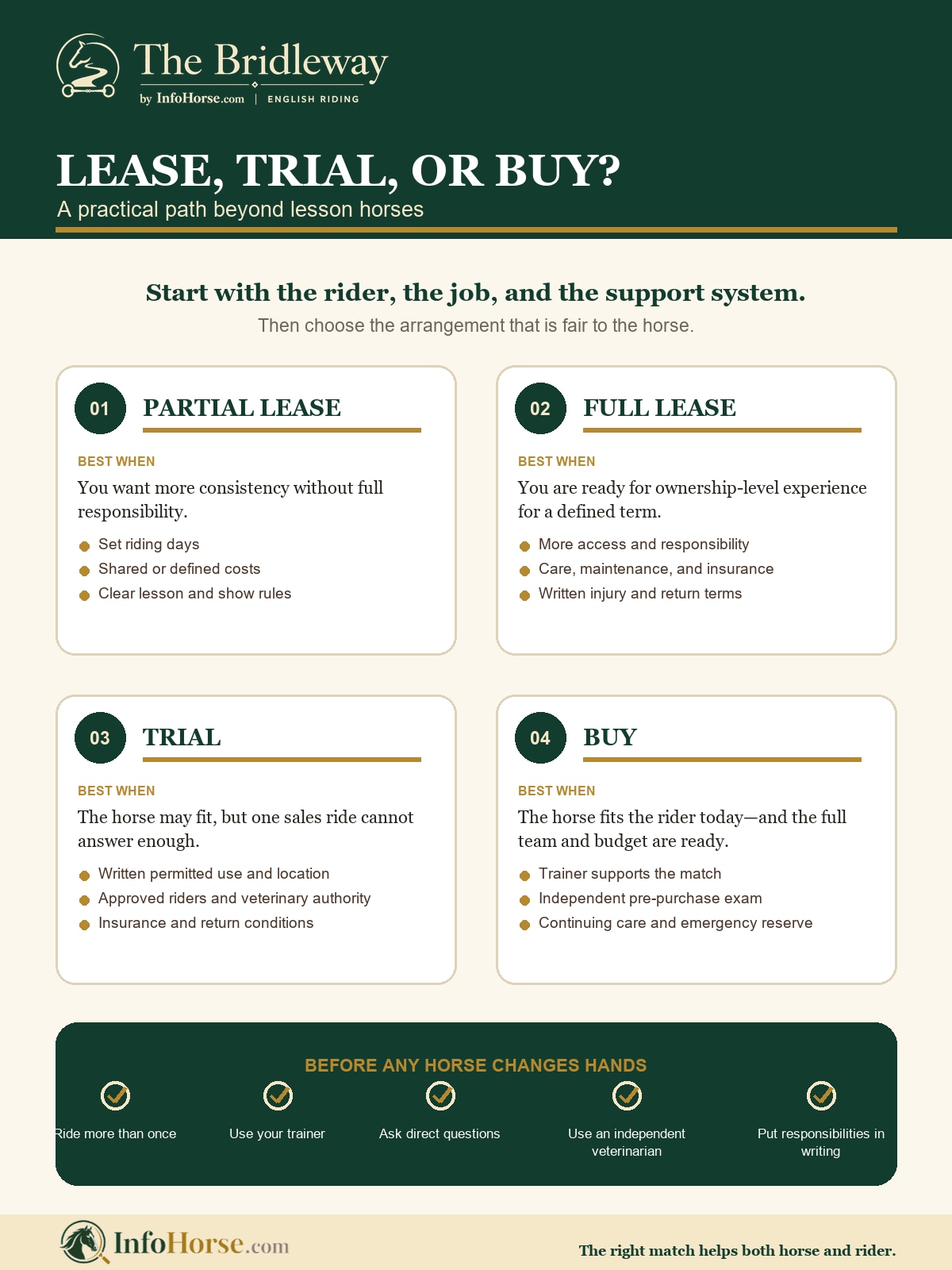
Partial or half lease
A partial lease usually gives the rider a set number of riding days each week while the owner or another lessee uses the horse on the remaining days. Expenses and responsibilities vary.
This can be the best bridge between weekly lessons and full responsibility. The rider develops a more consistent partnership, learns the horse’s routine, and begins to understand what regular care costs without taking on the entire commitment.
The weakness is that shared use requires clear communication. Riding days, lessons, shows, tack, veterinary decisions, and schedule changes should not be left to assumptions.
Full lease
A full lease gives the rider substantially more access and responsibility, often for a fixed term. Depending on the agreement, the lessee may pay a lease fee and most or all routine expenses.
A full lease can feel very much like ownership while still having an end date. It is especially useful for a rider whose skill, size, or competitive goals may change. Very few horses carry one rider from beginner lessons through every level of the sport.
But “leased” does not mean “low responsibility.” Read the agreement. Understand the care standard, approved uses, location, insurance requirements, maintenance, emergency decisions, and what happens if the horse becomes injured or unusable.
Pre-purchase or pre-lease trial
A trial is a limited period to evaluate a horse under agreed conditions. It is not an informal promise or permission to take the horse home and see what happens.
A good trial agreement identifies who may ride the horse, where the horse will live, which activities are permitted, who pays which expenses, what insurance is required, who may authorize veterinary care, and how the horse will be returned.
Some sellers will not allow off-property trials, and they may have sound reasons. In that case, arrange multiple visits, watch the horse in different circumstances, and consider having your trainer ride or school the horse.
Purchase
Buying may make sense when the rider is ready for a long-term commitment, the horse fits the rider’s current ability and realistic goals, the team agrees on the match, and the continuing costs are manageable.
Ownership gives you control, but it also gives you the responsibility when the plan changes. The rider may outgrow the horse’s ability. The horse may need a different job. A family situation may change. That does not make ownership a mistake, but it belongs in the decision before the check is written.
Buy the Horse You Can Ride Now
Horse advertisements use familiar labels: schoolmaster, amateur horse, prospect, green, project, and packer. Those words are useful only when you ask what they mean for this particular horse.
Schoolmaster
A true schoolmaster knows the work and can teach the rider. He is not a machine, and he may still have preferences, maintenance needs, and limits. His value is not that he never makes a mistake. His value is that he understands his job well enough to help the rider learn it.
Proven amateur horse
This horse has a record of being ridden successfully by a nonprofessional. Ask what kind of amateur. An experienced adult amateur riding six days a week with a professional program is different from a first-time owner riding twice a week.
Green prospect
A green horse may be talented, kind, and promising, but he still needs education. Every unfinished part of his training becomes somebody’s responsibility. If the buyer cannot provide that training, the budget must include the professional who can.
Project horse
A project may need retraining, conditioning, behavior work, medical rehabilitation, or simply time. Projects can become wonderful horses in experienced hands. They can also be unfair to a new rider and unfair to the horse when enthusiasm is mistaken for ability.
Never be embarrassed to choose the quieter, more experienced horse. Confidence is not a consolation prize. It is the foundation that lets a rider improve.
Your Trainer Should Be Part of the Search
An experienced trainer sees things a first-time buyer may miss.
Your trainer knows how you ride when you are nervous, what mistakes you repeat, how much horse you can organize, and whether a horse’s way of going will help or overwhelm you. A good trainer is not simply judging whether the horse is talented. The trainer is judging whether the match is workable.
Agree in advance how the trainer will be paid for searches, video reviews, visits, rides, negotiations, and commissions. Equine transactions can involve agents on one or both sides. Written disclosure of roles and compensation helps everyone understand whom each person represents.
If a seller objects to your trainer seeing the horse, slow down. A reasonable professional evaluation protects the horse as much as the buyer.
What to Ask Before You Go
You can save time by asking direct questions before scheduling a visit:
- Why is the horse available?
- How long has the current owner had him?
- What has he been doing during the last year?
- Who rides him, and how often?
- What level is he schooling and what level has he competed?
- How does he behave after several days off?
- Has he had lameness, illness, surgery, injections, special shoeing, or ongoing medication?
- Does he crib, weave, bite, kick, bolt, buck, rear, pull back, or resist loading?
- How is he for clipping, bathing, farrier work, veterinary care, trailering, turnout, and hacking?
- Does he require a particular warm-up, professional ride, feed program, turnout schedule, or maintenance routine?
- Are veterinary, farrier, competition, registration, and ownership records available?
A seller may not know every answer, and one imperfect answer does not make a bad horse. What matters is whether the story is complete and consistent.
Ask to see current unedited video that includes ordinary work: mounting, walking, transitions, both leads, stopping, standing, and whatever the horse is being advertised to do. A highlight reel tells you what happened during the best thirty seconds. You are trying to understand the other forty-five minutes.
At the First Visit: Watch Before You Ride
Arrive early if the seller agrees. Watch the horse in the stall or paddock, being caught, groomed, tacked, and led. Notice whether the horse can stand, whether his expression changes around the saddle, and whether the handling routine looks ordinary or carefully managed.
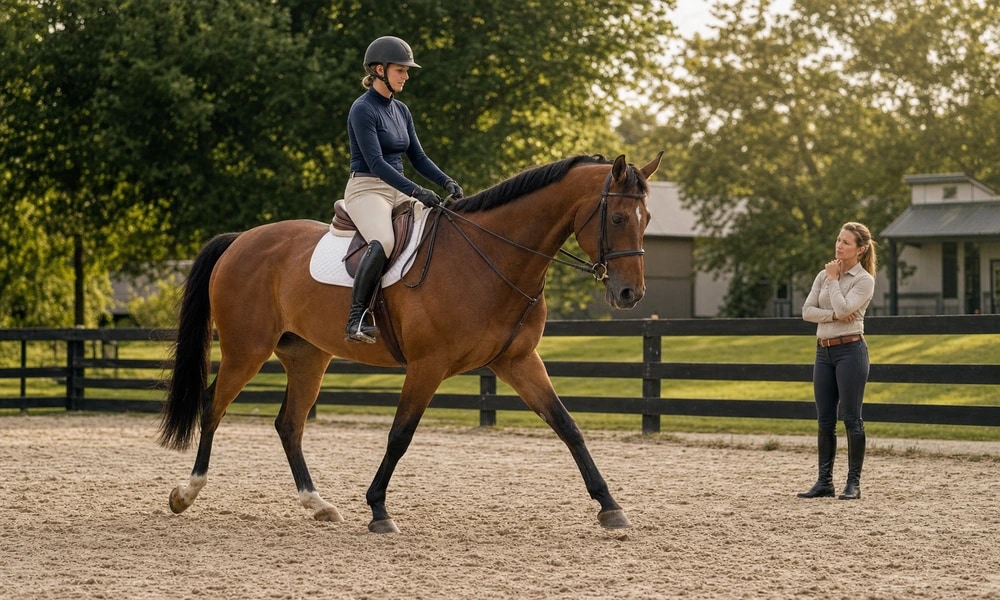
Unless your trainer has a different safety plan, have the seller or regular rider get on first. Watch the horse walk, trot, canter, halt, change direction, and perform the work being represented. You are not being impolite. You are learning how the horse goes for someone who knows him.
When you ride, begin with the basics. Can you mount quietly? Can you steer, stop, and control the pace? Does the horse become worried when you make a mistake? Does he listen without requiring more strength or timing than you currently have?
Try the horse in the situations that matter to you, but do not create a dangerous test. If you need to hack, jump, ride alone, or work in a busy warm-up ring, plan how to evaluate those needs with the trainer and owner. One spectacular fence does not prove the match. A calm twenty-minute flat ride may tell you much more.
Then go home and think.
Ride More Than Once
Horses have different days. Riders do too.
If possible, ride the horse on more than one day and at a different time. See him after a normal amount of work and, if it can be done honestly and safely, under a routine closer to the one he would have with you.
Your trainer may want to ride the horse. That can reveal whether a difficulty is a training issue, a rider-horse mismatch, or simply normal communication between two unfamiliar partners.
Do not let the excitement of finally finding a horse turn every question into an inconvenience. A suitable horse should become more understandable as you learn more—not more mysterious.
The Pre-Purchase Examination: Information, Not a Guarantee
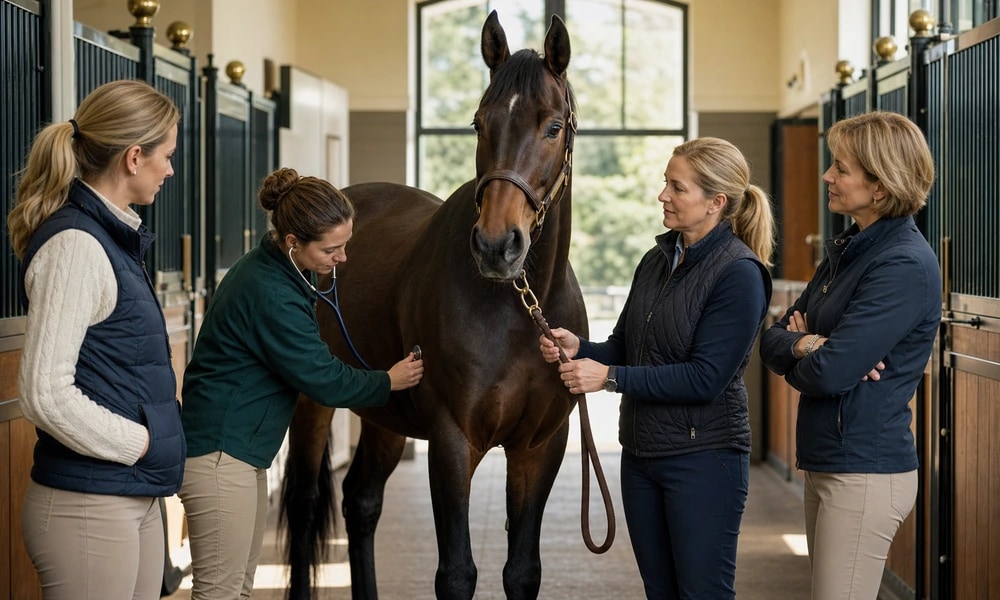
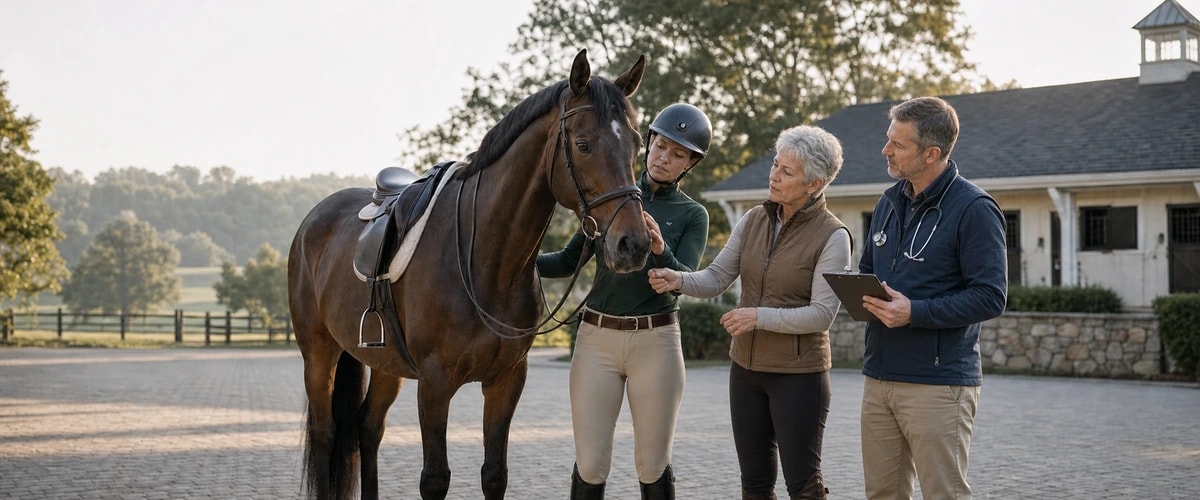
If you are buying a horse, arrange a pre-purchase examination with an equine veterinarian working for you. The veterinarian should be able to remain impartial. If the veterinarian has an existing relationship with the horse or seller, that relationship should be disclosed.
Tell the veterinarian your intended use, the rider’s level, your short- and long-term goals, and what you already know about the horse. The examination can then be tailored to the horse and the job. Your veterinarian may recommend additional diagnostics based on the examination, history, age, discipline, value, and level of intended work.
Be present if possible. Ask what each finding may mean now, what might need monitoring, what maintenance could be expected, and which recommended tests were not performed.
Here is the important part: the veterinarian is not handing you a lifetime guarantee. A pre-purchase examination describes findings and provides medical information at a point in time. The veterinarian does not choose the horse for you and cannot promise what will happen in the future.
I do not like treating the examination as a green “pass” or red “fail.” The better question is:
Can this horse, with these findings and this likely care, reasonably fit this rider’s intended use, budget, and tolerance for risk?
A finding that is manageable for one buyer may be unacceptable to another. A horse with a perfectly clean-looking report may still be the wrong temperament, training level, or ride. Medical suitability is one part of the complete decision.
For a lease, discuss with your veterinarian and trainer whether a pre-lease examination is appropriate. The horse’s value, work, length of lease, care obligations, and insurance requirements all matter.
Put the Agreement in Writing
Handshake horse deals are part of our history. Written agreements are part of taking good care of people and horses.
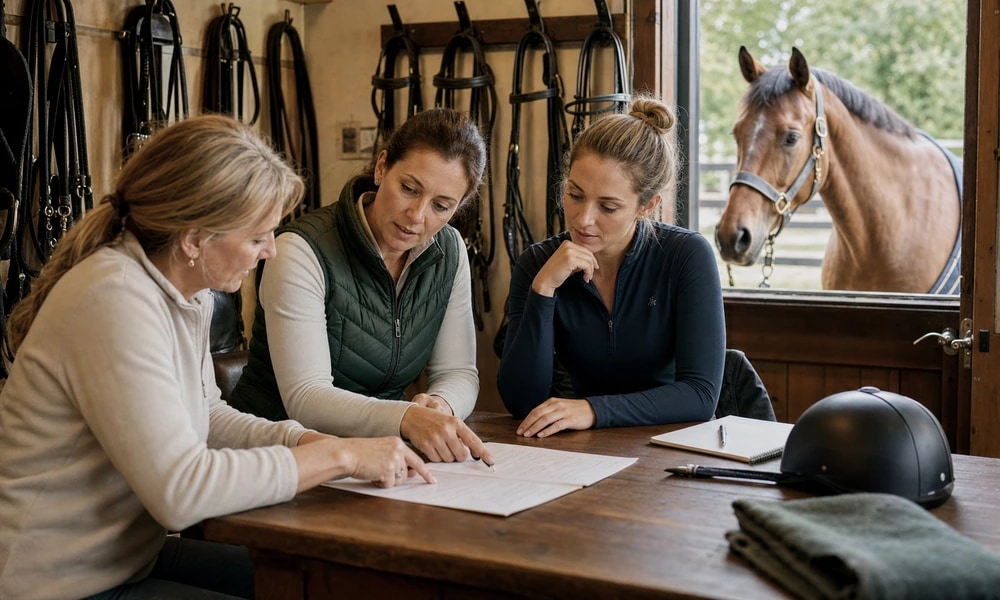
For a purchase, the paperwork may include a purchase agreement and bill of sale. For a lease or trial, the agreement should clearly describe the horse, the parties, the dates, payment, location, permitted use, and responsibilities.
Depending on the arrangement, questions may include:
- Who pays board, feed, routine veterinary care, emergency care, dentistry, farrier work, medications, supplements, training, hauling, and show expenses?
- Who chooses the veterinarian and farrier?
- Who may authorize emergency treatment?
- What activities, riders, trainers, barns, and travel are permitted?
- May the horse be shown, bred, subleased, or moved?
- What insurance must be carried, by whom, and who is named on the policy?
- Who bears the financial risk if the horse is injured, becomes unusable, or dies?
- What maintenance was disclosed, and who may change it?
- How and when can the agreement end?
- In what condition, location, and time frame must a leased or trial horse be returned?
- Which records, registration papers, tack, or equipment are included?
This article is not legal advice, and a checklist cannot guarantee an enforceable agreement. Equine law varies. For a meaningful transaction, use a licensed attorney who understands the laws that apply to you, and speak directly with the insurance provider before the horse changes hands or location.
If you intend to compete, ask your trainer or governing organization about current lease recording, ownership, membership, and entry requirements before the first show.
Budget for the Horse After the Horse
The purchase price or lease fee is only the front door.
The continuing budget may include:
- Board and feed
- Lessons and training rides
- Farrier care
- Routine and emergency veterinary care
- Dentistry and vaccinations
- Medications, supplements, and ongoing maintenance
- Mortality, major-medical, surgical, and liability insurance as appropriate
- Saddle fit, tack, blankets, and equipment
- Trailering and transportation
- Show entries, memberships, coaching, braiding, stabling, and travel
- Professional schooling when the rider cannot ride
- Retirement, rehabilitation, or a change of job
Costs vary too much by region, discipline, barn, and horse for one national number to be useful. Get real local estimates before committing. Ask the barn, trainer, farrier, veterinarian, and insurer what this particular horse and program are likely to require.
Then create an emergency reserve. Horses do not schedule colic, lameness, torn blankets, lost shoes, or truck repairs for a convenient month.
The least expensive arrangement is usually the one you can sustain without cutting corners in the horse’s care.
Warning Signs That Mean “Slow Down”
Not every warning sign proves dishonesty, but several together should change the pace of the transaction.
Slow down if:
- You are pressured to send money immediately.
- The price or story changes during the conversation.
- The seller will not identify the horse clearly or provide ordinary records.
- Your trainer is discouraged from attending or riding.
- An independent veterinary examination is refused.
- You cannot see the horse perform the advertised job.
- The horse arrives already tired, unusually quiet, or handled under unexplained conditions.
- You are told not to contact a veterinarian, previous owner, barn, or competition organization.
- Important promises are made verbally but will not be written into the agreement.
- You keep explaining away the same concern because you have already fallen in love.
There will always be another horse. That is hard to believe when you are standing beside one you already imagine in your barn, but it is true.
The Decision Path
The Horse Gets a Vote
The best transaction is not simply one where the buyer feels successful.
The horse must be suited to the rider, barn, workload, turnout, care, and expectations. A sensitive horse who thrives in a professional program may struggle when moved to a quiet backyard with an inexperienced rider. A steady older horse may be a priceless teacher, but he still deserves appropriate work, pain management, and retirement planning.
Do not buy a horse because you want to save him from a seller you distrust. Do not buy more athletic ability than you can ride because somebody says you will “grow into him.” Do not assume kindness can replace knowledge.
Kindness matters. Knowledge is one of the ways we practice it.
What About an Off-Track Thoroughbred?
An off-track Thoroughbred may be an excellent sport horse, but that description tells you where the horse came from—not whether he is the right first horse for you.
Some Thoroughbreds become quiet teachers. Others are athletic, sensitive prospects who need experienced retraining. Judge the individual, the training he has today, the support available, and the match with the rider.
For the breed-specific transition, aftercare resources, and the qualities that make these horses successful in English disciplines, read The Thoroughbred’s Second Career: Why Off-Track Thoroughbreds Can Be a Big Win for You.
Final Thoughts
Buying your first English sport horse is not a beauty contest and it is not an exam you pass by finding the most impressive horse you can afford.
It is a matching decision.
Match the horse to the rider you are today. Match the job to the horse’s experience. Match the care to the family’s time and budget. Match the medical findings to the intended use. Put the responsibilities in writing. Keep good professionals around you.
A partial lease may be the wisest answer. A full lease may give the rider exactly the experience needed. A carefully managed trial may answer questions that a sales video cannot. A purchase may begin one of the great partnerships of your life.
The right first horse is rarely the one who makes the biggest impression in the advertisement. He is the one who helps you come home from the barn a little safer, a little more confident, and a little better than you were before.
And if the match is right for the horse too, that is when everybody wins.
Editorial sources consulted
- American Association of Equine Practitioners, “Don’t Skip the Purchase Exam”
- American Association of Equine Practitioners, “Guidelines for Reporting Purchase Examinations”
- American Association of Equine Practitioners, “Principles of Veterinary Medical Ethics (Equine Addendum)”
- US Equestrian, “Horse Leasing 101: Where to Start”
- US Equestrian, “Equine Transaction” resource packet
- US Equestrian, “Ownership Transfer & Lease Guide”
- United States Hunter Jumper Association, “Owning or Leasing a Horse or Pony”
General educational information only. Veterinary, legal, insurance, and financial decisions should be made with qualified professionals who understand the horse, transaction, intended use, and laws that apply.