


A dressage test sheet is not a verdict. It is a compressed record of one ride, seen from one judging position, under one set of conditions. Read it well and it can tell you where the test lost clarity, which basics kept resurfacing, and what deserves attention in the next lesson. Read it badly and one lonely 5 can ruin the drive home while six useful 7s sit unnoticed in the same column.
Riders often ask what the judge “really meant.” Usually the answer is on the sheet, but in three different places: the number, the movement directive, and the comment. The number grades the performance. The directive tells you what qualities were being evaluated. The comment records the most useful reason the judge could give in a few seconds while the next movement was already arriving.
The trick is to connect those pieces without pretending the judge diagnosed the horse, the rider, the saddle, or the entire training system from C. Observation first. Explanation second. Training plan third.
The Bridleway rule: Do not ask one box to tell you more than it can. Find the repeated pattern, verify it on video, and take one clean question to your trainer.
The dressage mark scale in plain English
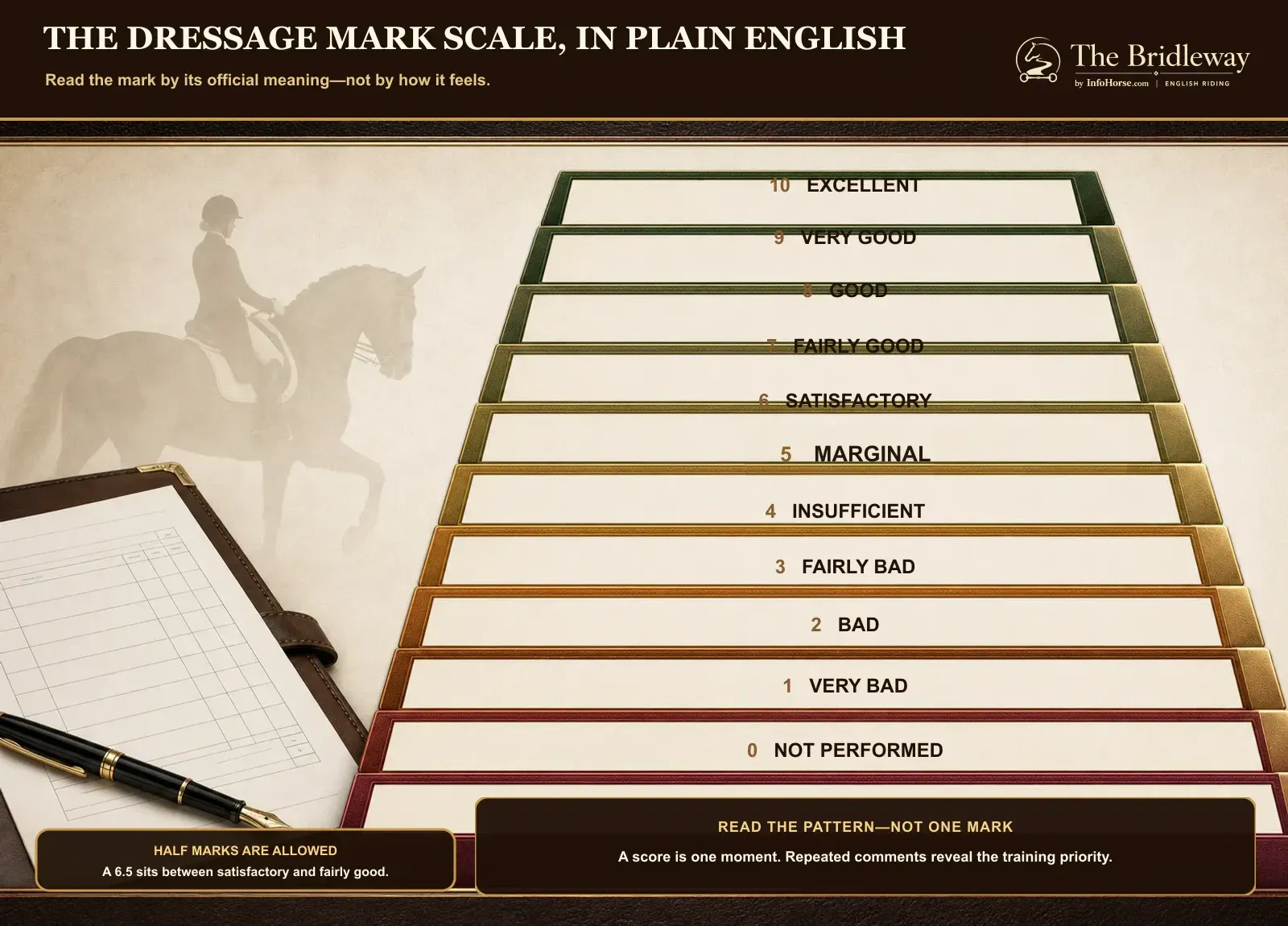
The standard scale runs from 0 to 10. These are not school grades with 60 percent labeled a failure. They have defined performance terms used across dressage judging:
| Mark | Meaning | Useful rider translation |
|---|---|---|
| 10 | Excellent | Exceptionally complete expression of the directive |
| 9 | Very good | High-quality work with only a very minor limitation |
| 8 | Good | Clear, correct work with a small area to improve |
| 7 | Fairly good | Competent work with a recognizable limitation |
| 6 | Satisfactory | Requirement shown, but quality or execution is limited |
| 5 | Marginal | Requirement only just shown or a significant problem |
| 4 | Insufficient | Major deficiencies in the requested work |
| 3 | Fairly bad | Serious problem; movement poorly shown |
| 2 | Bad | Very little of the requirement achieved |
| 1 | Very bad | Barely recognizable attempt |
| 0 | Not performed | Nothing of the required movement was executed |
A 6 is satisfactory. It is also an invitation to find the limitation. Perhaps the movement was clear but the horse lost balance. Perhaps the gait stayed regular while the figure was inaccurate. Perhaps the transition happened but was not prepared. The comment and directive distinguish those possibilities.
Half marks may be used where the current rules permit them. A 6.5 lives between satisfactory and fairly good; it is not a secret code. Do not spend the afternoon trying to reverse-engineer whether the judge “almost liked” you. Read the words beside it.
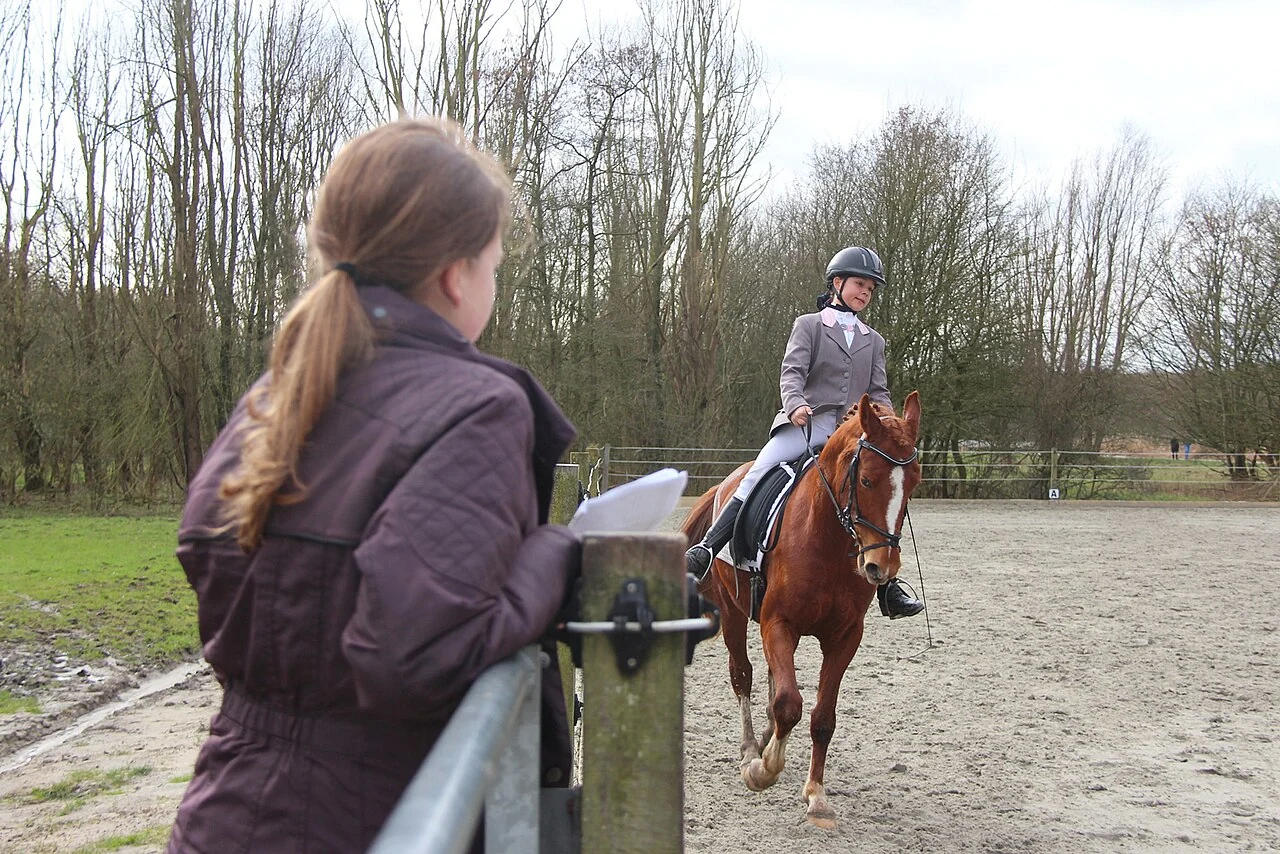
Start with the directive, not the disappointment
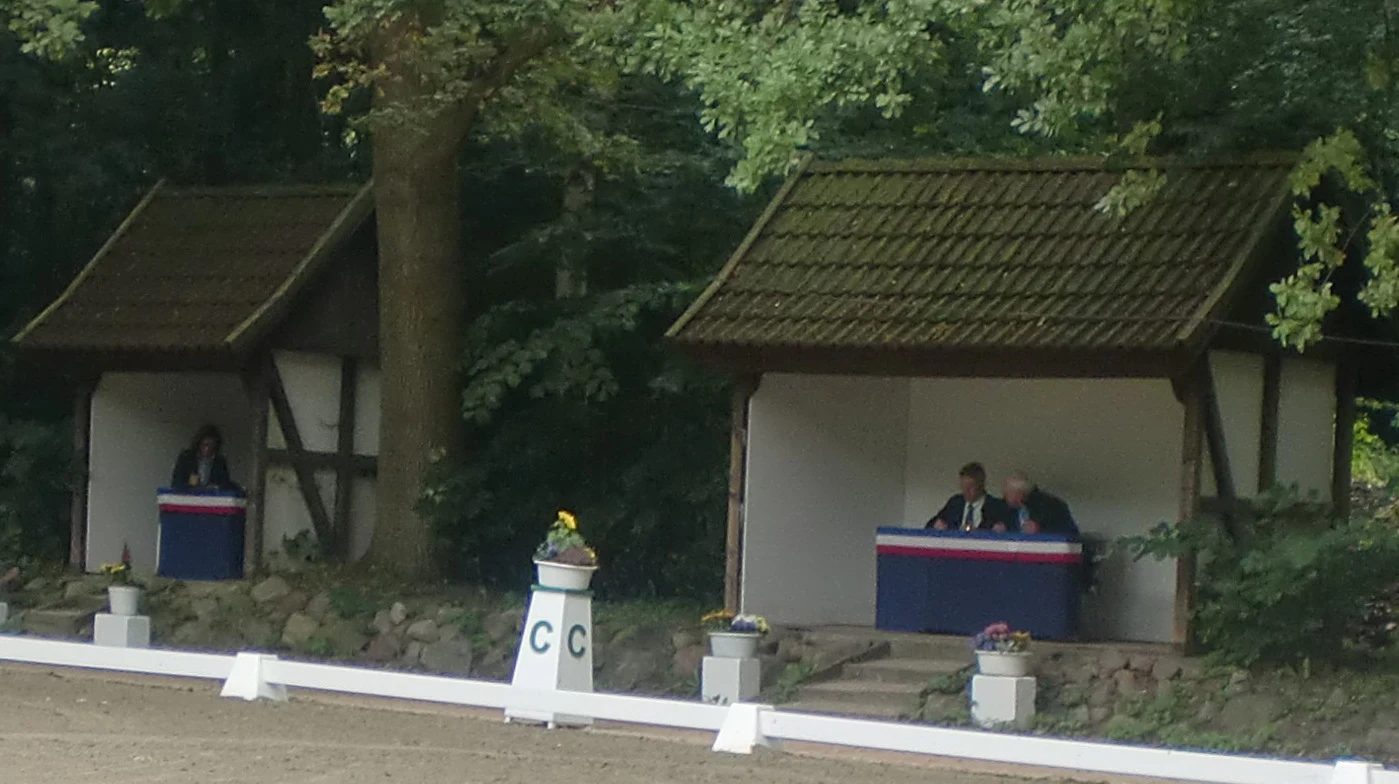
Every movement box has a prescribed pattern and a directive. The pattern might say where to trot, circle, halt, or change gait. The directive lists the qualities to judge—perhaps regularity, bend, balance, straightness, transition quality, or accuracy.
Suppose a rider receives a 5 on a 20-meter circle with the comment “loses rhythm; large.” The training conversation has at least two parts. The circle did not hold its specified size, and the rhythm deteriorated. Making the horse rounder in the neck will not answer either problem by itself. The next school might use visual quarter points on a slightly larger circle to restore rhythm, then return to the correct size when balance is available.
Without the directive, riders tend to chase nouns. “The judge did not like my canter.” With the directive, the question sharpens: “The canter depart was late and the first strides lost balance; how should I prepare the aid?” Sharp questions are trainable.
How the percentage is built
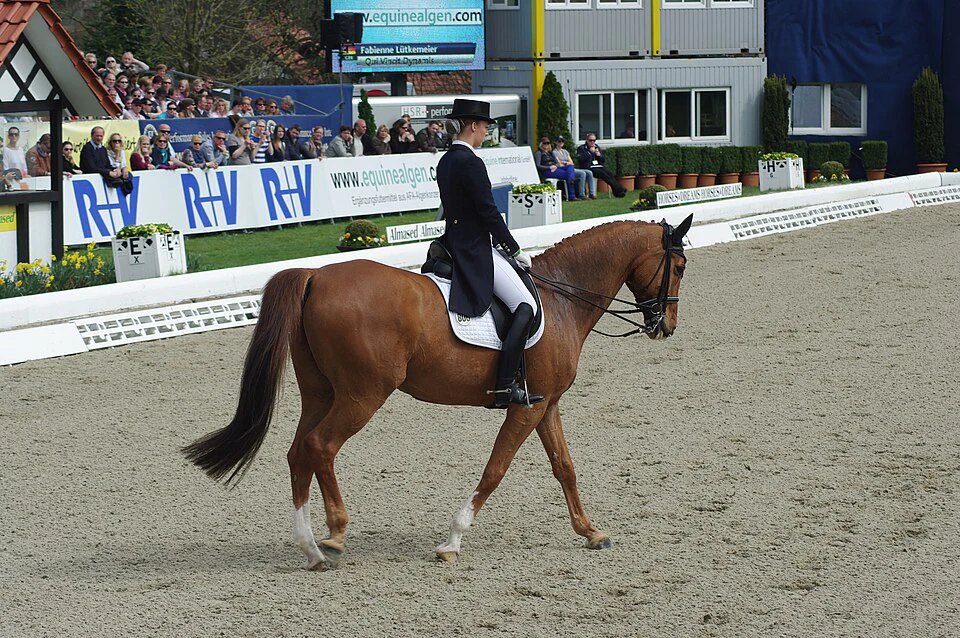
Each movement receives points. Marks carrying a coefficient are multiplied by the stated factor. Applicable penalties are deducted. The resulting points are divided by the maximum possible and multiplied by 100. The official show calculation governs the result, but understanding the arithmetic helps riders see why one double-weight movement can matter.
Use the free Bridleway dressage score calculator to explore the math. Change a coefficient-two score from 5 to 7 and watch the effect. Then change four ordinary 6s to 6.5. The lesson is not to obsess over decimals; it is to understand that consistent, modest improvements across a test can matter as much as one flash of brilliance.
What a coefficient is telling you
A coefficient gives a mark extra weight because that quality or movement carries particular importance in the test. It does not necessarily mean “school this movement twice as many times.” A poor coefficient mark may be the downstream result of a basic weakness.
If the free walk has a coefficient and repeatedly scores low, the answer may involve relaxation, clear overtrack, contact, and the rider’s ability to allow the neck—not endless laps of free walk immediately before a show. If a transition or collective carries weight, examine its ingredients. Coefficients reward priorities, not shortcuts.
Collective marks: the view after the movements
At the end of the sheet, collective marks address broader qualities defined by that test—often aspects of gait, impulsion, submission, and rider position or effectiveness. Read the exact labels and directives printed on your current sheet; tests and scoring formats evolve.
Collectives are not a second, unrelated opinion. They summarize patterns visible across the ride. If several movement comments say “behind leg” and an applicable collective also reflects insufficient energy or engagement, that repetition is useful. If the movements are mostly steady but one collective surprises you, compare video and ask your trainer what picture might have produced it.
Decode comments without inventing a diagnosis
A judge and scribe have seconds, not paragraphs. The USDF glossary of judging terms helps keep language consistent. Here are common observations translated into useful questions:
| Comment | What the judge likely saw | Question for video and trainer |
|---|---|---|
| Hurried | Tempo quickened; balance or clear rhythm suffered | Did the rider chase, or did the horse lose balance? |
| Behind the leg | Insufficient forward response or activity | Was the first aid answered, and did the rider keep nagging? |
| Above bit / against hand | Posture or contact became resistant or disconnected | What happened in the preparation, back, and rider hand? |
| Drifting | Shoulders or quarters left the intended line | Which end moved first, and toward which attraction? |
| Needs bend | Figure lacked sufficient uniform positioning | Was the circle correct, and did outside aids control the shoulder? |
| Loss of rhythm | Regular sequence or tempo changed | Did the figure, aid, balance, or tension interrupt the gait? |
| Hollow / braced | Back and topline lost throughness; contact stiffened | Was the rider holding, was the horse tense, or did balance fail? |
| Inaccurate | Line, size, location, or execution did not match the test | Which visual point or preparation was missed? |
Notice that the last column contains questions, not verdicts. “Above the bit” does not tell you to pull the head down. “Needs more bend” does not authorize more inside rein. The judge reports the visible result; the trainer helps determine cause and an ethical training response.
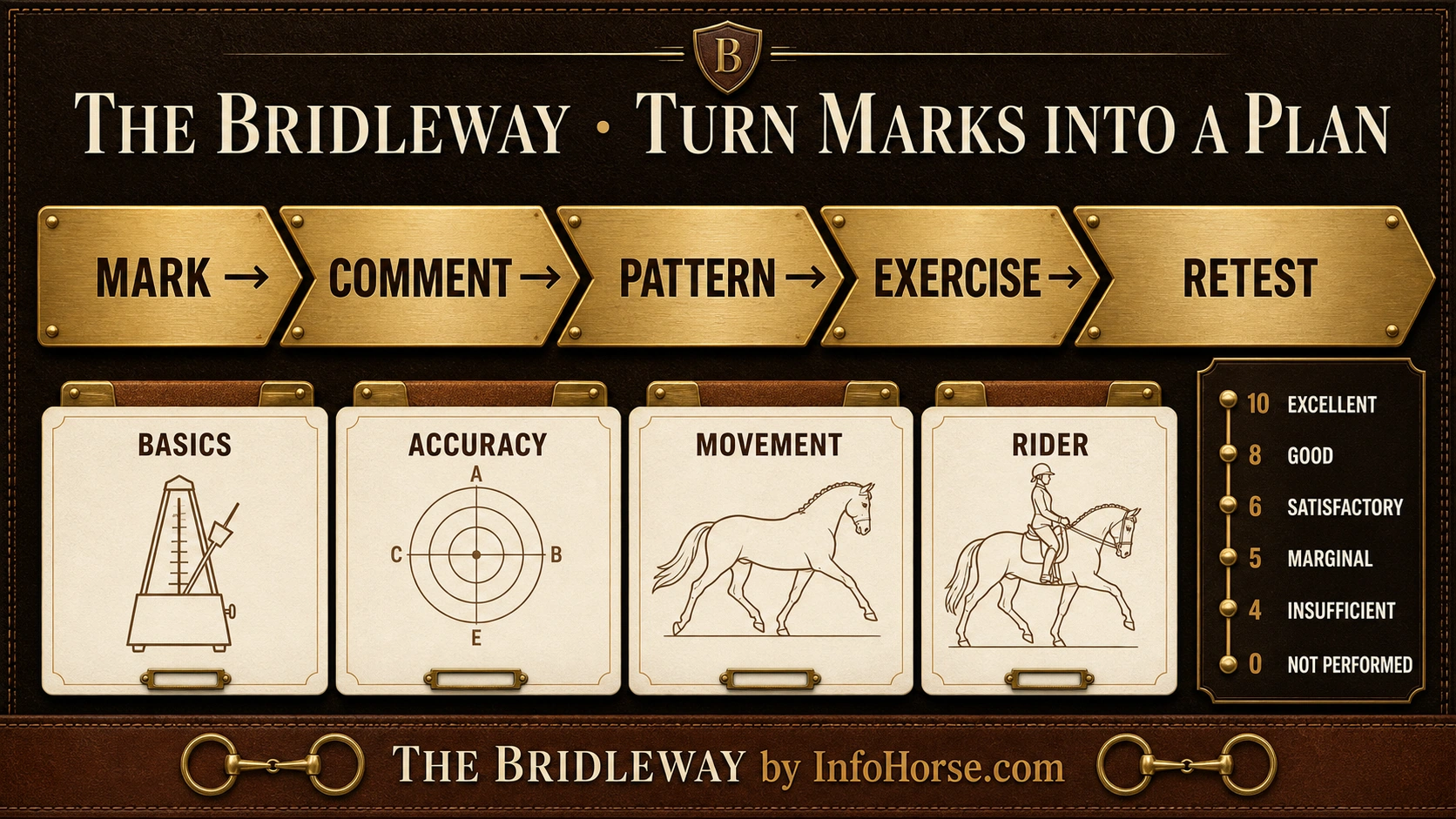
The pattern test: one moment or one priority?
Highlight every mark below your normal band and every repeated comment. Then sort them into four baskets:
- Basics: rhythm, relaxation, connection, impulsion, straightness, balance.
- Accuracy: figure size, line, letter timing, endpoints, halt placement.
- Movement skill: the horse does not yet have enough strength, understanding, or coordination for the requested quality.
- Rider influence: aid timing, position, steering, breathing, preparation, or correction.
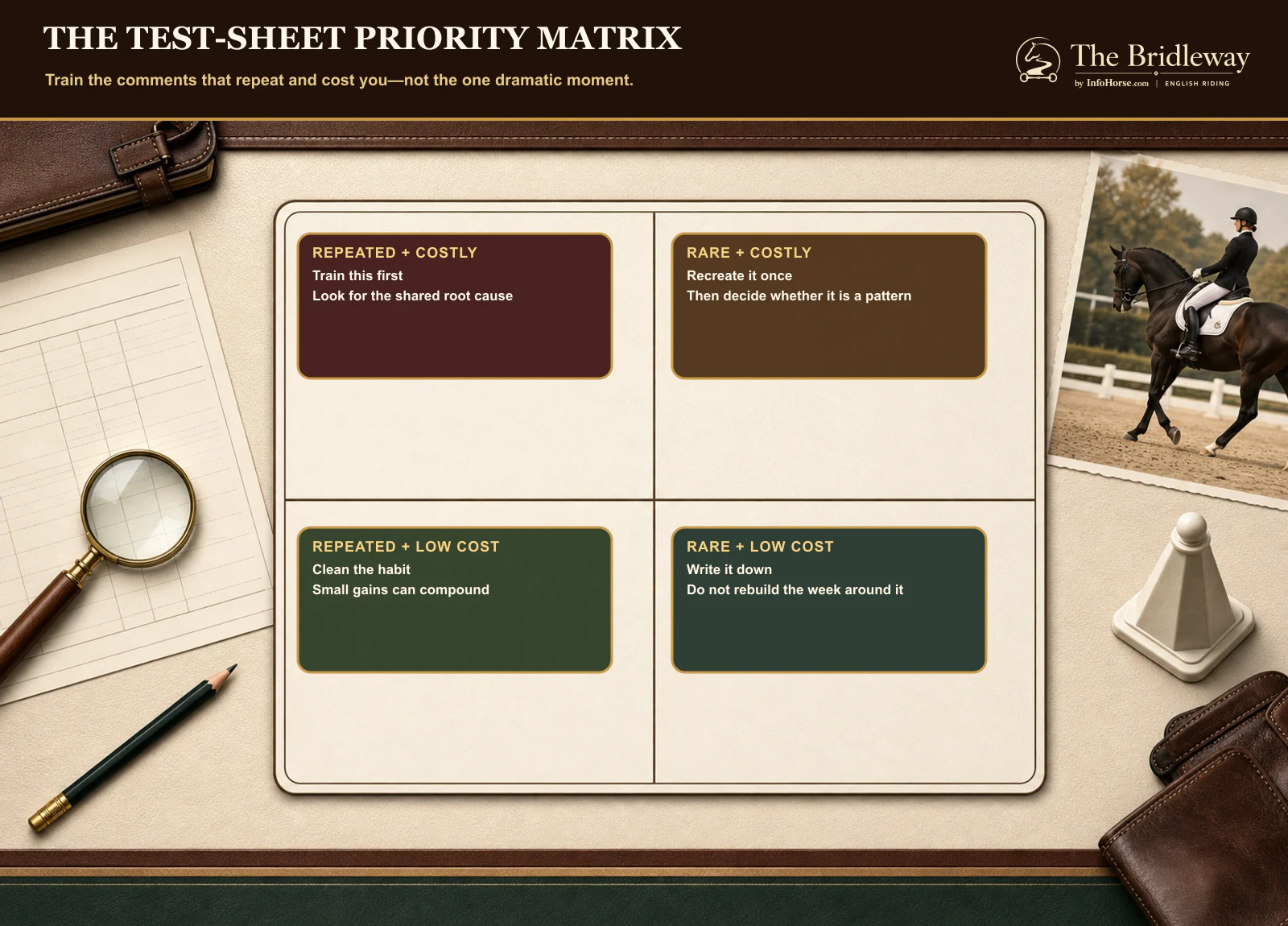
Look for an issue in three places: multiple movement boxes, the collective/final comments, and the video. When all three point toward the same family—say loss of rhythm in turns and transitions—you have a genuine priority. When only one box is low because a bird flew out of the hedge, you have a moment.
The three-hit rule: Before reorganizing the training week, find the issue three times or find one unmistakably major event. Dressage rewards pattern recognition; anxiety rewards overreaction.
Compare judges without score shopping
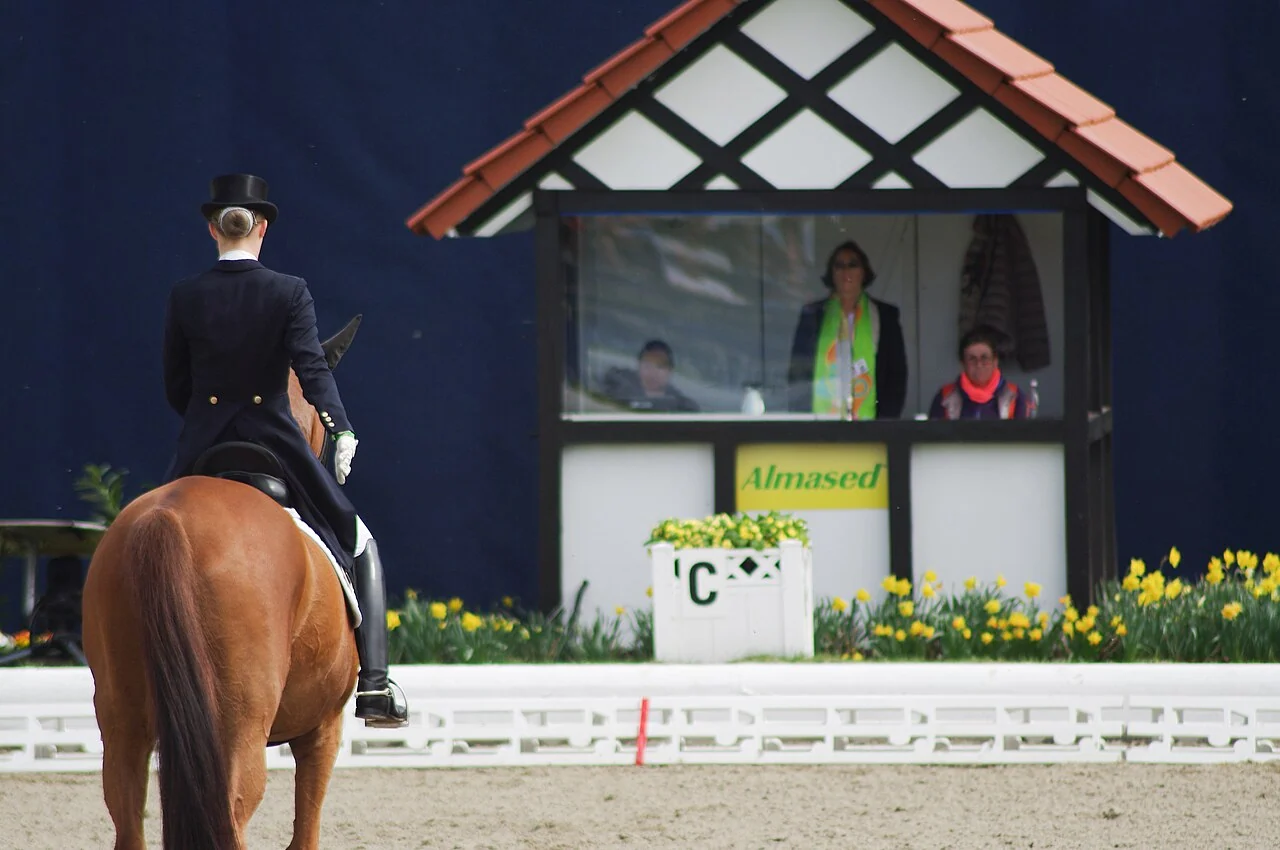
Judges train toward a common standard, but they are evaluating live movement from different positions. Modest variation is normal. A judge at C has a strong view of centerlines and certain straightness questions; a side judge sees other relationships. Light, weather, distance, and the actual ride matter too.
If two sheets differ, compare movement by movement. Did both identify loss of energy, even if one wrote “needs more forward” and the other “behind leg”? Did both reward the same walk? Is the total gap concentrated in one movement or spread across the test? Agreement in patterns can be more useful than agreement in arithmetic.
Do not dismiss the lower score and frame the higher one. Do not assume the judge who rewarded the horse “understood the type.” Bring both sheets and video to a qualified trainer. The objective is not to pick the friendliest judge; it is to improve the performance so its quality is clearer from every chair.
Errors, penalties, and clerical questions
Keep penalties separate from movement quality. An error of course can reduce the final score without changing how well the completed movements were ridden. Under the 2026 USEF national-test framework, the first error costs two points, the second four, and the third eliminates the pair. Different tests and federations may use different provisions, so verify the rulebook and class conditions.
If the sheet appears to contain an addition, transcription, or penalty problem, do not confront the judge. Take the question promptly to the show office and follow the competition’s process. The scribe records a fast-moving test; score checking exists for a reason. Ask a factual question while the records are available.
The 20-minute post-show review
Wait until the horse is cooled out, watered, and comfortable. Then use a short review:
- Name three strengths. Which marks, comments, or video moments show training that is becoming dependable?
- Name the repeated pattern. What appeared across multiple movements?
- Find the preparation. Rewind five to ten seconds before each result. Problems often begin earlier than the scored box.
- Choose one home exercise. Match it to the likely cause with your trainer.
- Choose one test habit. Look earlier, prepare before the letter, breathe at the corner, or ride the entry gait sooner.
- File the sheet. Do not carry all its language into every stride of the next ride.
Score reaction
Circle every 5, explain the judge away, school all weaknesses tomorrow.
Training review
Read directives, find patterns, verify video, choose one priority and one habit.
Build a useful test history
Keep the sheets, but track categories rather than only percentages. Record the level and test, judge, venue, weather, horse state, errors, geometry leaks, best gait, repeated comment, and next priority. Over time you may discover that straightness comments are disappearing while transitions remain late, or that the warm-up plan changes the first three movements.
A percentage is a summary. A history is evidence. Moving from 61.8 to 63.1 under different conditions may mean little. Moving from repeated 5s to steady 6.5s on the same training question—supported by better video and a more confident horse—means something.
Do not train the comment at the horse.
Judge language describes a performance. If the horse suddenly shows pain, irregularity, marked resistance, breathing difficulty, or behavior outside its normal pattern, stop and involve the appropriate professional rather than drilling for a better box.
Bob’s conclusion: the sheet should make the next lesson clearer
The final percentage tells you where the arithmetic landed. The movement pattern tells you why. Read the directive, respect the defined scale, notice coefficients, translate comments into questions, and verify the repeated issue on video.
Then reduce the whole piece of paper to one training priority and one ring habit. The test sheet has done its work when the next lesson becomes clearer—not when it makes the rider smaller.
Continue the Bridleway dressage show series:
Research and scoring note: Definitions and scoring mechanics were checked against USDF tests and scoring, USDF judging and scribing, the USDF glossary, and FEI scoring basics. Rider forums were used to identify confusion about percentages and comments, not to define judging rules. Always use the current test sheet and governing rulebook for the class.
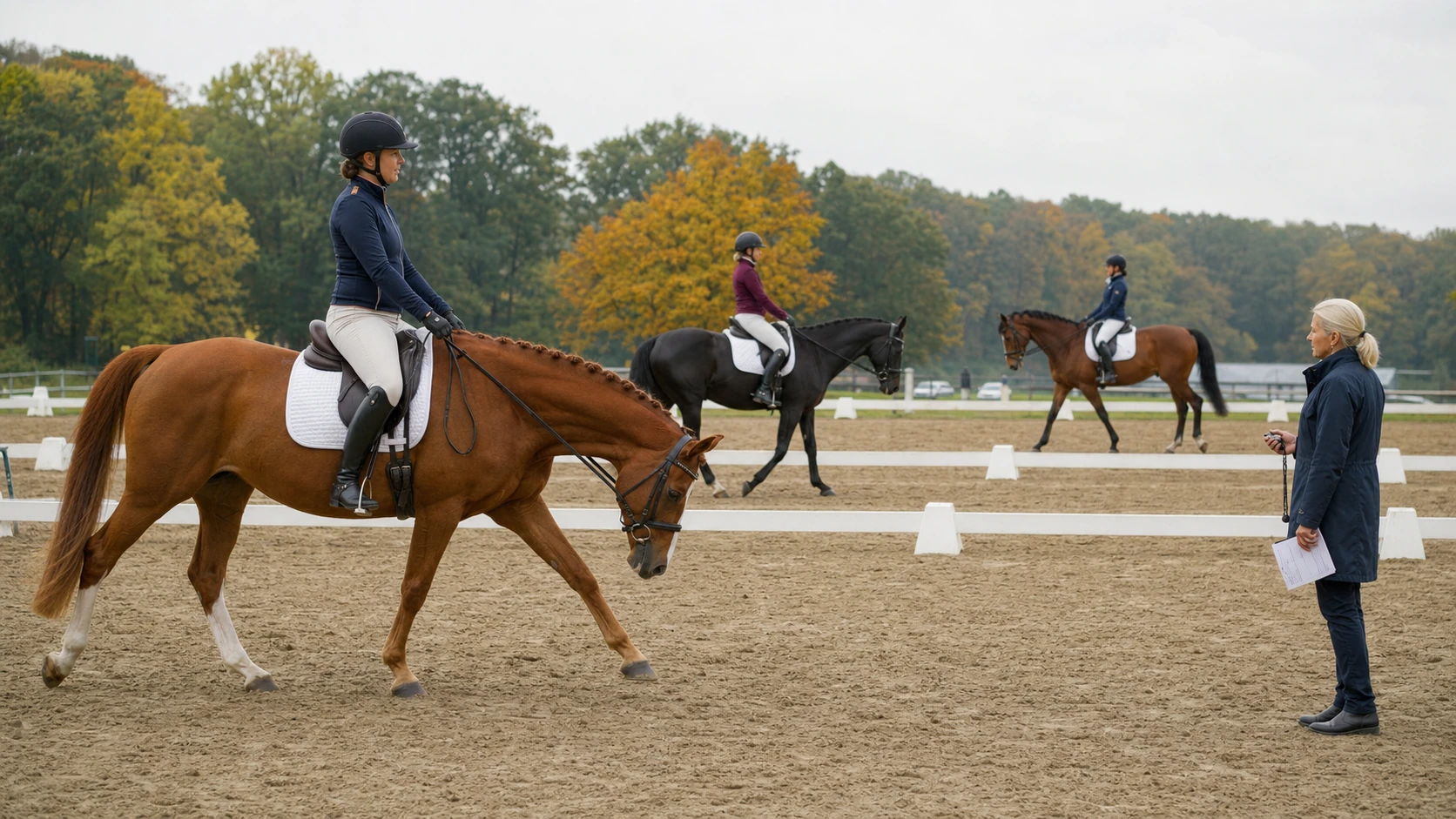
Visual note: The hero is an original Bridleway AI-assisted editorial illustration, not documentary photography. The educational infographics use AI-assisted visual foundations with human-set wording and Bridleway branding; they are not documentary photographs. Documentary photographs are licence-verified and credited at the image.