


When the Saddle Is the Problem: What Your Horse Tells You Before Your Saddle Fitter Does
Nobody wakes up in the morning worried about tree angle.
What happens is this. Your horse starts doing something. He swings his hindquarters away from the mounting block, the way he never used to. He pins his ears when the girth comes up and somebody at the barn calls him girthy, as though it were a personality trait he was born with. He gets quick and flat at the trot when he used to be soft. He stops taking one lead change cleanly. He bucks two strides after the fence, once, then twice, then every time.
And every one of those gets explained as something else. He is being fresh. He is testing you. He is green. He needs his hocks done. He has ulcers. You are riding him badly.
Sometimes all of that is true. And sometimes there is a saddle sitting on his back that stopped fitting him in March, and nobody has unbuckled a billet to look.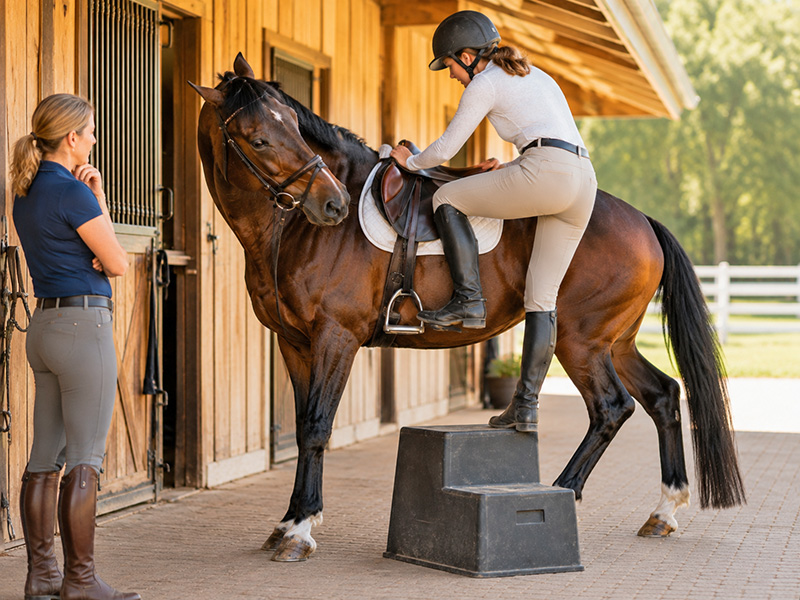
I have been around horses for more than fifty years, and I have watched good riders spend a small fortune chasing a training problem that was a fit problem the whole time. The horse was not arguing. He was telling the truth in the only language he has.
The horse complains first.
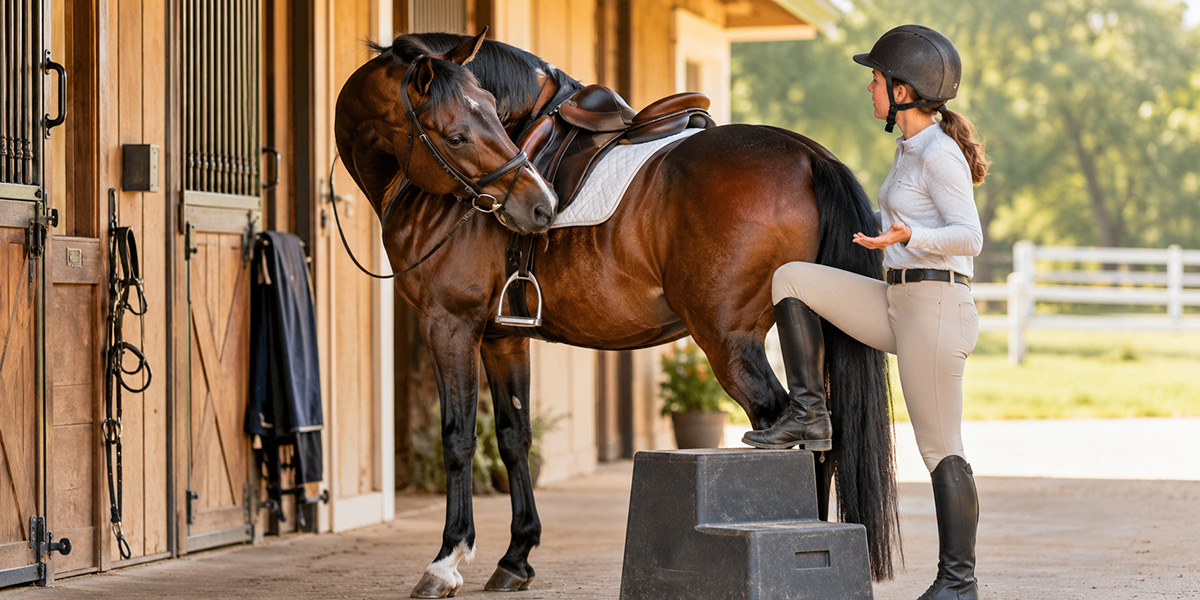
He is your earliest and most reliable witness, and he complains in a specific order. Trouble on the ground comes before trouble under saddle. Watch him being tacked. A horse who once stood square and now shifts, tightens, swishes, or turns his head toward you when the saddle comes down is saying something about the saddle, not about his manners. Watch him at the mounting block, which is where the saddle loads hardest and most unevenly. Watch the first three minutes of the ride, because pain that is present at the walk and disappears once he is warm and braced is still pain.
Under saddle, listen for the things that come and go. A horse who is sore in one lead only. A horse who is fine on the flat and unwilling over fences, or fine over fences and hollow on the flat. A horse who gets worse as the ride goes longer instead of better. Stiffness that improves with work is usually stiffness. Resistance that grows with work is usually pressure.
The tell that should stop you cold is a horse who used to do something well and no longer will. Horses do not unlearn skills. They protect themselves.
The coat keeps the record.
Your horse writes down what happened to him, and he writes it on his own back. Pull the saddle after a real working ride, before you do anything else, and look at both sides of him at once.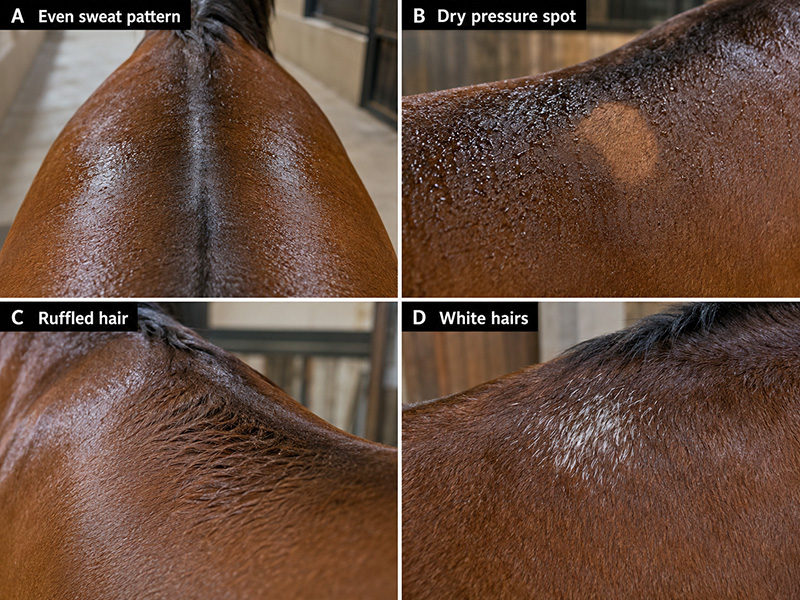
You want an even sweat pattern down both sides of the spine, matched left to right, running the length of the panel. What you are looking for is anything that breaks that evenness.
Dry spots are the loudest signal. A dry patch in the middle of a wet back means the pressure there was hard enough to shut the sweat glands down. That is not a mystery to be pondered. That is a spot where the saddle is bearing more weight than the tissue underneath it can carry. Two dry spots low behind the withers, one on each side, usually mean the tree is too narrow and the points are pinching. A dry stripe running the length of the panel often means bridging, where the saddle touches at the front and back and floats in the middle.
Ruffled hair matters too. When the hair lies every direction after a ride instead of lying flat, the saddle moved against the back rather than sitting on it. Look for it under the cantle especially, where a saddle that is too wide will drop and rock.
White hairs are the record of an argument you already lost. Hair goes white where pressure damaged the follicle, and that takes weeks or months of the same pressure in the same place. If your horse has white patches behind the withers, the saddle has been wrong for a long season. Those hairs may never come back.
One more, for the horse who lives outside and comes in dirty. Tack up over the dirt and ride. When you pull the saddle, the dust will be rubbed away exactly where the contact was hardest and left sitting where there was no contact at all. It is a cruder version of the sweat pattern and it works on a cold day when he barely breaks a sweat.
Your hands confirm it.
Long before professional saddle fitting was a service most Americans could hire, horsemen checked backs with their hands, and the method still works. It costs nothing and it takes two minutes.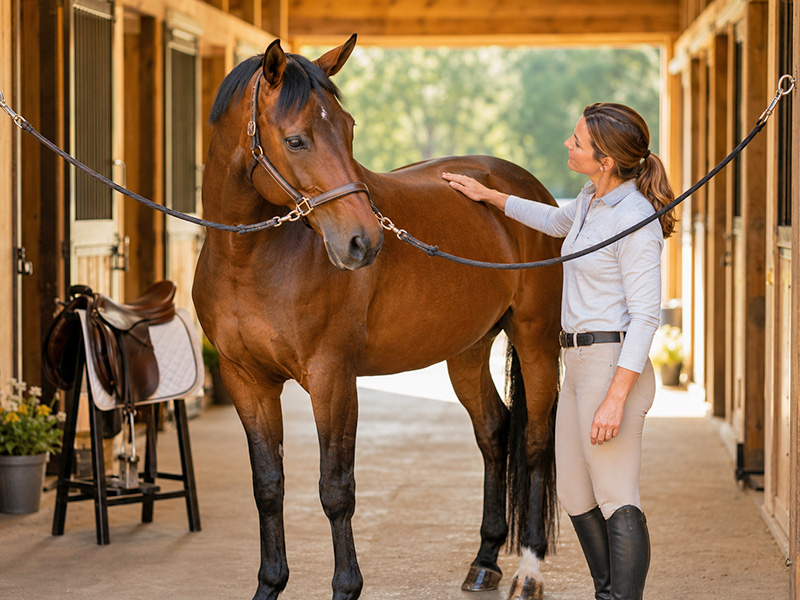
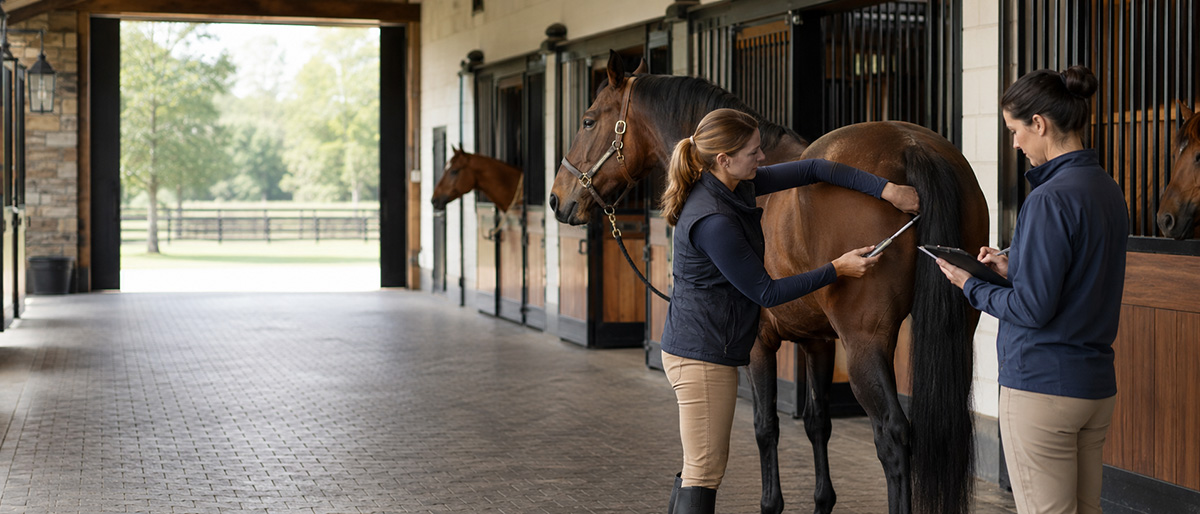
Stand at his shoulder where you can see his eye, because his face is half the exam. Lay your palm flat along the muscle beside the withers and run it down the back to the loin, following the length the saddle covers. Use enough pressure to mean something, about what you would use to press a thumbprint into soft clay, and keep it even the whole way down. Then come back up the same line with your thumb and fingers on either side of the spine, an inch or so out from the bone.
You are watching for three things. A flinch. A dip away from your hand. And the eye, which will tell you before the body does.
Then do the same thing on the other side and compare. Most saddle problems are not symmetrical, because most riders are not symmetrical and most horses are not either. One side sore and one side quiet is a very common finding and a very useful one.
Do this again right after you untack, while the back is still warm, and run your hand under the panel before you carry the saddle away. Heat in one spot, damp in one spot, a panel that feels lumpy or hard on one side and soft on the other, all of that is information.
Now call the fitter.
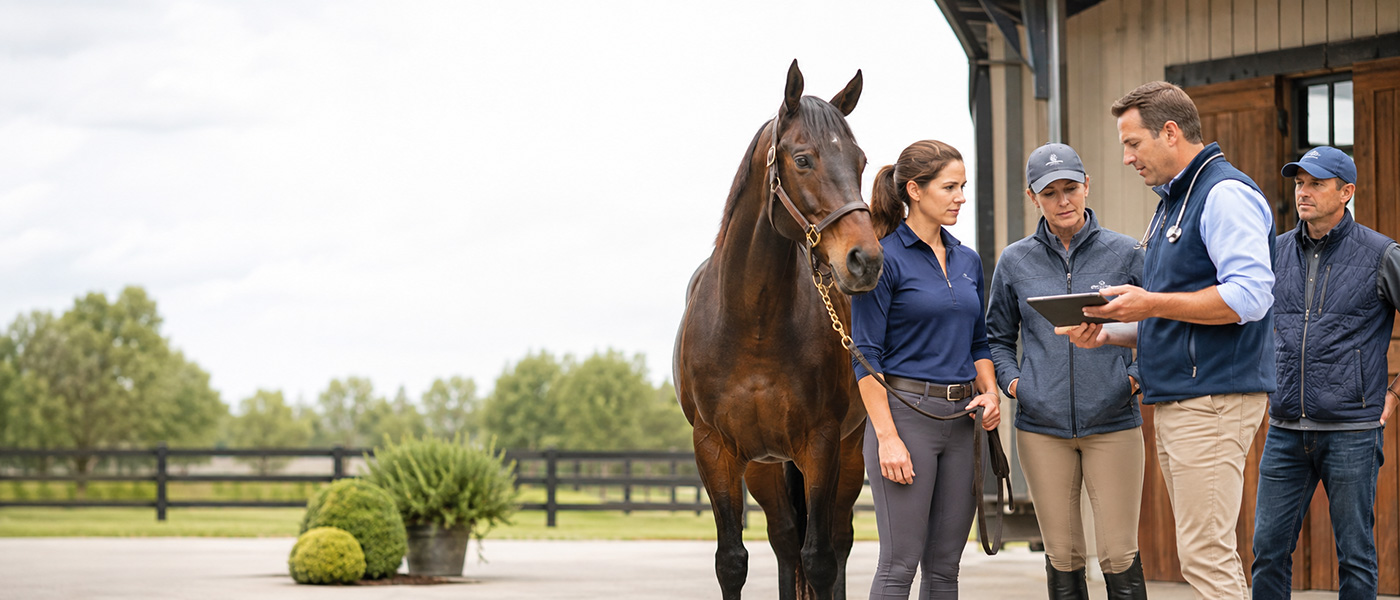
Everything above tells you that something is wrong. It does not tell you what to buy, and it should not. Measuring the tree, checking the flocking, reading the balance, and matching a specific saddle to a specific back is skilled work, and a rider who arrives at that appointment having already read her horse gets far more out of it.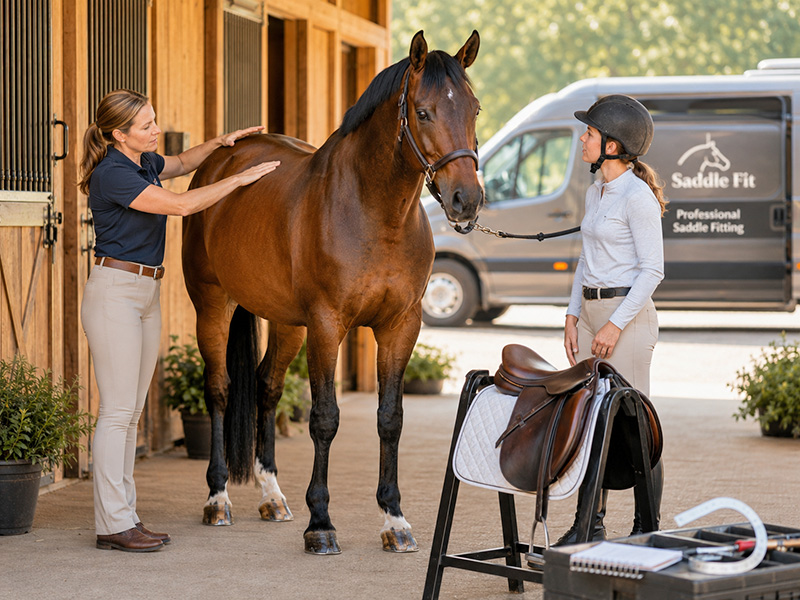
Ask the fitter to look at the horse before the saddle. Ask what specifically is wrong, in words you can repeat. Ask whether the saddle can be adjusted or reflocked rather than replaced, and take that answer seriously, because a good reflocking runs a few hundred dollars and a new saddle runs several thousand. Ask when to have it checked again. And know that a fitter who works on commission for one brand is answering a different question than a fitter who does not.
A half pad is not a repair.
This is where the most money gets wasted in the English world, so let me be plain about it. If a saddle is too tight, adding a thicker pad underneath makes it tighter. 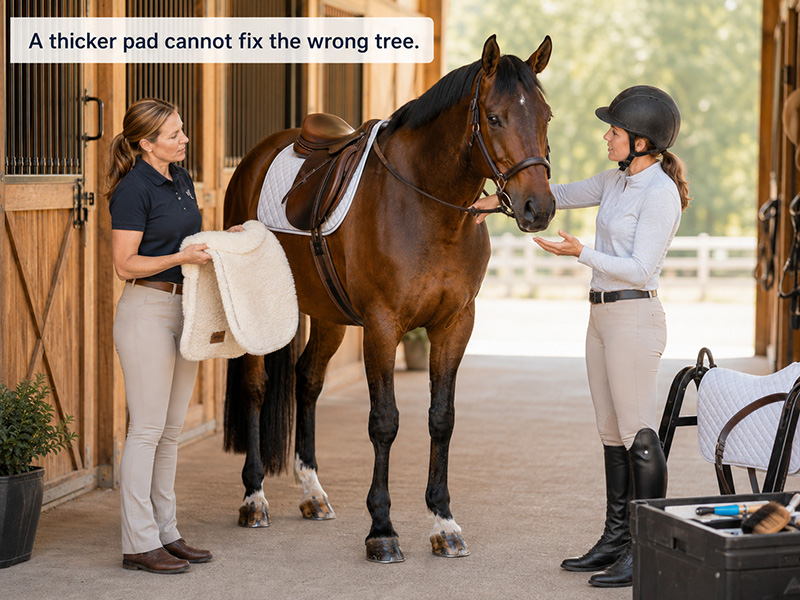 You have put a heavier sock inside a boot that already pinched. Shims and gel pads and sheepskin have real uses, mostly for a horse whose shape is changing week to week or a saddle that needs a small correction while you wait on an appointment. They do not fix a tree that is the wrong width, and they do not fix a saddle that bridges. Buying one to quiet a symptom you have not diagnosed just delays the day you deal with it, and your horse pays the interest.
Fit is a moving target.
The last thing worth saying is the one almost nobody says, and it is the reason the article most people read on this subject leaves them stranded.
Fitting is not a thing you did when you bought the saddle. Your horse's back changes constantly. It changes with the season. It changes when he comes back from six weeks off. It changes as he ages, and it changes with every pound he gains or loses. Check it twice a year at a minimum, and check it any time his shape or his work changes.
And here is the part that catches good riders flat. A horse who develops a correct topline over a winter of honest work has a genuinely different back in April than he had in November. That is what you were trying to do. That is the whole point. But the saddle was fitted to the old horse.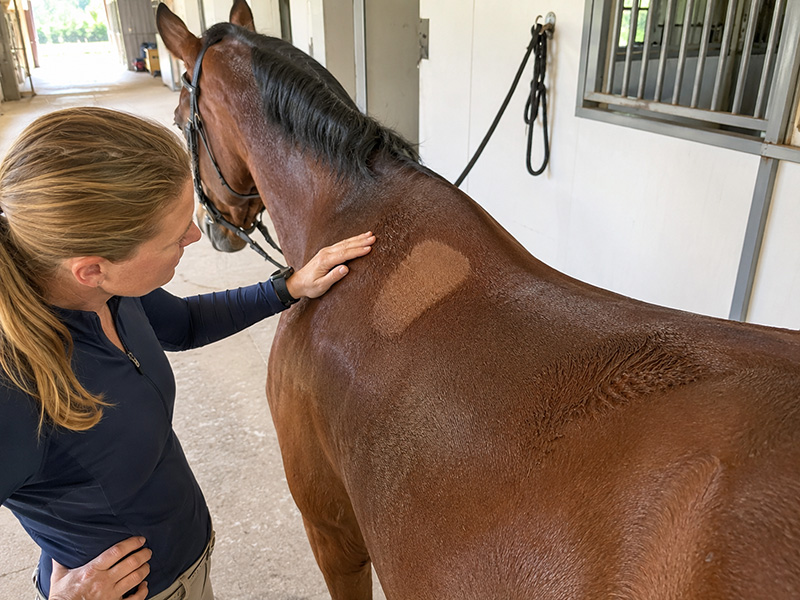
Good training breaks saddle fit. I owned a gelding named Dream for twenty-five years, and I watched his back change across a whole life, through work and rest and age and the shape a horse takes on at the end. The saddle that was right for him at eight was wrong for him at twelve, and it was wrong because he had gotten better, not worse.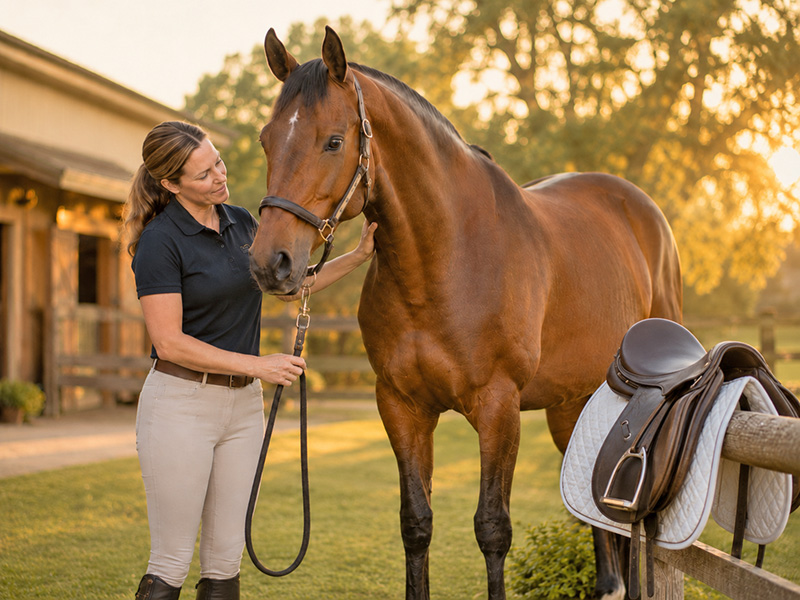
Your horse is not being difficult. He is filing a report. Read the horse, read the coat, use your hands, and then bring a professional into a conversation you already understand.