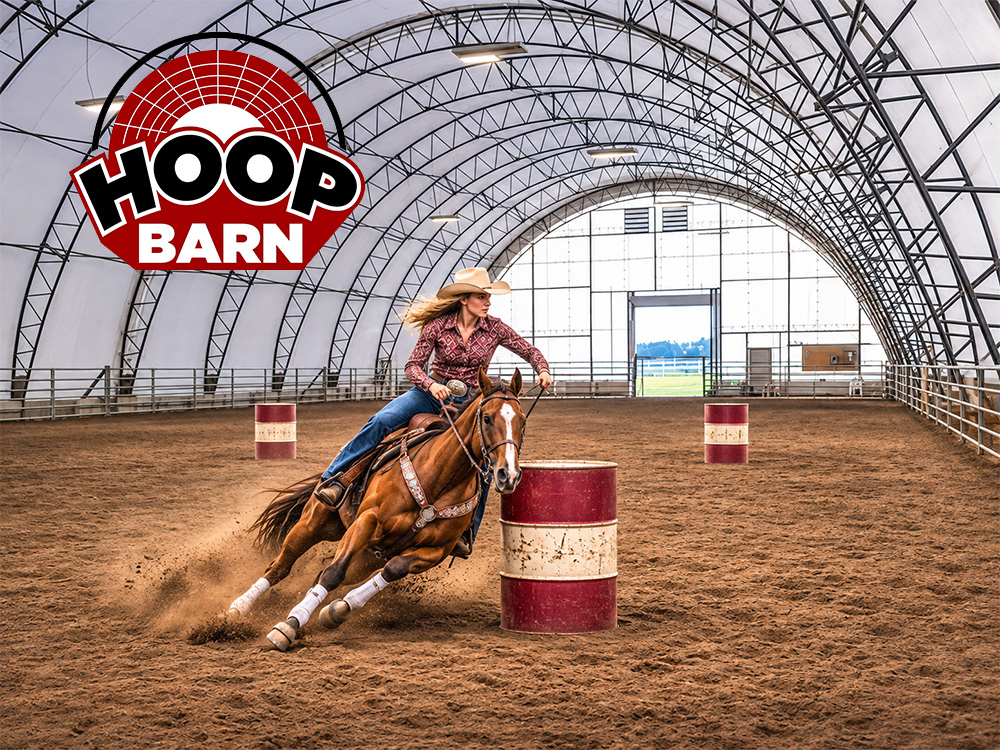

Rushmore fabric hoop barns from HoopBarn.com are affordable, heavy-duty, clear-span buildings made in South Dakota for horse owners who need a run-in shelter, a place to store hay, a new horse barn or a full-size covered riding arena that is strong, practical and built to last, without spending more than they have to.
If you have horses, you already know how quickly barn projects can grow into big projects with big price tags. Whether you need a simple run-in shelter, a place to store hay, a new horse barn or a full-size covered riding arena, you want something that is strong, practical and built to last. That is exactly why Infinite Earth, LLC is so excited about the Rushmore Buildings available through HoopBarn.com.
Some of the folks there have been serving horse owners for decades, and they know the difference between something that simply looks good in a brochure and something that actually works around horses. Rushmore hoop barns impressed them because they combine heavy-duty construction, useful clear-span space, American manufacturing and a price that can make a large building much more attainable for horse owners.
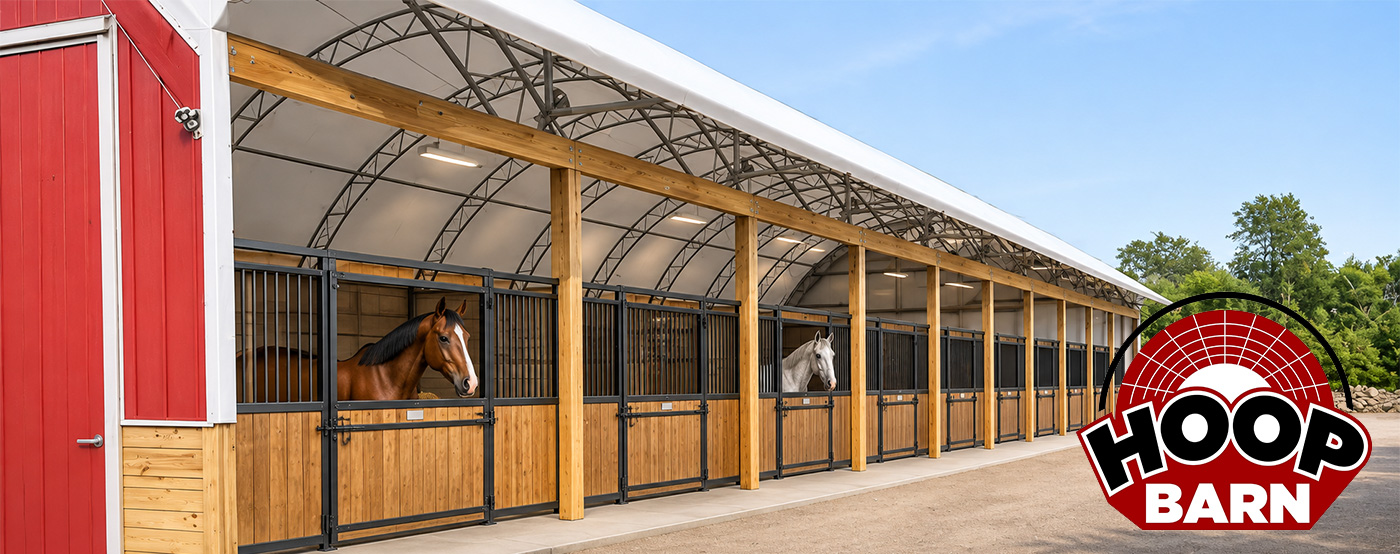
A hoop barn is a fabric-covered building built around a strong steel frame. Depending on the model, Rushmore Buildings may use heavy single-pipe framing or welded steel trusses with a tensioned fabric cover over the top. For horse owners, one of the biggest advantages is the clear-span interior: you are not dealing with rows of support posts underneath the roof.
That means you have much more freedom when planning stalls, aisles, hay storage, equipment areas or riding space. These buildings can work beautifully as run-in sheds, loafing barns, horse barns, hay barns, equipment buildings, covered riding areas and full indoor arenas. And because many Rushmore Buildings can be made in almost any length, you can build around the way you actually keep your horses instead of trying to make your horses fit the building.
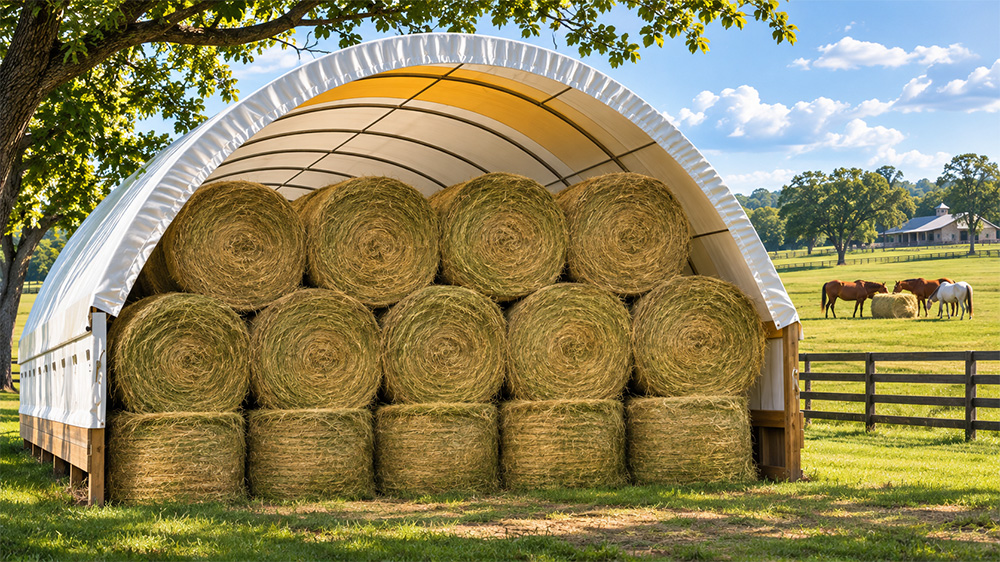
They certainly can be, especially when you start comparing how much usable covered space you are getting for your money. Traditional construction can become expensive very quickly once you add foundations, framing, roofing, labor and all the little things that seem to appear along the way. A fabric hoop building can give you a lot of usable square footage without requiring the same type of roof structure as many conventional barns.
For horse owners, that can mean getting the shelter, storage or riding space you really need without having to cut the project down so far that it no longer does what you wanted. The goal is not simply to find the cheapest barn. It is to find a building that gives you good value, dependable construction and enough room to comfortably work around your horses.
That really depends on how you plan to use it. For a smaller operation or a simple in-field shelter, a 30-foot single-pipe building can be an easy and economical choice. A 32-foot Rushmore truss building can also make a very nice run-in barn or loafing shed. If you are looking for something more permanent with additional room to work, a 50-foot low-profile building can make a very practical horse barn.
One of the nicest things about these buildings is that they can be made in many different lengths. That means you can plan for your horses and still leave room for tack, feed, hay, grooming space or equipment. Maybe you have two horses today but want room for four later. Maybe you want your hay stored under the same roof, or you would love to finally have a proper tack room. That flexibility is one of the reasons hoop barns make so much sense for horse properties.
Yes, especially if you want something much more substantial than a small backyard shelter. The 32-foot Rushmore truss building can be built with an open side, allowing horses to move in and out easily. It is clear-span inside, so there are no roof-support posts taking up valuable space. It can also be ordered in different lengths, so you are not limited to one standard-size shelter.
For a small herd, this can create a wonderful loafing barn where horses can get out of the sun, rain and bad weather while still having plenty of room to move around. If you have several horses turned out together, having one larger, open shelter can often be much more useful than trying to squeeze everyone into several tiny sheds.
The 45-foot freestanding Rushmore Building by HoopBarn is worth taking a close look at. It is designed to stand on a suitable flat surface using its perimeter frame and anchoring system rather than requiring the same type of foundation as some of the larger truss buildings. It gives you a lot of open interior space and can work well for livestock shelter, hay, equipment or other farm uses.
For some horse owners, the possibility of having a substantial shelter without committing to a more permanent foundation system can be a real advantage. As with any barn, it is important to match the building and anchoring system to your property and local weather conditions.
Absolutely, and many horse owners do just that! Because these buildings are clear-span, you have a lot of freedom to design the inside around your horses and your own particular needs. You may want stalls along one side, a center aisle, a grooming area, a tack room and feed storage. Someone else may want mostly open shelter with just a few stalls and lots of hay storage. Interiors are fully customizable, with the only limits in your imagination.
This is especially useful because horse operations are all different. A private three-horse barn is not going to be laid out the same way as a boarding stable, breeding barn or training facility. With the right planning, you can build the interior around the way you actually care for your horses every day.
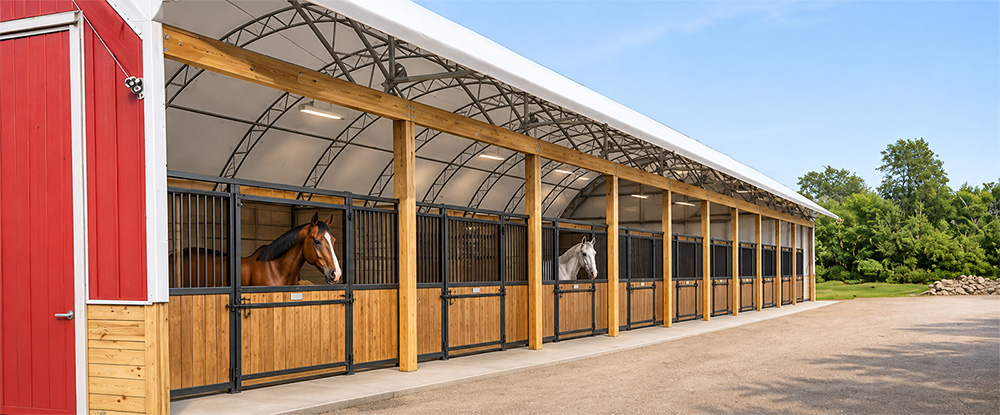
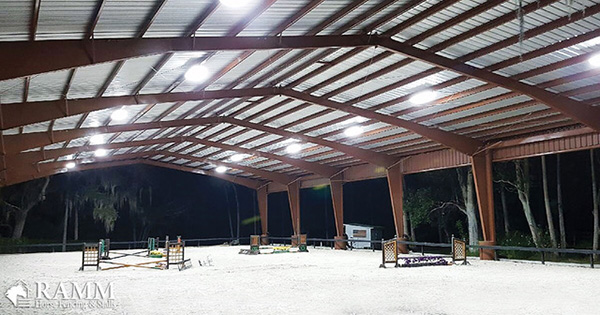
So many of HoopBarn's clients love a fabric hoop building for their riding arenas. The natural lighting and airy interiors are wonderful for riding, but this is where choosing the right width becomes especially important. For riding arenas, HoopBarn.com generally recommends staying at 60 feet wide or larger. A 60-foot building may work very well for certain types of riding, but if you have the room and budget, an 80-foot-wide arena gives you noticeably more freedom.
For many horse owners, an 80-foot building can be a very nice balance between riding space and cost. If you are building a larger training facility, commercial barn or simply want a more spacious arena, Rushmore's gable-style buildings begin around 100 feet wide. The beauty of these larger buildings is the open riding space, with no support posts running through the middle of your arena. For anyone who has ever ridden around columns, that alone is a wonderful thing.
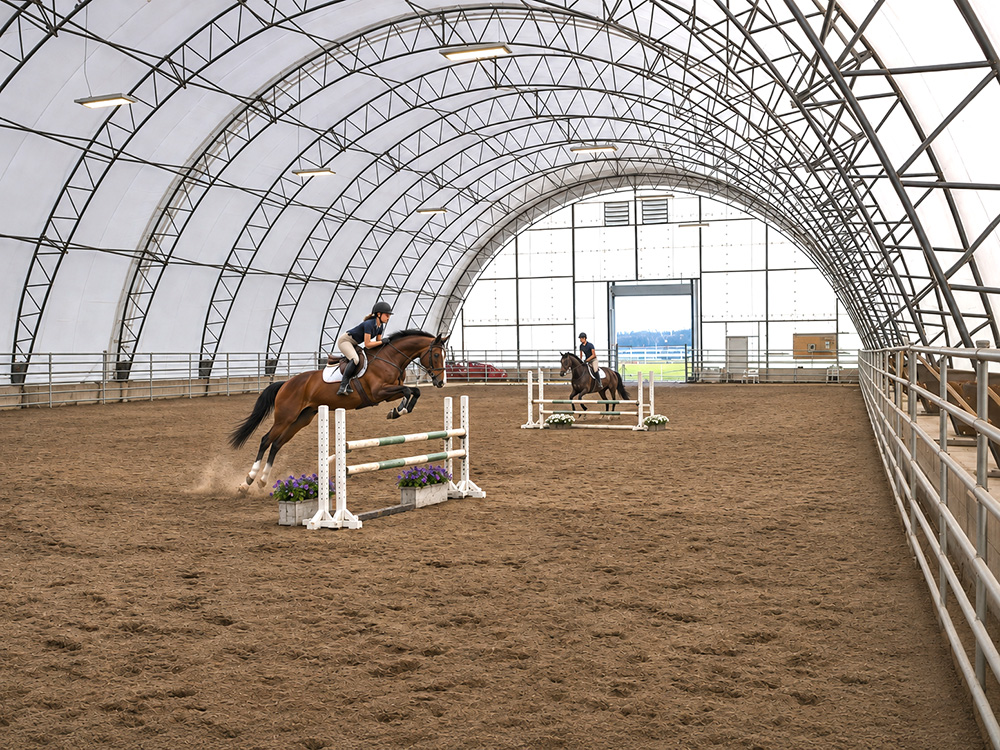
A 100-foot-wide clear-span building gives you serious riding room. Rushmore's 100-foot structure uses a welded steel truss system with a more traditional gable-style roofline. That allows it to create a very wide, open interior without filling the arena with support posts. You can also choose different building lengths and spacing depending on your property and how much riding space you want.
For a trainer, boarding facility, lesson barn or serious horse owner who wants room to ride year-round, this type of building can be a very attractive alternative to a traditionally constructed indoor arena. It gives you a lot of arena without necessarily bringing the same price tag as conventional construction.
Very well, and that is especially important when you are putting horses underneath them. Rushmore Buildings are manufactured in South Dakota, where buildings have to be able to deal with real wind, snow and cold. These are not lightweight shade structures, although HoopBarn also has those.
Depending on the building, truss spacing and engineering package, Rushmore structures can be built to meet substantial wind and snow-load requirements. For example, the 45-foot freestanding model is available with engineering for a 90-mph wind load and a 40-pound-per-square-foot snow load. Other models can be built for even heavier conditions.
This is one of the reasons you should never compare hoop barns based on price alone. Ask about the steel, trusses, rafter spacing, anchoring, fabric and engineering. When horses are living underneath a building, strength matters.
The standard covers are made from high-density polyethylene, or HDPE. The material is UV treated, waterproof and made to hold up outdoors through changing weather conditions.
HoopBarn's fabric is specifically designed to handle cold weather. It has strong cold-crack resistance and is used in areas that see serious winter conditions. Proper installation and proper fabric tension are still very important; like any building, the structure will perform best when it is installed the way it was engineered to be installed. These covers are made for long-term outdoor use, not temporary seasonal shelter.
Rushmore covers are backed by a 15-year prorated warranty, and they commonly perform well beyond that period when properly installed and maintained. Lighter-colored fabrics can have an advantage when it comes to long-term sun exposure, which is one reason they are often recommended when maximum lifespan is the priority.
Naturally, every building lives a different life. Sun, wind, installation, local weather and maintenance all play a role. But this is a long-term building membrane, not a tarp you expect to replace every few years.
A small tear does not automatically mean you need a whole new roof! Minor damage can often be repaired using the proper fabric repair tape, and on some buildings individual cover sections can be replaced rather than replacing the entire membrane. If something does happen, the best thing to do is reach out to the team at HoopBarn.com and let them help you decide the simplest way to fix it. They are happy to help you no matter where you got the building.
Yes, and this is one of the best things about the hoop-building concept. When the cover eventually reaches the end of its useful life, the steel frame does not simply become useless. Measurements can be taken and a new custom-fit cover can be made for the building.
HoopBarn can also help horse owners who already have an older hoop building from another company and simply need a replacement cover, and they do it all the time. So if you have a perfectly good steel frame with an old or damaged fabric cover, it may be worth talking with HoopBarn before assuming you need a completely new building.
HoopBarn prefers to say flame-resistant rather than simply calling any horse barn fireproof. Rushmore's standard covers are manufactured with flame-resistant properties, and specialized cover materials are also available for projects that need to meet specific flame-retardant requirements.
Because fire and building codes can vary depending on where you live and how the building will be used, this is something to discuss with the HoopBarn team when you order. They can help determine what type of fabric and building specifications are appropriate for your project.
Depending on the building, options may include roll-up doors, door headers, ridge vents, window vents, side curtains, awnings, end walls and different fabric colors. Horse owners should pay particular attention to ventilation: horses create moisture, dust and ammonia inside barns, and good airflow makes a huge difference in how comfortable the building feels.
If you are planning a horse barn, tell HoopBarn how many horses you expect to keep inside, whether the barn will have stalls, how much of the building will be enclosed and how you plan to use it. Those details help determine which ventilation options make the most sense.
Some horse owners can certainly build the smaller models themselves, especially if they are comfortable with construction and have the right equipment. The kits include building components, hardware and instructions. Once you start getting into the larger buildings, however, this becomes a much bigger project.
Large trusses, tall structures and wide-span buildings require equipment, proper foundations and people who know how to safely work at height. For the larger barns and riding arenas, professional construction is usually the wiser choice. The goal is not just to get the building standing: you want it installed, anchored and tensioned correctly so it performs the way it was designed to perform.
Yes. Rushmore Buildings are manufactured in Springfield, South Dakota. For the HoopBarn team, that is part of the appeal. They have spent many years around horse owners and farm products, and they are genuinely impressed with the quality of these buildings. They also like being able to work with a manufacturer that understands severe weather conditions and builds structures accordingly.
Working with the customer service team at HoopBarn means you get the best price and people who know horses. Buying a barn is a little different from ordering an ordinary farm product online. Most of us do not buy horse barns every year; you may only do this once or twice in your lifetime, so having someone help you think it through is valuable.
Are they turned out most of the day? Do you need stalls? Will you store hay under the same roof? Do you need tractor access? Are you building an arena, and what kind of riding do you do? How much room do you have, and what kind of wind and snow does your area get? Those are the questions that really matter.
The folks at HoopBarn have been serving the horse world for decades, and they understand that horse owners are trying to make practical decisions that work for both their horses and their budgets. They are enthusiastic about Rushmore Buildings because they believe these barns offer an unusually good combination of strength, usable space, durability and affordability.
If you only need a smaller horse shelter, you may find that a 30- or 32-foot building gives you everything you need. If you want a larger permanent barn with storage and working space, a 50-foot building may make more sense. If you are dreaming about finally having a covered riding area, start looking at 60- and 80-foot buildings. And if you are building a serious indoor arena, the 100-foot and larger Rushmore buildings deserve a very close look.
There is no single best hoop barn for every horse owner. The best one is the building that fits your horses, your property, your riding and your budget.
The people at HoopBarn have dedicated their lives to creating happy clients. They know horses, and they certainly know fabric buildings and all the benefits of owning one. Whether you need a simple pasture shelter, a roomy horse barn, more hay storage or the indoor riding arena you have been dreaming about, tell them what you have, what you need and what you would love to be able to do with the building.
They can help you compare building widths, lengths, structural options and prices so you are not buying too much building, or wishing a year from now that you had bought more.
A fabric hoop barn is a steel-framed building, built from heavy pipe or welded trusses, with a tensioned fabric cover over the top. The frame spans the whole width, so the inside is clear-span with no roof-support posts. Horse owners use them as run-in sheds, loafing barns, hay barns, horse barns with stalls and indoor riding arenas. HoopBarn.com sells the Rushmore line, made in South Dakota.
HoopBarn.com generally recommends 60 feet wide or larger for a riding arena. A 60-foot building works for certain types of riding, while 80 feet gives noticeably more freedom and is a nice balance between riding space and cost. Trainers, boarding barns and larger facilities can look at Rushmore's gable-style buildings, which begin around 100 feet wide with no posts through the middle of the arena.
For a small operation or a simple in-field shelter, a 30-foot single-pipe building can be an easy, economical choice. The 32-foot Rushmore truss building can be built with an open side so horses move in and out easily, and it is clear-span inside. A 50-foot low-profile building suits a more permanent horse barn, and most models can be made in many different lengths.
It depends on the building, truss spacing and engineering package. As one example, the 45-foot freestanding model is available with engineering for a 90-mph wind load and a 40-pound-per-square-foot snow load, and other models can be built for even heavier conditions. That is why you should compare the steel, trusses, rafter spacing, anchoring, fabric and engineering, not price alone.
Rushmore's standard HDPE covers are backed by a 15-year prorated warranty and commonly perform well beyond that when properly installed and maintained. The fabric is UV treated, waterproof and cold-crack resistant, and truss buildings typically use a heavy 12.5-ounce cover. Lighter-colored fabrics can have an advantage for long-term sun exposure when maximum lifespan is the priority.
Yes. When a cover reaches the end of its useful life, the steel frame is still good: measurements can be taken and a new custom-fit cover made for the building. HoopBarn does this all the time for older hoop buildings from other companies too. Small tears can often be fixed with the proper repair tape, and on some buildings single cover sections can be replaced.
Rushmore's standard covers are manufactured with flame-resistant properties, and specialized cover materials are available for projects that must meet specific flame-retardant requirements. HoopBarn prefers to say flame-resistant rather than calling any horse barn fireproof. Fire and building codes vary by location and use, so discuss the right fabric and specifications with the HoopBarn team when you order.
Some horse owners build the smaller models themselves, and the kits include building components, hardware and instructions. Larger barns and riding arenas involve big trusses, tall structures, proper foundations and safe work at height, so professional construction is usually the wiser choice. The goal is a building installed, anchored and tensioned correctly so it performs as engineered.
Explore more from the InfoHorse.com directory

Explore expert guides on topics related to your business
By Karen Elizabeth Baril
By Bob Pruitt
By Bob Pruitt
By Bob Pruitt
By Armour Companies
By Bob Pruitt