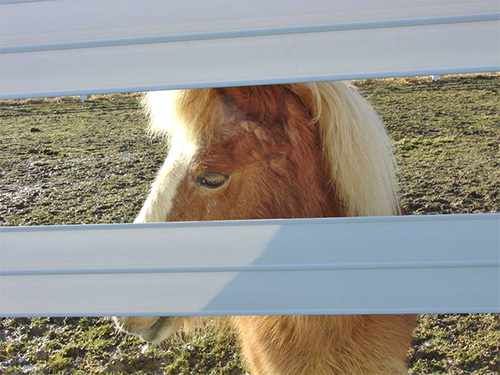
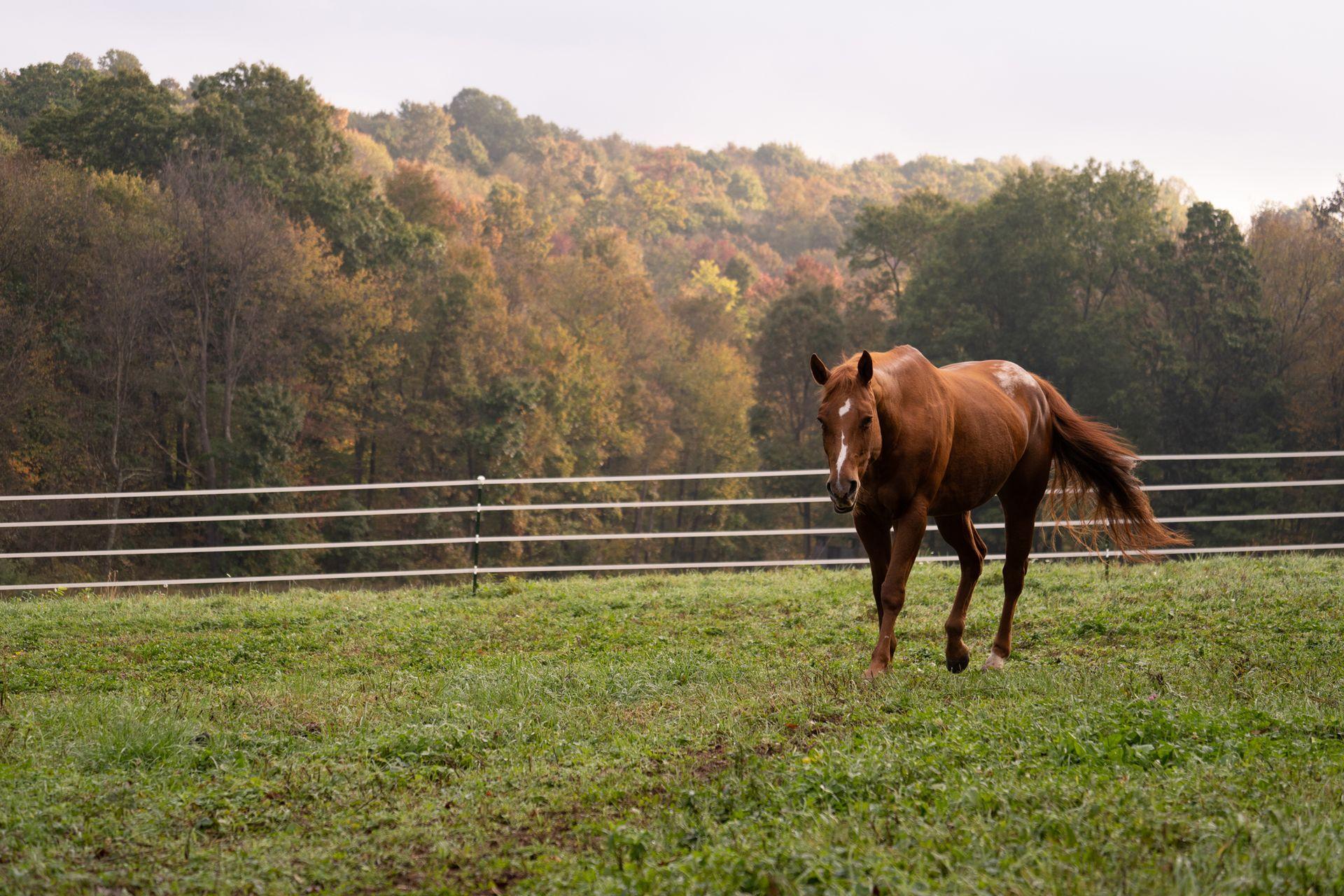


A turnout fence has three jobs, and a horse tests all of them at speed: it has to hold, it has to be read as a barrier before it is reached, and it has to be cheap enough per foot that you can run it around the whole property instead of one small paddock. Powerfields has been building to that brief for more than 25 years, from 344 Kendall Road in Blairsville, Pennsylvania. The company started as a niche manufacturer and grew into a full-line supplier carried by retailers across the United States, and it designs and builds what it sells — premium polytape and polywire, high-tensile wire, energizers, portable netting, and the insulators, hardware and tools that make the rest of it work.

This is the question worth settling before you buy anything, and Powerfields publishes the answer in its fencing-requirements-by-species guidance. Horses sit lower on that table than most people expect: 2,000 to 3,000 volts on the line is the working target, against 4,000 to 5,000-plus for sheep, goats, llamas and predators, whose insulating coats soak up the hit. The two recommendations beside the horse row matter at least as much as the voltage.
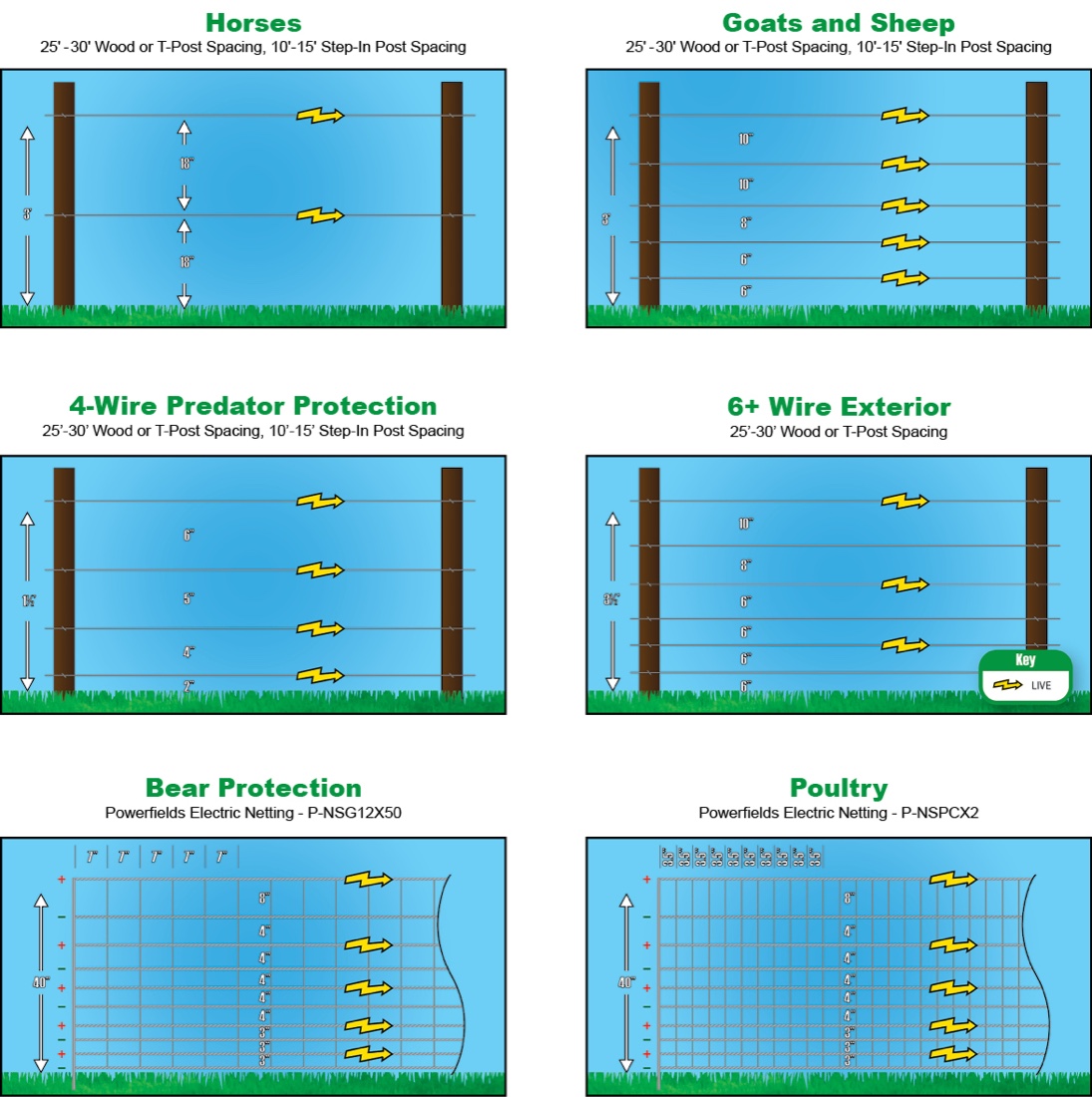
The first is high visibility. The second is that the bottom strand should sit about 18 inches off the ground — high enough that a pawing foot is unlikely to find it, low enough that a horse does not simply learn to graze underneath the fence line. Powerfields names polytape, polywire and rope as the safest conductors for horses, which is the entire case for tape over bare wire stated in one line.
Strand count is a question about the job rather than the animal. A perimeter boundary against a road carries more wires than an internal division between two known, settled horses, and mixed stock moves you along that table rather than straight up it. Cows sit on the same 2,000 to 3,000 volts as horses, at a minimum of one to three strands depending on disposition and pasture. A bull or bison is the step up — 3,000 to 4,000-plus volts and a minimum of four strands — and deer are the outlier, at seven strands and a six-foot height. The charts below are the short version, and they are exactly the sort of thing worth confirming against your own acreage before you order rolls.
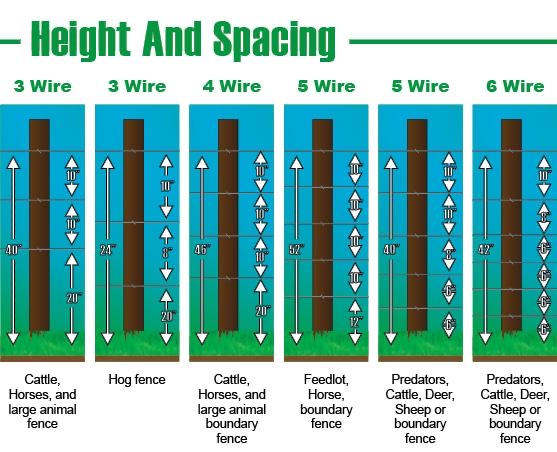
Spacing is the other half of the same decision. Wires bunched too closely waste tape; wires spread too far let a horse put his head through and treat the fence as a feeder. The reference below sets post intervals and wire heights for permanent and semi-permanent runs, with a layout drawn specifically for horses.
Safe-Fence 1½-Inch Polytape — Sizes, Colors And How Many Rolls To Buy
Safe-Fence is the horse line, and the conductor at the center of it is 1½-inch premium polytape. Width is the point. A horse traveling at speed registers an inch and a half of white webbing across his path; he does not register a strand of steel.
Rolls come in 200-foot and 825-foot lengths in white, black and brown — six catalog items in all, from the white 825-foot spool (H-3) through black (Z-3) and brown (X-3), with the shorter rolls stocked as R-3 in black and Y-3 in brown. The spool label carries the claim the line has been sold on for years — stronger than wood, safer than wire — and a note that it is proudly made in the USA.
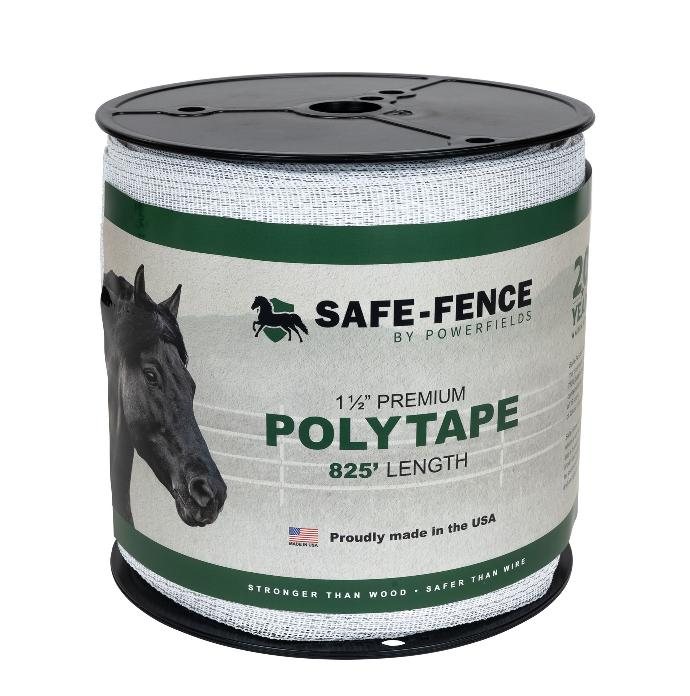
The 825-foot spool is the number to run your arithmetic against. A square five-acre turnout is roughly 1,870 feet around, so a three-strand boundary is about 5,600 feet of tape, or seven of the big rolls plus a spare for the gate openings and the mistakes. Do that sum before you call, along with a rough post count, and the conversation about what to order takes five minutes instead of three phone calls.
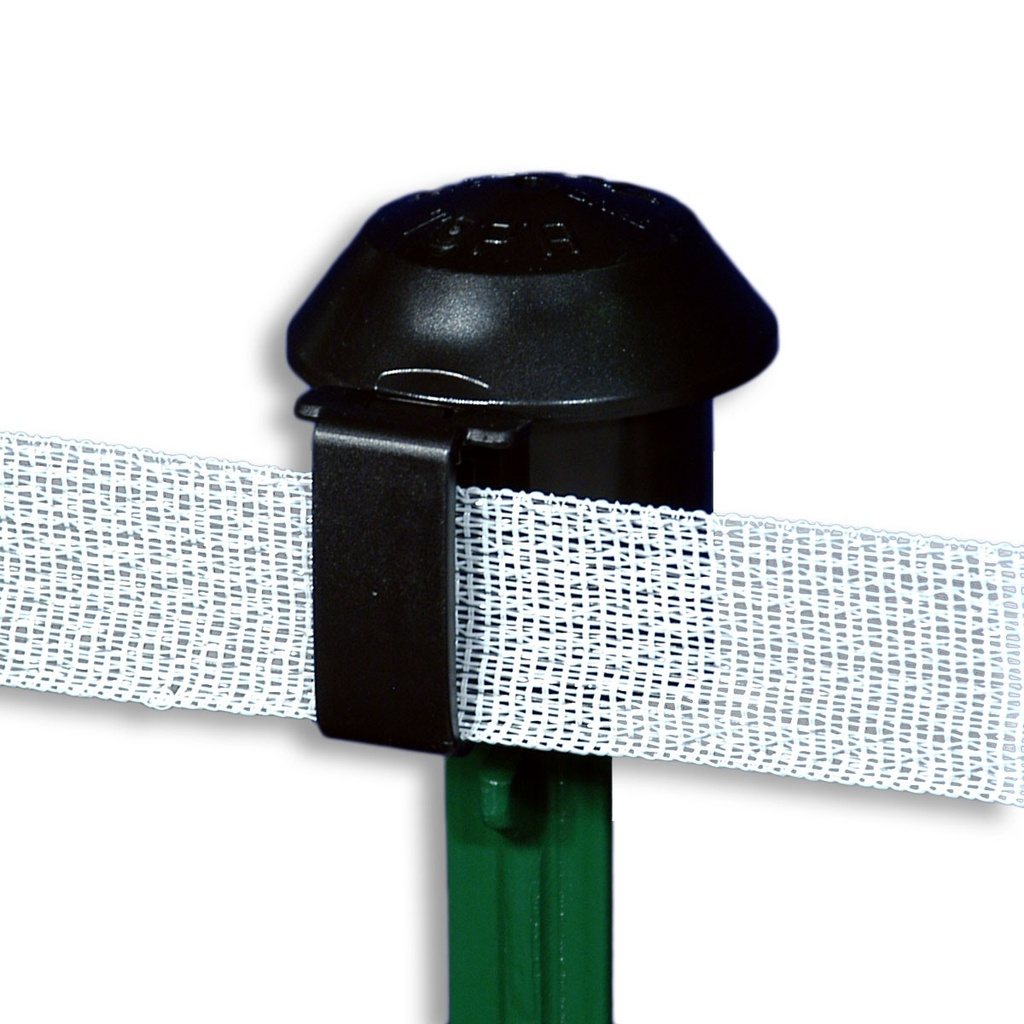
Tape is the visible part of a fence; hardware is the part that decides whether it is still tight in August. Safe-Fence insulators screw flat to the post and hold the tape open across its full width rather than pinching it into a rope, which is what kills conductivity and visibility together. The Safe-Fence category lists three: the Safe-Fence Insulator itself, the Rod Post Polytape Insulator (RP-25) for rod posts, and the T-Post Cap Insulator for steel T-posts. What comes in two versions is the fastener — stainless steel screws, W-16-C for wood posts and S-16-C for vinyl. Stainless is not a luxury on a fence that lives outdoors year after year.
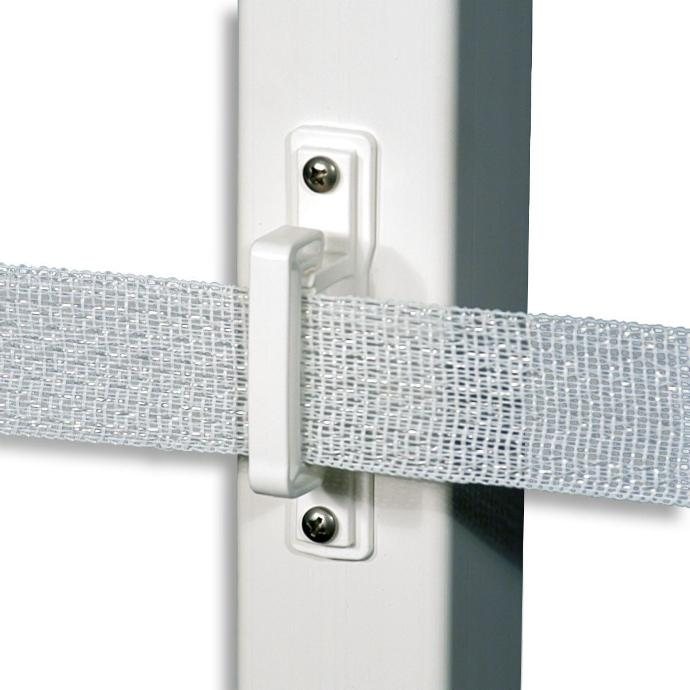
The rest of the system is the unglamorous list that decides how the fence ages. End and corner tensioners take up the slack polytape develops in hot weather, so a run that sagged in July can be pulled straight in ten minutes with a hex driver. The 1½-inch Polytape Splice Buckle (R-24-C4) joins two rolls without the knot that would otherwise become a dead spot. Pyramid caps and vinyl post sleeves in 2-inch and 4-inch sizes finish off post tops. And the T-Post Cap Insulator does two jobs at once: it carries the tape and it caps the top of a steel T-post, which takes the single sharpest object in most paddocks out of play.
What Size Energizer Do I Need, And What If There Is No Outlet?
Powerfields builds four families of energizer so the power supply fits the property rather than the other way around. The 110-volt AC units run from 0.5 to 2.0 joules plus dual-zone models for larger operations, and every one of them carries power-surge and radio-interference protection. The DC units run off a 12-volt external battery, with a deep-cycle marine-style battery giving the best results.
The AC/DC dual-input models accept either a 12-volt battery or 110-volt house current, which means a temporary fence can become a permanent one without buying a second energizer. Solar units carry an internal 12-volt battery trickle-charged by a built-in panel; mount one on a T-post or a south- or southwest-facing wall and it runs without an outlet anywhere in sight.
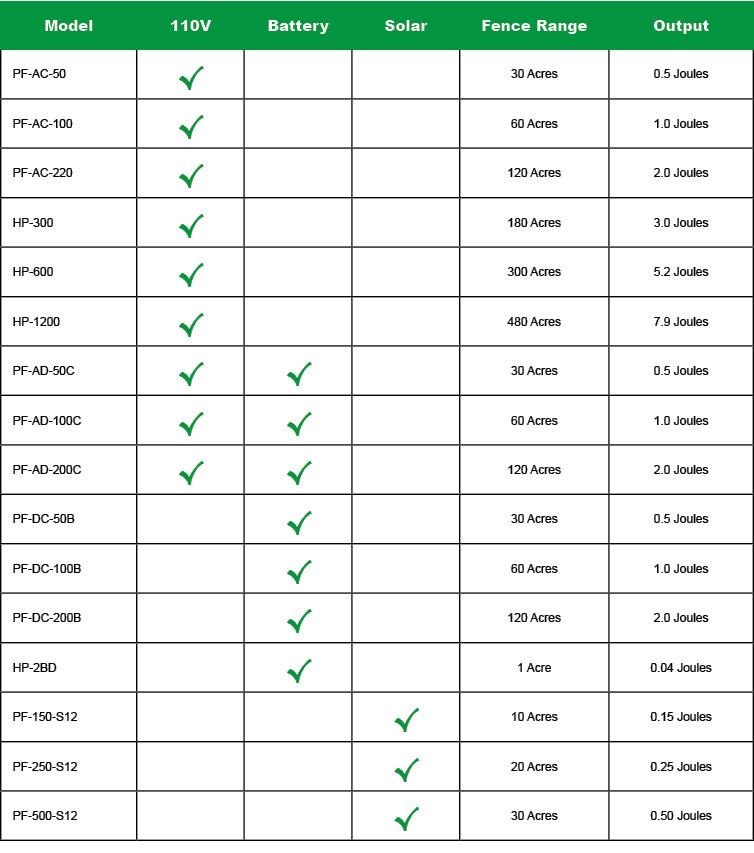
Named units run from the 0.5 Joule 12V (PF-DC-50B), the 0.5 Joule Solar (PF-500-S12) and the 0.6 Joule Portable 12-volt (PF-MB60), through the 1.0 Joule 110-volt AC (PF-AC-100), which the sizing chart puts at 60 acres, and its AC/DC twin (PF-AD-100C), up to the dual-zone HP-600 at 300 acres and the 12-joule dual-zoning Cattleman (HP-1200) for a large operation. At the small end of the chart sits the HP-2BD at 0.04 joules and one acre, which runs on two D-cell batteries in a wind- and rain-resistant case with a built-in fence hook.
Powerfields asks four questions when sizing: where the power is and where the fence is, what you are containing or excluding, how long the run is, and how many wires it carries. Grounding is the fifth, and the most commonly skipped — the ½-inch by 3-foot galvanized ground rod (P-MG3) and the 12-volt connection leads (PF-12VCL-1) are not optional extras. Every Powerfields energizer carries a 36-month warranty: 12 months of in-store exchange and 24 months of repair, covering failure from remote lightning strikes but not a direct strike on the unit itself.
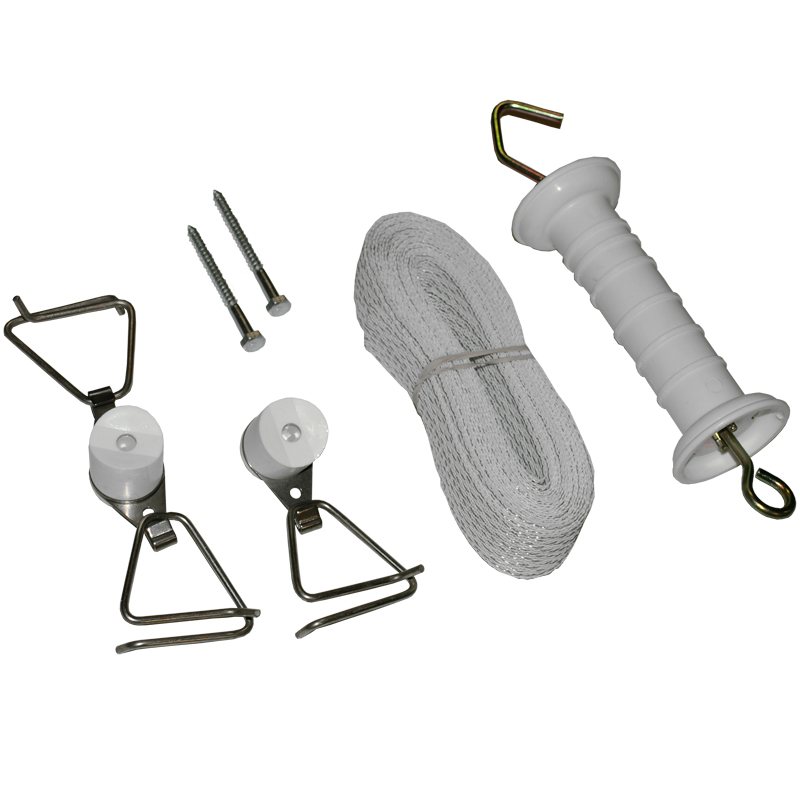
Nobody plans a fence around its gates, and everybody regrets it. The 1½-inch Polytape Gate Kit (R-22-W) carries the current across the opening in the same white webbing the horse already respects, and it arrives complete — gate handle, tensioners, hook plate and 20 feet of polytape — so the gateway gets built rather than improvised out of baling twine and hope. For a steel tube gate, the 2-Way Gate Latch (P-GL2W) lets the gate swing either direction and helps stop the latch end sagging, and you can open it from the saddle with one hand, gloves on, without setting down a lead rope; a 1-Way Gate Latch (P-GL1W) covers openings that only need to swing one way.
Where the opening changes width — a temporary alley, a rotational-grazing lane, a spot you drive a truck through twice a week — the Electric Bungy Gate Kit (P-BG) uses a high-visibility red-and-white cord that stretches from roughly 8 feet to 16 feet with a heavy-duty handle on the end.
Permanent fence is permanent. Electric fence is an opinion you can change. That is what makes it the practical tool for resting a grazed-off section, holding a horse back off spring grass, or turning an easy keeper onto a narrow lane rather than the whole forty acres. The Loaded 3:1 Geared Reel (P-RRK3-1320) is built for the job: it arrives loaded with 1,320 feet of braided electric twine carrying nine stainless-steel conductors, hangs directly on the perimeter fence, and the 3:1 gearing is what turns retrieving several hundred feet of line from an afternoon into a chore you will actually keep doing.
The 9-Wire Polywire (EW936-1320) is the black-and-white alternative, more visible than plain white against snow or dry summer ground, with the same nine stainless conductors. Powerfields offers three styles of polywire in total, and all of them pair with step-in posts and a battery energizer for a division you can put up and take down in a morning. Where a division has to hold hard-to-keep stock on a large property, Hot Rope steps up to a 1,000-pound break strength and Hot Braid to 1,200 pounds, built on a polyester core with a polyethylene outer braid and nine strands of 8-mil stainless steel wire.
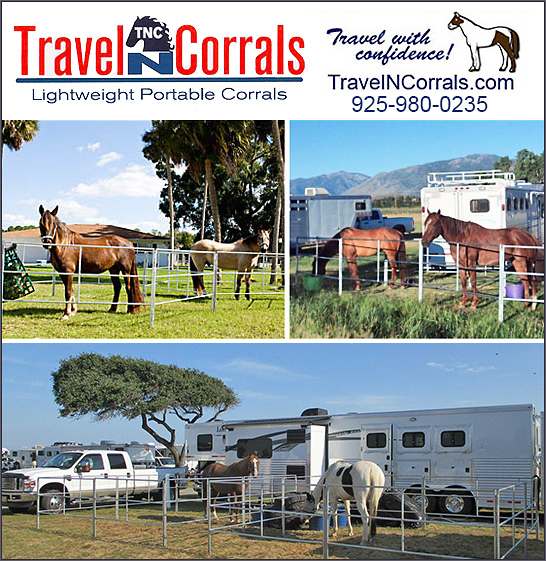
The PF-R-60 Portable Polytape Corral is the answer for anyone who camps with horses, hauls to clinics, or spends a night away at a show and would rather not depend on whichever pen happens to be free. It builds an enclosure of roughly 50 feet by 50 feet from 200 feet of 1-inch polytape, and the kit includes eight two-piece treaded posts, adjustable insulators, corner tie-downs, a ground rod, a lockable rewind reel and the Powerfields Trail 2 D-Cell Fence Charger. The whole system packs into a rugged carrying bag at about 18 pounds — light enough to live behind the trailer tack door permanently rather than being loaded only for the trips you remember it on.
Plenty, and it is worth knowing because most horse properties are not only horse properties. The line runs from 12½-gauge 180 KSI high-tensile wire and coated wire through crimp sleeves in 12½ and 14-16 gauge, wire links, Gripple joiners, 1½-inch barbed staples, 10-inch brace pins, earth anchors and portable post drivers. Portable fencing covers electric netting, sheep netting and poultry-and-goat netting, each net drawing about 0.25 joule; the Electric Poultry Pen is positive/negative netting, which means it works without a ground rod — useful on dry summer ground where grounding is hardest — and the pen is marked with a five-year warranty.
Roll lengths across the wider catalog run 50, 100, 250, 330, 500, 660, 1,320, 2,000 and 4,000 feet, and the online store filters by color as well as length.

What Does It Cost To Think About, And Where Do You Buy It?
Powerfields sells through authorized dealers across the country rather than only online, so the Where to Buy locator on powerfields.com is the first stop; the online store also lists the full line and sorts by price if you want to see where a component sits before you call. For budgeting, three numbers drive the total: rolls of tape (the perimeter multiplied by your strand count, divided by 825), one insulator per strand per post, and a single energizer sized once and correctly.
The energizer is the place not to economize, because an undersized unit is the usual reason a fence reads low on a tester and a horse learns he can lean on it. The site also carries the virtual catalog, warranty registration, installation instructions and a troubleshooting section worth reading before you decide a fence has failed.
The fastest way through all of this is to describe the job rather than shop for parts. Four horses on six acres with a road on one side. A dry lot to build. A pasture to split three ways. A trailer that needs a corral in it by Friday. Powerfields customer service is at , vendors and suppliers, the fax line is, and email reaches them.
The address is 344 Kendall Road, Blairsville, Pennsylvania 15717. Give them the acreage, how many head are turned out on it, what power you have at the fence line, and whether this run is a boundary or an internal split. More than 25 years of fencing experience then does the specifying, which beats guessing at a shopping cart.
SAFE-FENCE is a 1½-inch electric polytape system made for stand-alone horse enclosures. Its wide, visible tape combines stainless-steel conductors with UV-stabilized polyethylene, and Powerfields offers the matching tensioners, insulators, splice hardware and gates needed to build it as a complete system.
The wide tape gives horses an easier-to-see boundary while its woven conductors carry the energizer’s pulse. Powerfields also designs matching splice buckles and tensioners so damaged or stretched sections can be repaired or retightened without replacing an entire fence line.
Powerfields offers 110-volt AC, 12-volt battery, AC/DC dual-input and solar energizers. Match the unit to the available power source, total fence length, number of strands and what the fence must contain or exclude. SAFE-FENCE must be used with a low-impedance energizer.
A typical plan includes polytape, line and corner or end insulators, tensioners or splice buckles, gate hardware, an energizer, lead-out connections and a properly designed ground system. Use Powerfields’ installation manual to match the components to your posts and layout before ordering.
Powerfields says correct installation with SAFE-FENCE hardware is required to preserve the system warranty. Its terms also require correct tape tension, post spacing within the published limit and a low-impedance energizer, so review the current manual and warranty before substituting components.
Powerfields recommends testing the energizer with the fence disconnected, then checking the line for broken material, damaged insulators, vegetation contact and dirty connections. Inspect the ground rods as well; dry soil and poor grounding can reduce performance. Use a fence tester and follow the company’s troubleshooting sequence.
Yes. Its portable polytape corral creates an approximately 50-by-50-foot enclosure using 200 feet of 1-inch polytape, eight two-piece treaded posts and a Trail Fence Charger. The kit also includes tie-downs, adjustable insulators, a ground rod and carrying bag, and Powerfields lists the packed weight at about 18 pounds.
Explore more from the InfoHorse.com directory
Explore expert guides on topics related to your business
By Bob Pruitt
By Karen Elizabeth Baril
By Bob Pruitt
By Karen Elizabeth Baril
By Bob Pruitt
By Karen Elizabeth Baril