

How CBD Can Help Your Horse's Health
By: Maryanna Savage Phinn & Dr.
Joyce Harman for Doc's Hemp
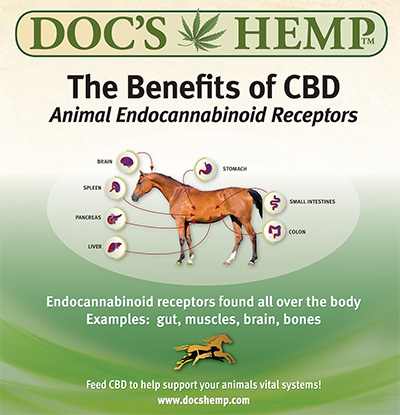
CBD supports a horse’s health by working with the endocannabinoid system, a cell-signaling network found in practically all mammals that helps maintain balance across the body’s major organs—including the gut. CB1 and CB2 receptors throughout the digestive tract respond to cannabinoids like CBD, which may help stabilize digestion and relieve gut-related discomfort, and a University of Bologna study found a wide distribution of cannabinoid receptors in the horse’s intestines. Because hemp-derived CBD must contain less than 0.3% THC by U.S. law, it offers these benefits without the psychoactive effect of marijuana.
The endocannabinoid system (ECS) exists throughout the bodies of horses, dogs, humans and practically all mammals. It impacts every major biological system within the body, including the “gut” or gastrointestinal tract. Its main role is to maintain balance or stability, often called “homeostasis” within the body and affects all major organs. Cannabinoids such as CBD (cannabidiol) naturally occur in the body.
ECS is an intricate cellular signaling network that basically communicates with CBD and other cannabinoids via two primary receptors called CB1 and CB2. Cannabinoids are used by ECS to stabilize gut functions, as well as other bodily functions. Phytocannabinoids derived from the cannabis plant hemp, also stimulate ECS. The gut can benefit from CBD extracted from hemp via ECS or phytocannabinoids when it binds to the receptors and helps relieve or stabilize problems related to the gut.
The Endocannabinoid System and the Gut
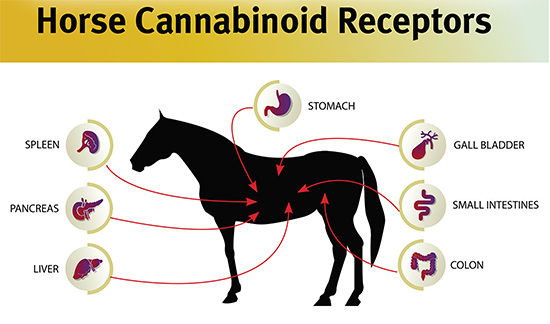
The digestive tract’s main functions in horses and all mammals are to digest and absorb food and eliminate waste. The digestive tract uses all of its primary parts to achieve these goals including the mouth, pharynx, esophagus, stomach, intestines, rectum and anus. ECS helps support normal digestive functions and maintain well-balanced “good” microorganisms and bacteria living in the intestines.
CB1 and CB2 receptors are found throughout the digestive system to support and maintain digestion and healthy bowel functions and help with gastric distress. As food is ingested, digested and eliminated, ECS supports normal muscular movements of the digestive tract through each of these phases. Gut-related disorders or irregularities such as diarrhea, constipation, abdominal pain, bloating, flatulence, loss of appetite, nausea, vomiting, irregular bleeding or regurgitation can be extremely challenging and uncomfortable for horses. It is equally challenging for horse owners who are searching for options to help relieve these problems.
The ECS works with naturally occurring cannabinoids within the body. Cannabinoids such as CBD for horses can be fed in hemp-related products and may be a tool to help with a horse’s gut problems.
ECS and the Brain-Gut Axis In the early 1990s, scientists discovered the endocannabinoid system and named it after the cannabis sativa plant, primarily the hemp and marijuana species, after research on cannabis led to its discovery in mammals. Many commonly used expressions such as “my gut instinct” or “butterflies in my stomach,” have relevance to ECS and the gut-brain connection.
Amazingly, these expressions have a real scientific basis. Scientists have known for many years that there’s a direct connection between the brain and the digestive system, called the “brain-gut axis.” This dual communication system from the brain to the gut has major implications for physical and mental stability in animals and humans alike.
Billions of neurons or nerve cells in the brain send and receive messages to the body and its immune system. Millions of nerve cells in the gut communicate through the vagus nerve within the nervous system which is the primary connection from the brain to the gut. CB1 and CB2 receptors within ECS play a main role in signaling the brain-gut axis to help with conditions that affect the gut such as stress, anxiety, nausea, vomiting, gastrointestinal pain, diarrhea, anorexia, obesity that horses experience.
Research Growing on Gut Health and CBD Research is growing significantly in the United States and worldwide on ECS and CBD in animals and humans as laws governing hemp and marijuana change. CBD derived from hemp has many useful purposes related to its health and wellness benefits. CBD from hemp does not give an animal or person the psychoactive effects from THC which is the main ingredient in marijuana that gives the “high” effect. CBD from hemp has only trace amounts or no THC, and by law in the United States, it must contain less than 0.3%.
A recent promising study conducted by researchers at the University of Bologna in Italy analyzed the distribution of cannabinoids and various cannabinoid receptors at the cellular level in the ileum, which is a section of the horse’s small intestine . The study demonstrated that there is a wide distribution of cannabinoids and cannabinoid receptors in the horse’s intestines. This finding may have beneficial implications for colic or abdominal pain and other digestive disorders. The study was conducted on six healthy horses at the slaughterhouse and published in the Journal of Equine Veterinary Science.
The good news is that research such as this on animal and human health-related supports for improving digestive and brain health, such as Doc’s Hemp CBD products, will likely increase and trend in a positive direction over the next decade. Horse owners and trainers considering trying hemp products for their horses, particularly to help with problems such as gut and gastrointestinal problems, should spend some time learning more about effective products.
A good start is to watch an episode on Doc’s Hemp YouTube channel called What is All the Hype about? Hemp and CBD. It’s important to understand the differences between hemp and marijuana especially as it relates to the amount of THC in each plant. Hemp plants have many nutritious properties from its rich compounds -- without THC or with only trace amounts. Hemp provides the naturally occurring benefits of not only CBD but also other healthy cannabinoids such as CBG, CBE and CBT in addition to flavonoids which are antioxidants, and terpenes which are other healthy components of the plant.
Whatever you decide to purchase and try related to hemp and CBD products, do your research and make sure the products, like those available at Doc's Hemp, meet your horse’s health needs. Another very important point is to make certain the final product is verifiably third-party tested, has a certificate of analysis and uses the highest quality consumable hemp plant, preferably grown sustainably in the United States that are free of toxins, chemical fertilizers, heavy metals and pesticides.
[i] Overview of the Digestive System by Atenodoro R. Ruiz, Jr., MD, The Medical City, Pasig City, Philippines; Last full review/revision Oct 2019| Content last modified Oct 2019.
[ii] The Endocannabinoid System and the Gut. March 25, 2019 by Jacqueline Jacques.
[iii] Wiley JW. The Role of the Endocannabinoid System in the Brain-Gut Axis. Gastroenterology. 2
[iv] The Gut-Brain Connection: How it Works and The Role of Nutrition. Written by Ruairi Robertson, PhD; Updated on August 20, 2020.
[v] https://pubmed.ncbi.nlm.nih.gov/25715910/; Malik Z, Baik D, Schey R. The role of cannabinoids in regulation of nausea and vomiting, and visceral pain.