

Why Go to Animal Massage School?
Taking the reins of your life firmly in your hands and making the decision that is the absolute best for you! Written by Callie Rulli of the Rocky Mountain School of Animal Acupressure and Massage
Attending an animal massage school matters for three big reasons—legality, scope of practice, and knowing what lies beneath the skin. What a massage therapist may legally do varies state by state: some states permit only licensed veterinarians to perform massage therapy, others allow practice under a veterinarian’s supervision, and others allow it once you hold a certification from a recognized school. Reputable programs also teach in-depth anatomy and pathology, so you know when it is—and is not—okay to massage an animal.
Sitting down with coffee in hand at your computer, you realize that you really want to work with animals in some capacity. Actually, you decided this a while ago but now you are ready to make the commitment to do some research on the topic. Working with animals…think harder…okay, you want to help them feel better. What different avenues are there to help them feel better? After exploring the possibilities you land on the one that really reels you in: massage.
Having your hands on the animal, being part of the team that helps keep them happy and in good quality of life, sounds ideal. So…what now? What is involved with getting from here- sitting on my comfy couch with coffee, to running my animal massage business? Furrowing your brow at the computer, you realize being educated on the topic is probably a good idea. Taking the plunge to begin a career in the animal massage industry can seem a bit overwhelming, whether this is your first time envisioning a career for yourself or changing from one you are already pursuing.
There are many different options to consider: what species do I want to work on? What schools specialize in those areas? What kind of time commitment am I willing to make? These are the questions the logical side of our brain starts firing off. On the other side of our brain we get questions like am I too old/young for this? My background was never in this subject area…what if I don’t understand it? What if I start out loving it and then decide it’s not for me?
Let’s think about the latter conversation with your brain. This industry is made up of people from all areas of the age spectrum; so long as you want to be passionate about your life and career and are excited to learn, age is just a number! The beauty of institutions that teach animal massage is that they are comprised of founders, instructors, staff, and workers that come from all backgrounds and walks of life.
This means that there is going to be someone, at least one out of that whole matrix of people, that you resonate with and can easily learn from. Many people had zero background in this subject area before beginning their own journey, as is natural with anything in life. Should you decide to pursue a career in animal massage, you might realize while doing so that it isn’t the career for you.
The incredible thing about an experience like that is that you know what you don’t want to do, which is just as important as the opposite!
There may be something you covered in class that really resonates with you, and that’s the avenue you decide to explore instead; awesome!
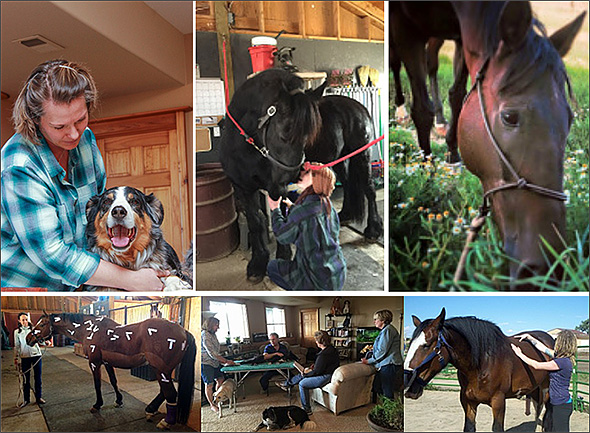
Now back to what your brain was first thinking about, the more logic-based questions. In regard to what species you would like to work with, some people are very comfortable with dogs and some with horses, and some prefer both. That’s a question you should be able to reason through pretty quickly, as both dogs and horses have their easy aspects and more difficult ones as far as massage is concerned.
Make a list of the pros and cons for working with a species if you are not sure about it, but remember that comfort level and skills will grow in time. This means that you may want to work with horses down the road, but while building your skillset you feel comfortable just working with dogs for the time being. Totally doable. The next question is also easy to answer, as a quick internet search will readily show you what schools are available that teach the program you are interested in. Some schools focus on one species or modality, and some have a wide range of offerings.
Deciding how much time you can commit to the education
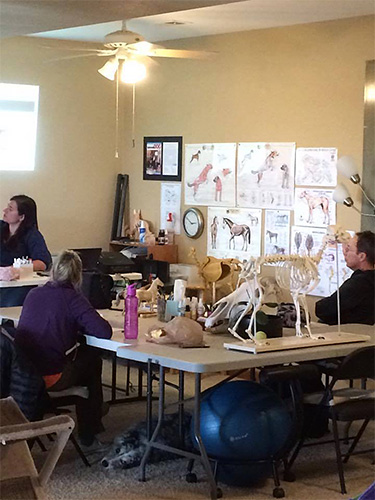
process is also key in making the decision for what school you’d like to attend. As the nature of massage is hands-on, many people opt for on-site programs where they have many opportunities during the duration of the class to have their hands on animals. The length of program varies by school, as well as when the courses are offered during the year. There are a variety of locations of schools around the country (and world), and many schools have satellite locations.
Animal massage programs are designed to teach you a marketable skill, and are not typically set up like standard higher education institutions. One course may last a week, and you travel to the location of the school and stay in that area while you complete it. Many schools help students find affordable lodging nearby to make their stay easier.
This can be a great option for those that are able to take a week or so off from current jobs or be away from home. It can be a way to see some areas of the country that you may have never been to before!
Newer on the horizon are schools that have seen great success in their onsite programs and are now also branching into long-distance or correspondence programs. Students might opt to do one level or class on-site, and then future classes or levels through correspondence after their confidence and skill set has begun to grow. Or there are those that are great at working on their own in a self-paced manner.
Correspondence programs offer interaction with the instructors through email, webinars, videos, tutorials, video chats, and more to ensure that students studying from a distance feel as part of the school and learning process. Students are also typically able to travel to the school if they so desire for one-on-one time with an instructor. Send an enquiry email with your questions to the schools you are interested in.
They have awesome people with the answers to your questions, and answers to some you may not have thought of! They can make sure you have the most updated information on their courses so that you are able to make the best decision for you to find what is the best fit. Check out their websites and social media pages to see what other people thought of their experience at the schools.
With so much information out there, it can seem overwhelming when you are looking into attending an animal massage school. A final question that pops up is ‘do I really need to go to school for this? Can’t I just figure it out as I go?’ Great question: why attend school to become an animal massage therapist? Legality, scope of practice, and knowing what lies beneath the skin are the heavy-hitting answers
First let’s think about legality. What an animal massage therapist is legally allowed to do varies state by state. In some states only licensed veterinarians may perform massage therapy. Others allow massage therapists to work under the direct supervision of a veterinarian. Others allow for legal practicing so long as the massage therapist has obtained a certification from a recognized school. If you were practicing against the laws of your state, you could be assigned a cease-and-desist, meaning you are shut down. It is very important, therefore, to understand how the laws of your state work, and how being certified keeps you on the happy side of the law.|
Scope of practice is a huge area of concern for massage therapists. This is also an area where cease-and-desists can be
issued by the state veterinarian board. The term “scope of practice” means that we stay within our area of knowledge, legally and morally. Massage therapists do not treat, diagnose, prescribe, or cure illnesses. They do not replace the care of a veterinarian. This may seem very simple in concept, but the more you become immersed into the language and actions, lines may begin to blur.
How you write up a report can be a breech in scope of practice. How you interact with a client, or the client’s veterinarian, can be a scope of practice issue. Going through the education process with a recognized school means that you will learn the “do’s and do not’s” for being a massage practitioner, and help you to be confident that you are staying well within your scope of practice.
Finally, knowing what lies beneath the skin may appear obvious, but the body is a very complex thing. Reputable schools offer in-depth anatomy and pathology portions of their courses so that anatomy pros and newbies alike can benefit from the modules. It is imperative to know and understand the systems beneath your hands, for it is possible to cause damage if you are unaware of the situation.
Knowing when it is and is not okay to massage, based on anatomy and pathology, is something clearly learned through the education process. Also important to learn is how to interact with the client’s veterinarian when the client has certain conditions. When should I consult with their veterinarian? Is it okay to just go ahead and massage? This is an imperative part of animal massage.
So as you finish up the last bit of coffee in your mug, you look at the pad of paper or Word document where you’ve been taking notes and feel much more confident in your decision to pursue animal massage. You have locations, numbers, prices, contact information, and a much better feel about the whole process. What’s left? Taking the reins of your life firmly in your hands and making the decision that is the absolute best for you.
Contact: Our Friendly Staff P.O. Box 1470 Elizabeth, Colorado 80107 Phone: 1-866-903-6462 or 303-660-9390 Email: [email protected] Website: rmsaam.com