

Advantages of Wool for Horse Tack
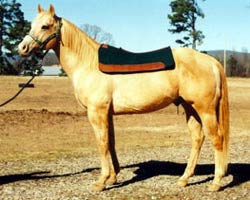
Wool, The Natural High Tech Material by Mike Easton 5 Star Equine Products Content Review – DR. Joyce Harman, DVM
Wool outperforms synthetic saddle pad materials because each hollow fiber wicks sweat away from the horse’s back while absorbing up to 30 percent of its own weight in moisture—cotton absorbs up to only 8 percent and synthetics usually less than 5 percent—whereas open and closed cell foams have no wicking ability and simply trap moisture and heat. Wool’s natural crimp creates millions of air pockets that give it insulating properties and the ability to stretch and bounce back to its original shape, making it a superior compression protector.
Veterinary research using a Forced Sensory Array machine found that pressed wool felt with high virgin wool content provides the best compression, wicking ability, and heat reduction of all materials on the market.
In the equine world it seems that each year we are presented with new ideas about training, health care requirements, and tack. Some of it is a new twist to old ideas or a new twist with a new idea or simply nothing has changed – just a marketing ploy.
Technological advancements in the fields of chemistry and physics created many materials. These materials seem to have endless benefits, as long as the application is correct and does not create harm. Open and closed cell foams are some of the modern space aged materials, but when applied to the equine world are they correct?
The design intent of foam was to provide a new material for compression protection, using inorganic raw materials. And a high percentage of these foams came as a result of the Nasa space program. When various individuals decided that these materials could have beneficial use in the equine industry, product development arose out of an idea, which was good in principle only.
In reality the new product was developed and marketed without testing by reputable scientific sources to prove whether the product had natural therapeutic benefit and structural fit for the intended activity. Instead these new product developers presented new products to the public based on personal bias and testimonials. And in most instances profit margins and retail cost became the selling points.
One such incidence of product abuse has been in the area of saddle pads. High tech fibers, open and closed cell foams, air filled pockets and layered combinations. These materials could be presented in bright colors, soft to the touch, and have a feel of real comfort. These became instantly popular because individuals involved in the show world could provide additional flash and those not involved could have the same flash at less expense. Companies with access to large sums of marketing dollars could now be a driving force.
But in the age of modern miracle fibers and foams, scientific research supports that the almost forgotten fiber made by God still remains the original high-tech fiber. That material is Wool.
The old-timers in the tack world used wool for years and had great success with it. Even the avid modern day hunter has found that all the high tech fiber in the world does not surpass the attributes of wool. Especially when it comes to socks, which is equivalent to the saddle pad in the equine world.
Today’s sportsman and equine owner are learning what sheep in the hottest and coldest climates of world have known for thousands of years. When it comes to thermal-regulation and all-around protection performance, Wool, the original high-tech fiber, is still unmatched.
The secret to wool lies in its complex cellular structure. Each hollow strand is engineered to trap heat while resisting the buildup of moisture. Every follicle of wool is made up of a hydrophobic (water-hating) exterior shaft and a hydrophilic (water-loving) inner core. This gives wool the unique ability to wick perspiration (sweat) away from the body and at the same time shed moisture.
This is why you can’t mop up spilled water with a wool cloth. And at the same time it is why wool can absorb up to 30 percent of its own weight in perspiration/water vapor; cotton can absorb up to only 8 percent of its weight; synthetic usually less than 5 percent of its weight and has very limited wicking ability.
A contradiction certainly seems apparent with wool not being able to mop up spilled water and yet is still able to absorb 30% of its weight in perspiration/water vapor. Moisture transport in textile materials is the same as wicking in capillaries. Capillary wicking is determined by two fundamental properties of the capillary: Its’ effective diameter, and the surface energy of its’ inside face (such as the inner core of a wool fiber – see diagram above). The smaller the diameter or the higher the surface energy, the more readily water moves up the capillary.
This combination of both diameter and surface energy differences results in a strong wicking gradient between the inside and outside of the felt. This allows for sweat to be picked up from the skin and be pulled to the outside face of the wicking gradient (outer edge and surface of the pad).
When textiles materials are woven together the spaces between fibers create a pattern that functions like capillaries. The closer fibers are packed together in fabric, yarns or felt, the smaller the apparent capillary diameter, and the more readily wicking can occur. In other words, it is just like two magnets, the closer they get to each other with the correct polarity the stronger their magnetic attraction. Other fiber properties that play a supporting role in capillary action are fiber diameter, cross-section structure, crimp and stiffness.
Because of the structure of wool, the surface energy (measure of attraction between water and the internal surface of the capillary) is very high. This hydrophilic – “water-loving” component is the aspect that delivers sweat and heat away from horses or mules backs and through the pad.
The “hydroscopic” aspect (moisture adjustments in response to changes in humidity) of natural fibers is greater than that of synthetic materials, but it is not relative to any arguments that relate to the strength of natural fibers for moisture transfer in saddle pads.
Wool’s unique ability to deal with perspiration is ONE OF THE Important components of limiting sores or the severity of a sore from a pressure point of an improperly fitted saddle or piece of tack. Wool’s ability to wick sweat away from the body leaves the skin dryer and cooler than other materials. Under a saddle, the primary problem is one of constant pressure in areas where the saddle fits poorly. Pads of a variety of materials are often used to try and alleviate these pressure points with no thought given to heat removal. The problem with most materials is that pressure is transferred through the pad to the horse’s back and is often made worse after adding the pad.
Another Important aspect of wool is the ability of a one-inch thick piece of wool felt to contain and limit pressure points. When there is a pressure point, damage to the underlying skin and muscle occurs. Swelling of the skin, and edema or fluid under the skin or in the muscle, occurs as the bruising causes fluid to leak out of the cells. When you eliminate bruising, you eliminate the swelling and pain that goes along with it.
In humans, wool has long been known for its ability to prevent blisters. Blisters are formed from friction, and sometimes from pressure and friction together. During blister formation, heat can build up, and it is known that wool reduces the severity of blisters by dissipating heat and pressure.
The point being, wool socks can’t eliminate the blister, but it will reduce the initial impact and severity of the injury before one decides to do something about it. Nothing replaces a shoe that is correctly fitted, but we can’t always afford to replace shoes once the mistake has been made, so we must do the next best thing – pad our feet correctly. Also, Nothing replaces a correctly fitted saddle!
Synthetic materials, fibrous, open and closed cell foams, trap heat and do not wick and increase the chances of heat related pressure sores. Also, they have limited compression protection. Their strength lies in ease of cleaning, reduced saddle slippage in some cases and colorful patterns.
Unlike synthetic materials, wool fiber contains hundreds of tiny waves, called crimp, creating the millions of air pockets that give the fabric its insulating properties and ability to breath. It is this same component that allows wool to stretch up to 50 percent when wet, 30 percent when dry and still bounce back to its original shape. It is this natural physical property that makes wool such a superior and beneficial compression protector.
If “open and closed cell” foams are stretched, they begin to break down immediately because their molecular structure has memory constraints of less than 5% before they begin to break down and tear apart. These same materials also break down much quicker than wool when subjected to heat, sweat salts and pressure. Despite the influx of new fibers and foams being introduced into the equine world, Wool continues to hold its own and be a main stay for top saddle makers and equine professionals that care about their animals well-being.
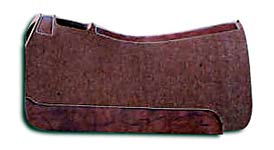
Through research, Dr. Harmon used the Forced Sensory Array machine just like Dr. Collier. They found pressed wool felt with high virgin wool content providing the best compression, wicking ability and heat protection (reduction) of all materials on the market today.
Dr. Harmon’s original research stemmed from years of studying the correct mechanics of saddle fitting and bio-mechanics of saddle placement. In a nutshell, what they found and what Dr. Collier pointed out later was, a “Shoe is to Sock” as “Saddle is to Pad” analogy. Without putting a correctly fitted saddle with a correct type of pad, no horse, mule or donkey is free from compression related injury that stems from saddle pressure points.
When pads are added under a saddle, the saddle must still fit the horse with the pad in place. If a saddle basically fits with the pad, then a pad can enhance the situation. If a saddle is too narrow, no pad will solve your problem any more than a thick sock will correct the fit of those pinching dress boots you have in the back of your closet. If a saddle is a bit too wide, a thick pad can really help the situation, IF it is made from material that will not compress much (wool and some of the dense types of foam). However, if a saddle is very much too wide, it will continue to tip forward through any pad.
So how can you tell what is going on with your pad and saddle? Saddle up your animal with its new pad, making sure to seat the pad by pulling it up into the saddle gullet and off the animals’ withers. Next, take a 20-30 minute ride that allows the animal to heat up. Now stop and check to see how well the saddle and pad have stayed in place. Remove the saddle and pad, checking the sweat marks on the underside of the pad. What you would like to see is a fairly even sweat pattern across the entire pad.
If your saddle fits worse after adding a pad, then it means the pad is incorrect for your saddle, usually it is too thick. However, wool felt can require at least one hour of heated riding to seat and form to saddle and animal conformation correctly. So many riders today insist on double padding, but if one remembers the “shoe-sock” concept, two socks in a shoe is just like two pads under a saddle. Some aspect of the sock or pad is always slipping or moving around. This slippage creates or exacerbates pressure point problems and takes away from the close contact feel of a good saddle fit, minimizing the horses’ comfort and the riders feel.
If your horse feels great with the new pad, still be alert for old behavior issues for the next 6 months. A new pad may feel great initially, but pads have been known to cure one problem and simply transfer it to a new area on your horse’s back, and it takes a while for that new spot to become sore.
The cure for all these problems is quite simple. Noted horseman, Ray Hunt says, “It’s what happened before that you didn’t want to have happen.” Use common sense; don’t get caught up in every new gimmick without checking out the background from several sources. Endorsements don’t make a product, because most endorsers are paid for their association. Use a good reputable saddle maker that knows and understands correct saddle fit.
Check their background and whom they trained under. Find a time of year that your horse is in good using condition so that the saddle maker can fit your animal when it is not over fat or too thin! Lastly, when considering pads, consider seriously “would I wear it” as a “sock” or “underwear”? If not, then why in the world would I submit my animal to those same materials?
5 Star Equine Products has developed a reputation for creating 100% wool felt saddle pads that are beneficial to the horse because of their excellent fit and superior ability to wick the heat and moisture away from the animal. 5 Star pads have the highest virgin wool content of any pad on the market today, at 92% with an 8% reworked wool content. This is the reason for it’s superior qualities that make for a comfortable animal that will give you their best performance!
Also, 5 Star’s user friendly pads will outlast any other pads, thereby providing maximum $ value for your investment. To see these pads online, check out www.5StarEquineProducts.com or go directly to order online from one of these dealers