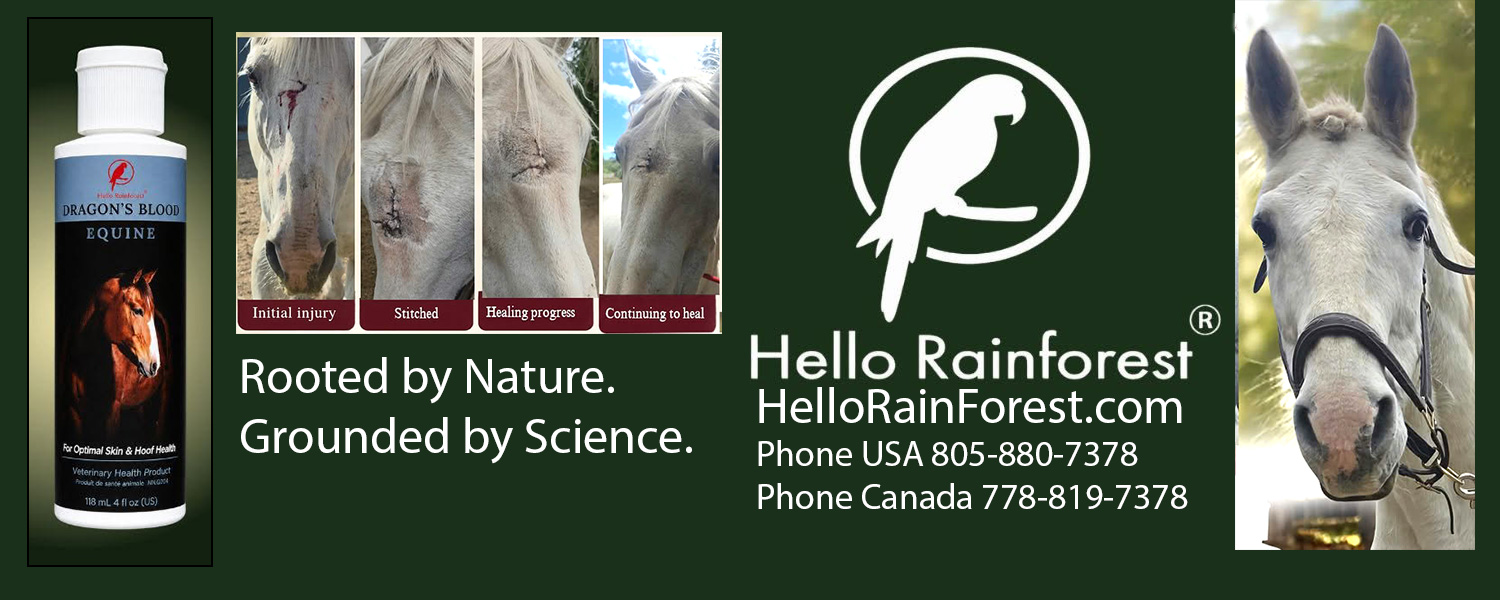
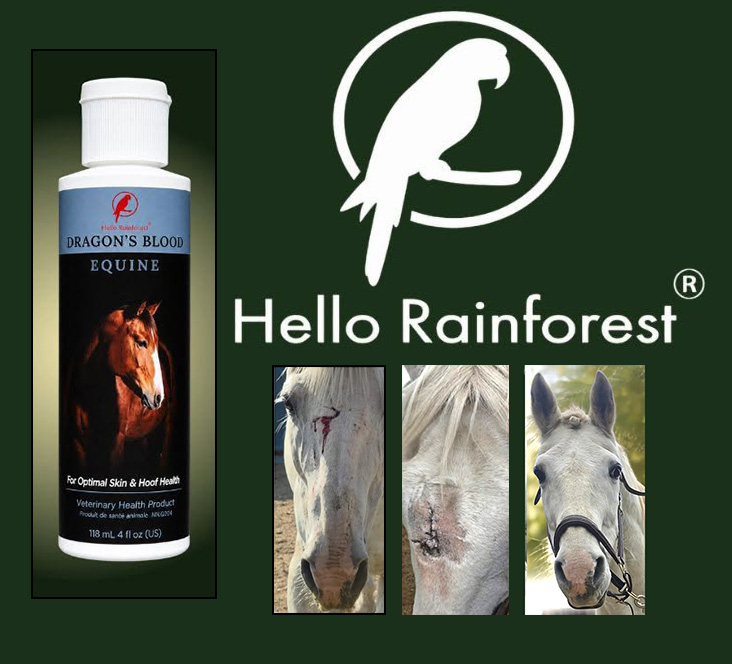

Dragon’s Blood for horses is a topical botanical resin made from Croton lechleri, a tree native to the Amazon region. The naturally deep red resin has a long history of traditional use, and modern research has increased interest in its potential role in supporting skin integrity, tissue repair, wound care and the horse’s natural protective barrier.
Hello Rainforest offers its Dragon’s Blood for Equine as a concentrated topical product for horse owners who want a simple botanical addition to their regular skin, wound and hoof-care routine. The company also offers a topical Dragon’s Blood product for dogs and cats, along with a separate human digestive product called Gastro-Ease.
What makes this unusual rainforest resin especially interesting is that Croton lechleri is not simply a traditional remedy. Researchers have studied its naturally occurring compounds in relation to collagen deposition, inflammation, tissue repair, protective film formation and gastrointestinal function.
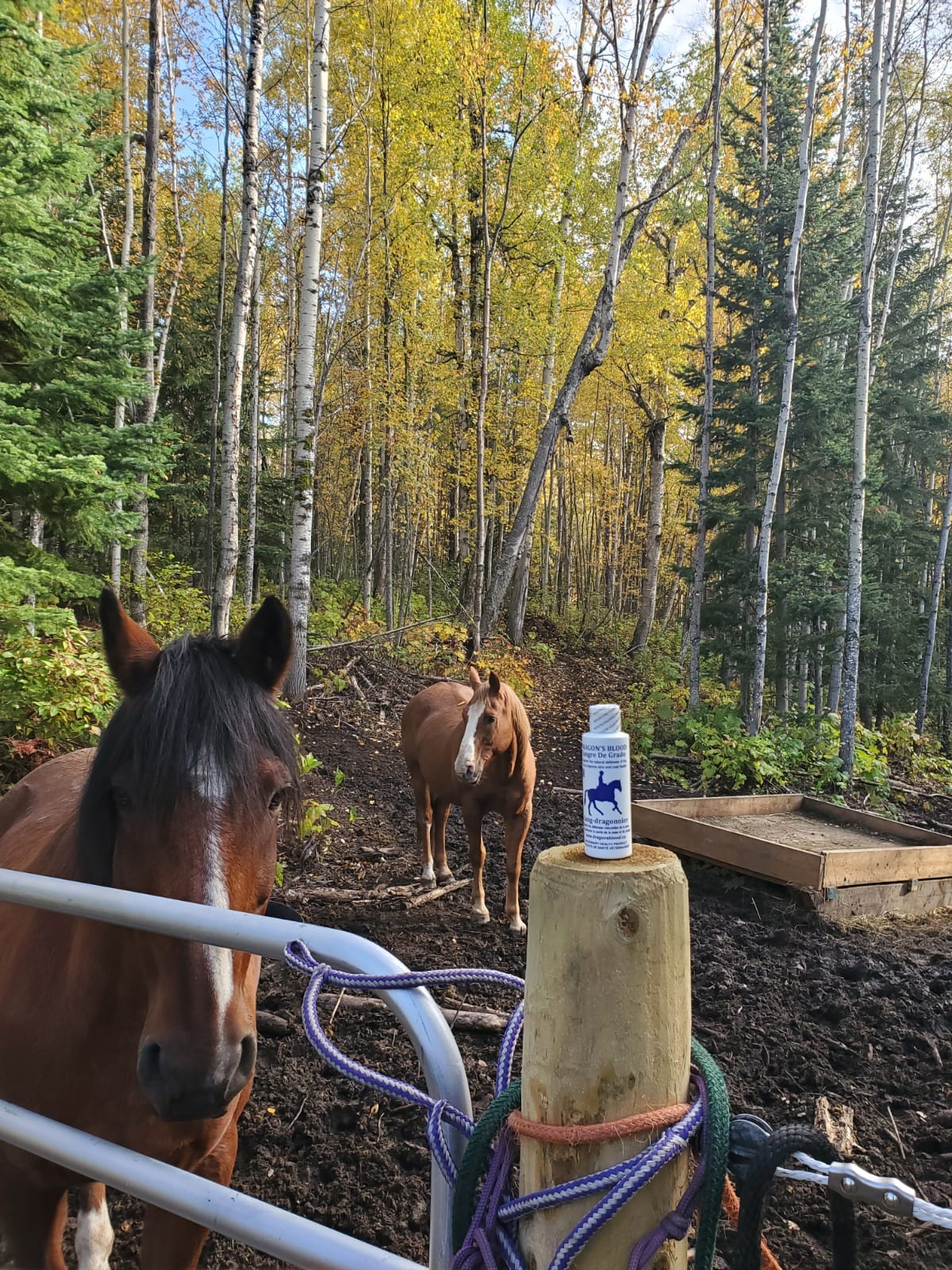
Croton lechleri is a tree that grows in the Amazon region of South America. When the bark is cut, the tree produces a dark red resin traditionally known as Dragon’s Blood, Sangre de Grado or Sangre de Drago.
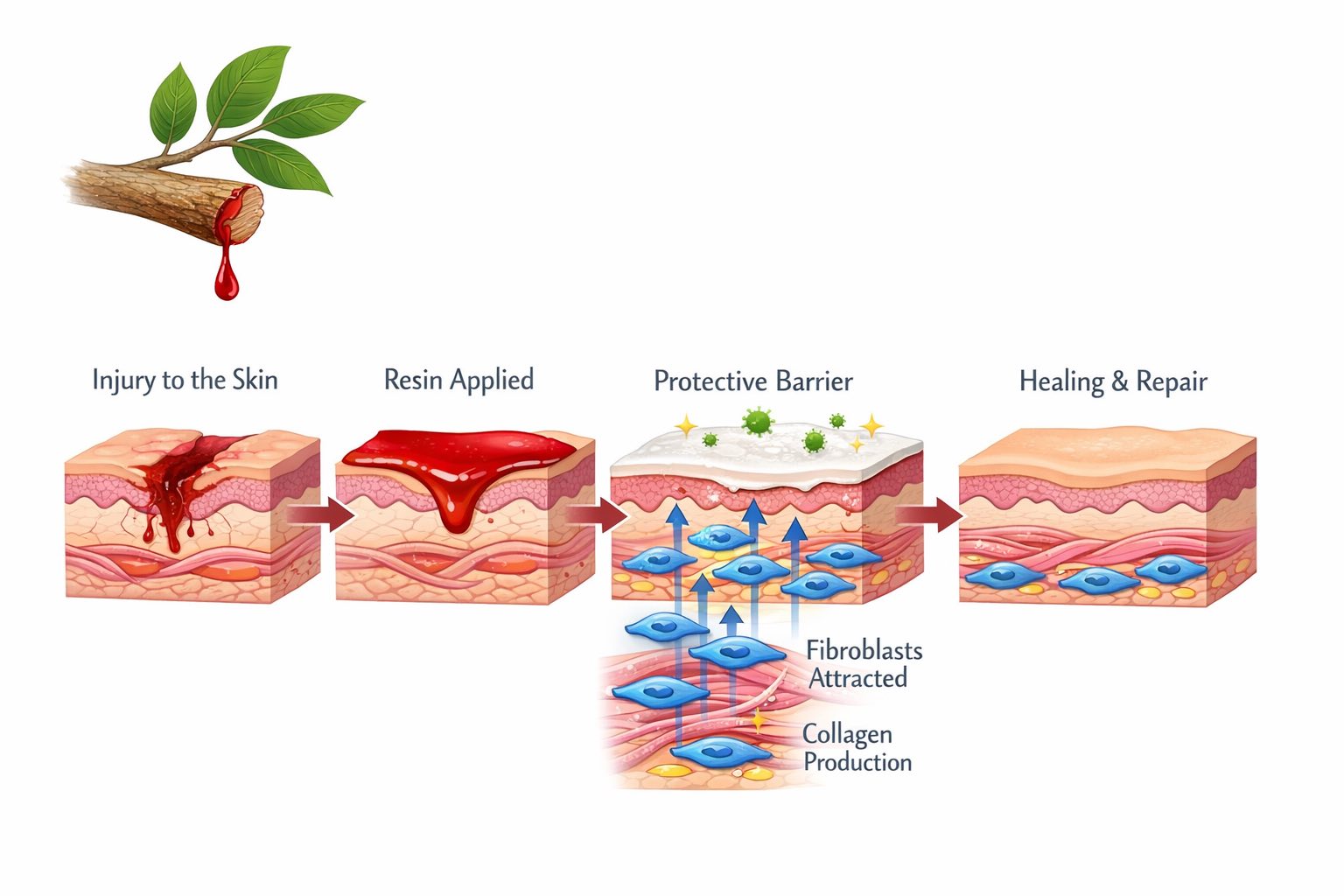
For horses, Dragon’s Blood is primarily used topically. When applied to properly cleaned skin, the resin can form a thin protective botanical layer over the surface. This has made Croton lechleri interesting to horse owners looking for botanical support for minor skin damage, superficial wounds, hoof and frog areas, and other places where maintaining a healthy protective barrier is important.
Research has also examined compounds naturally present in Croton lechleri, including proanthocyanidins and taspine, in relation to inflammation, collagen formation and tissue repair.
Not every product called “Dragon’s Blood” comes from the same plant! The name is a traditional name used for red resins from several different botanical species. That means two products with the same general name may differ considerably in source, composition, purity and consistency.
Hello Rainforest’s Dragon’s Blood is genuine Croton lechleri resin sourced from cultivated trees in Peru. According to the company, the trees are specifically grown for resin production and harvested at biological maturity.
Hello Rainforest says its equine and pet formulas are made with pure Croton lechleri resin and contain no added water, alcohol, dyes, fillers or unnecessary preservatives. The company also independently batch tests its resin for identity, purity and microbial quality and emphasizes traceability and responsible sourcing. For a botanical product built around one primary ingredient, those details matter.
Hello Rainforest’s Dragon’s Blood for Equine is intended as a topical botanical product. Horse owners may use it as part of routine care for clean superficial skin injuries, minor abrasions, rubbed areas, hoof and frog areas, moisture-prone skin and other places where supporting the natural skin barrier is desirable.
It may also be considered as part of a broader wound-care program after an injury has been properly cleaned and evaluated. Dragon’s Blood should not replace appropriate wound cleaning, veterinary diagnosis, farrier care or medical treatment when a horse has a serious injury, infection, deep puncture, severe lameness or a wound that is not healing normally.
Hello Rainforest lists scratches and superficial skin damage among the traditional topical uses of Dragon’s Blood for Equine, along with areas prone to moisture exposure, areas of thickened or stressed skin and environmentally exposed skin. Those are exactly the places, from muddy pasterns to rubbed spots under tack, where a horse’s skin barrier takes a beating.
The company describes the resin as a breathable protective layer that is a useful addition to equine grooming and skin-care practices, particularly where skin is exposed to environmental stress. Healthy skin underneath is the starting point for a good coat. Scratches can have several causes, so a case that spreads, cracks deeply, swells or will not clear up should be seen by your veterinarian.
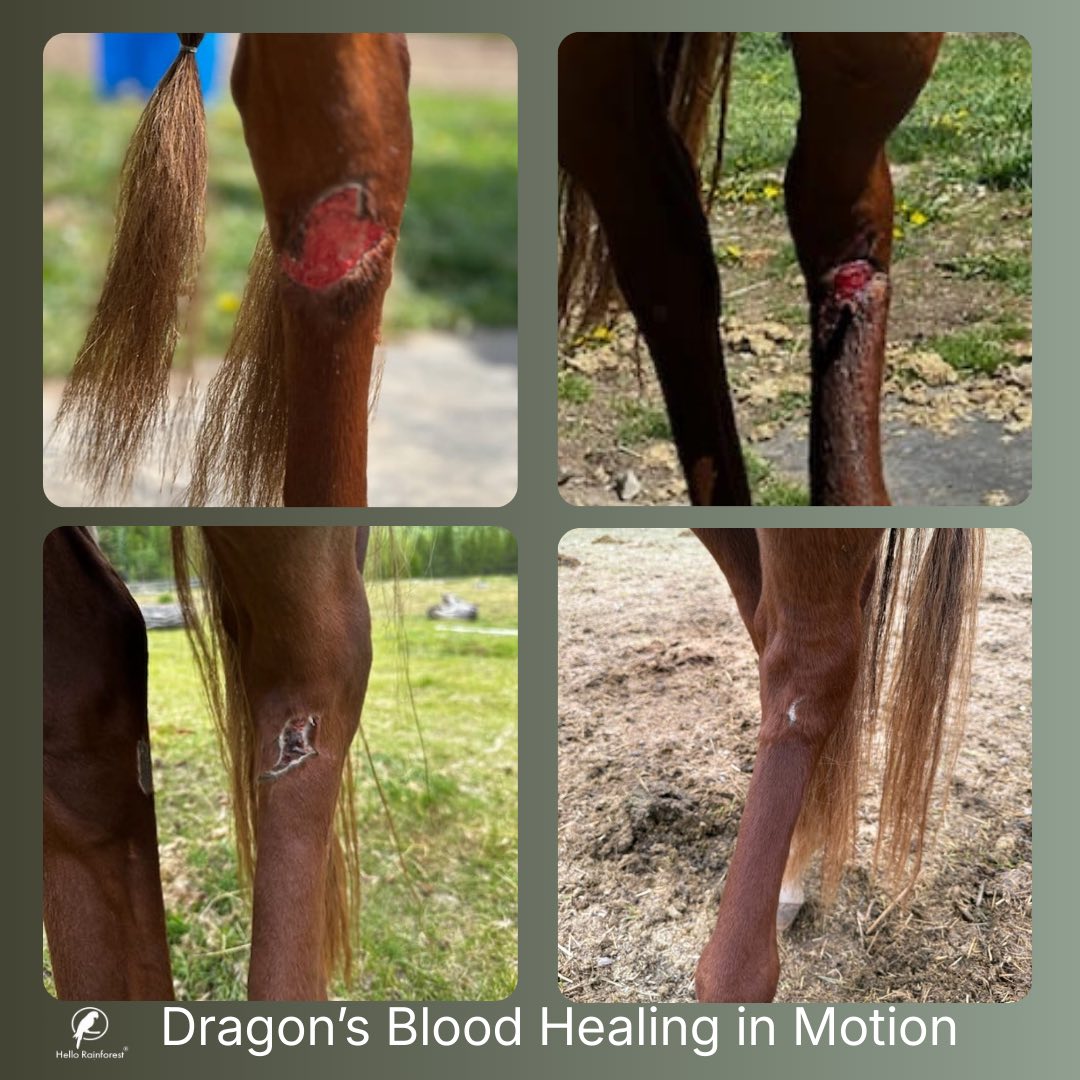
Dragon’s Blood for horse wounds has attracted attention because Croton lechleri forms a light protective layer over the skin and has been studied in relation to tissue repair. A 2026 controlled equine wound study involving metatarsal skin wounds found that topical Croton lechleri treatment appeared to support tissue repair through effects involving collagen deposition, angiogenesis and inflammatory response.
That makes the resin particularly interesting for horse owners dealing with lower-leg wounds, which can be challenging because of movement, contamination, limited soft-tissue coverage and the horse’s tendency to develop exuberant granulation tissue.
However, Dragon’s Blood is not a substitute for veterinary care. Deep wounds, punctures, heavily contaminated injuries, suspected joint involvement, tendon injuries, uncontrolled bleeding or wounds that become swollen, painful or infected should be examined by a veterinarian.
Yes. Dragon’s Blood for horse hoof care is another area of interest because the resin dries into a thin protective layer. Horse feet are constantly exposed to mud, manure, urine, wet bedding and changing environmental conditions. The frog and surrounding grooves can also trap moisture and debris.
After the hoof has been cleaned and dried, Dragon’s Blood may be applied topically to exterior hoof and frog areas as part of routine hoof care. It should be viewed as a supportive topical product rather than a replacement for proper trimming, drainage, environmental management or professional farrier care.
Some horse owners use their Dragon’s Blood around the frog and deep hoof crevices because the resin can be worked into irregular surfaces and allowed to dry. Laboratory research involving Croton lechleri and some of its natural constituents has reported antibacterial and antifungal activity. However, Hello Rainforest does not market Dragon’s Blood as a registered disinfectant, antibiotic or antifungal medication. That distinction is important.
For routine care, the hoof should first be cleaned thoroughly and allowed to dry. A small amount of resin can then be applied to the frog or affected exterior area. Persistent thrush, severe odor, deep cracks, significant tenderness, swelling or lameness should be evaluated by a veterinarian or farrier because the underlying problem may involve hoof structure, trimming, moisture, infection or environmental conditions.
A topical product cannot drain a sealed hoof abscess. A hoof abscess is a pocket of infection trapped inside the hoof, and the primary goal is to locate the source and establish drainage when appropriate. That job may require a veterinarian or qualified farrier.
Once a hoof abscess has opened and drained, Dragon’s Blood may be useful externally as part of follow-up hoof care. The area should first be properly cleaned. The resin can then be applied to the exposed exterior area and allowed to dry into a protective layer.
Horse owners should avoid sealing a closed or undrained abscess with any product that forms a barrier. Trapping infection beneath a sealed surface can make the problem worse. Severe lameness, heat, swelling, fever, drainage near the coronary band or failure to improve should prompt veterinary attention.
Ann Pruitt, Director, InfoHorse.comThis absolutely works! First we were so impressed as a company with Corrine and Jess, owners of Hello Rainforest. Their dedication to offering the highest quality Dragon’s Blood is second to none. I used this on a dog with a paw that this little dog would not stop chewing. The chewing stopped almost immediately, and the limping is now gone. I re-apply a few times a week to keep the ‘yeast infection’ of that paw— gone for good.
Ann Pruitt, Director, InfoHorse.comThen, I put it on the toe of my beautiful little Morgan Sugar, who was recovering from a small abscess. She had been limping and sore on it for 2 weeks. After ONE application (cotton ball soaked in Dragon’s Blood and tucked in the little abscess opening)… she quit limping and within 2 days, it appeared to be so healed that I rode her on the 3rd day and she was great! Highly recommend it to all horse/dog owners— and yes, I am using it on myself when needed!
Hello Rainforest does not market its Dragon’s Blood as a disinfectant or antibiotic. Laboratory research has reported antibacterial and antifungal activity in Croton lechleri resin and some of its components, but laboratory findings are not the same as proving that a finished topical product treats infection.
Before applying the resin to a wound, visible dirt and debris should be removed appropriately. Deep, puncture-type, heavily contaminated, infected or slow-healing wounds should be examined by a veterinarian. A good way to understand Dragon’s Blood is as botanical barrier support and tissue support rather than as a replacement for proper wound cleaning or veterinary medicine.
Start with a clean area. Remove visible dirt and debris as appropriate, and gently dry the surface. Apply a small amount of Dragon’s Blood directly to the skin and spread it gently over the area. The resin can then be allowed to air-dry and form its characteristic reddish protective layer.
For hard-to-reach or delicate areas, Dragon’s Blood can also be placed into a fine spray bottle and applied as a light mist. If the spray bottle ever clogs, simply rinse it under water. Hello Rainforest indicates that the product may be reapplied as needed according to label directions. Because Dragon’s Blood is naturally dark red, it can temporarily stain clothing, light-colored surfaces and equipment before it dries.
No… we have found that it does not. One reason Croton lechleri has received scientific interest is its relationship with sensory nerve activity and neurogenic inflammation. Research has examined how compounds in the resin may influence sensory afferent nerve activation associated with pain, itching, redness and swelling.
That does not mean every horse will react exactly the same way to every application, but it helps explain why this botanical continues to attract attention beyond its traditional use. As with any topical product, owners should watch the treated area and discontinue use if unexpected irritation occurs.
When a horse is injured, we care about more than how the wound looks—we want our horse to feel comfortable, too. Hello Rainforest Imports often hears from owners who say their horses seem calmer and more comfortable after Dragon’s Blood is applied. There may be an interesting scientific reason worth exploring. Injured or irritated skin can trigger sensory nerves to release Substance P, a neuropeptide involved in pain signaling, sensitivity, and inflammation.
Research published in Experimental Dermatology found that Dragon’s Blood resin from the Croton lechleri tree reduced the release of Substance P in a laboratory model involving sensory neurons and skin cells. Researchers concluded that the resin showed an ability to inhibit neurogenic inflammation.
While this research does not prove that Dragon’s Blood is a “pain reliever” for horses, it offers an intriguing scientific explanation for the comfort-related changes some animal owners say they observe after application, supporting Hello Rainforest’s findings that Dragon’s Blood can assist with making your horse much more comfortable!
No. Dragon’s Blood does not require refrigeration. Store the bottle tightly closed in a cool, dry location away from direct sunlight and extreme temperatures. A tack room may be appropriate if it does not become excessively hot during summer or freeze during winter.
Natural Croton lechleri resin may thicken or develop sediment over time. Because this is a concentrated botanical resin, some settling or thickening does not automatically mean the product has spoiled. Keeping the bottle tightly closed and protecting it from temperature extremes helps preserve the product.
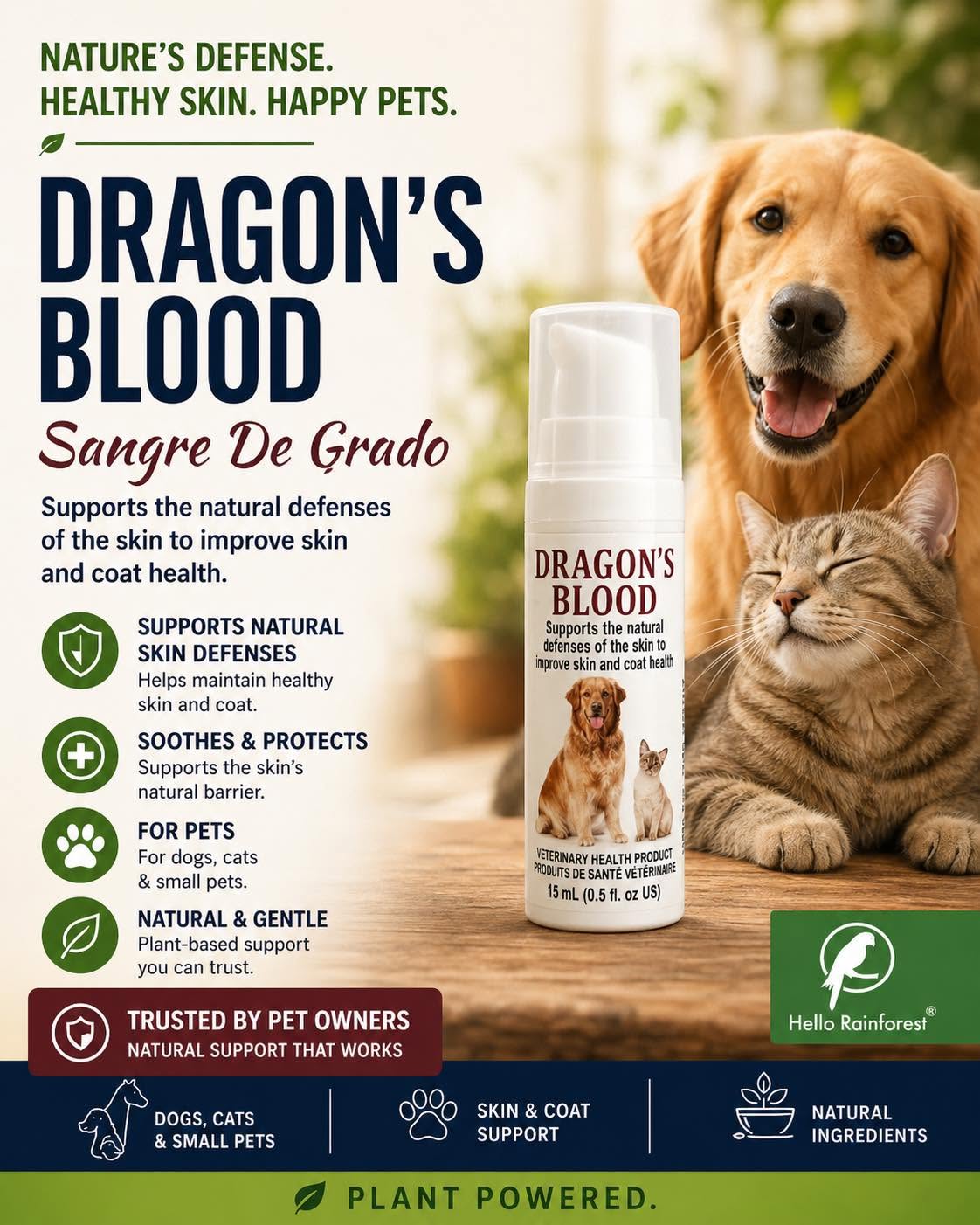
Yes. Hello Rainforest also offers Dragon’s Blood for Cats & Dogs. Like the equine version, the pet product is intended for topical use. It may be applied to clean, dry skin surfaces to support the animal’s natural skin barrier and tissue integrity. Dog owners may find it particularly interesting for minor superficial skin irritation or dry, chapped paw surfaces.
Before treating a sore paw, examine it carefully for cuts, punctures, splinters, burns, swelling, discharge or foreign material. Persistent limping, bleeding, odor, repeated licking or chewing, or signs of infection should be evaluated by a veterinarian.
Dragon’s Blood for Pets may provide topical botanical support for the skin barrier in areas of superficial irritation. However, the term “hot spot” can describe a painful, moist and rapidly spreading skin condition that may be caused by allergies, parasites, infection or repeated licking.
If an area is wet, spreading, foul-smelling, painful or producing discharge, veterinary care is appropriate. The underlying cause matters just as much as the condition of the skin surface.
Yes. Research involving dogs has examined Croton lechleri in relation to skin repair, wound healing and gastrointestinal function. Compounds derived from Croton lechleri also played a role in the development of crofelemer, an active pharmaceutical ingredient used in Canalevia-CA1, a prescription veterinary product conditionally approved by the U.S. FDA for chemotherapy-induced diarrhea in dogs.
Note: This does not mean Hello Rainforest’s topical pet product is the same as that prescription medication. It does, however, show that this particular botanical has received meaningful scientific and pharmaceutical attention.
Gastro-Ease is a separate Hello Rainforest product intended for human digestive support. It is a Health Canada-licensed Natural Health Product with NPN 80111301. Its authorized uses include providing antioxidants and use in herbal medicine to help soothe irritation and/or inflammation of the gastrointestinal tract. Although Gastro-Ease contains Croton lechleri, it should not be confused with the topical equine or pet formulas.
Note: Hello Rainforest specifically states that Gastro-Ease should NOT be administered orally to an animal unless a veterinarian recommends it and provides appropriate instructions. Horse owners should therefore use the equine product for appropriate topical horse care, the pet product for topical pet care, and Gastro-Ease according to its human label directions.
Some of the most significant scientific work on Croton lechleri concerns the digestive tract. Proanthocyanidin compounds derived from the resin have been studied for their influence on intestinal chloride secretion and fluid movement.
Research into these mechanisms contributed to the development of crofelemer, an FDA-approved pharmaceutical ingredient used in human and veterinary medicine. This helps explain why Dragon’s Blood has a scientific story that extends well beyond its traditional use as a topical rainforest botanical.
Demand for rainforest botanicals should never come at the expense of the rainforest itself. Hello Rainforest sources its Croton lechleri resin from cultivated trees in Peru rather than relying on unpredictable harvesting from mixed wild stands.
A botanical name alone does not tell the full story. Croton lechleri resin naturally varies in composition, including its taspine content. Taspine is one of the compounds studied in connection with tissue repair, so the resin’s deep red color alone cannot establish its chemical profile or quality.
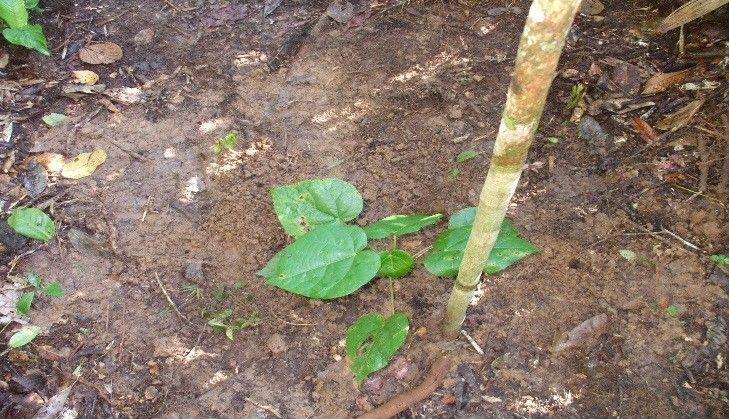
Wild harvesting offers far less control over growing conditions and tree history. Trees may differ in maturity, environment, and previous harvesting, making a well-documented supply chain and batch testing especially important.
Harvesting from cultivated trees reduces pressure on surrounding forest areas and supports a more sustainable, long-term supply. Hello Rainforest also emphasizes traceability and responsible partnerships connected with rainforest conservation. To learn more about the Hello Rainforest testing approach, read How We Test Our Dragon’s Blood Source on the company’s website.
Dragon’s Blood is NOT a replacement for your veterinarian, farrier, proper wound cleaning or good horsemanship. That is exactly why it may be useful. Hello Rainforest Dragon’s Blood for Equine is a concentrated topical botanical resin that can be incorporated into sensible horse skin, wound and hoof care.
Dragon’s Blood for Equine is made from genuine Croton lechleri. It forms a light protective layer. The botanical has a long history of traditional use, and modern scientific research continues to investigate its relationship with tissue repair, collagen, inflammation, skin integrity and gastrointestinal function. For horse owners who want to add a straightforward botanical product to the barn first-aid and hoof-care kit, Dragon’s Blood deserves a closer look.
Very simply, once you try this product, you will like it. It works. There is nothing like it, and it is all natural, plant-derived! From fungal problems, to abscesses, to cuts and wounds, Hello Rainforest says its Dragon’s Blood is the purest, most potent Dragon’s Blood on the market today. They are the Only Dragon’s Blood used and endorsed by InfoHorse.com. Be sure to order yours today— when you need it, you’ll be very glad you had it!
Dragon’s Blood is the deep red resin of Croton lechleri, a tree native to the Amazon region, also known as Sangre de Grado or Sangre de Drago. For horses it is used topically: applied to cleaned skin, it dries into a thin protective botanical layer. Research has examined its natural compounds, including proanthocyanidins and taspine, in relation to inflammation, collagen formation and tissue repair.
The name Dragon’s Blood is used for red resins from several plant species, so products can differ widely. Hello Rainforest uses genuine Croton lechleri from cultivated trees in Peru, harvested at biological maturity. The company says its equine and pet formulas contain no added water, alcohol, dyes, fillers or unnecessary preservatives, and it batch tests every lot for identity, purity and microbial quality.
Hello Rainforest lists scratches and superficial skin damage, moisture-prone skin and environmentally exposed skin among the traditional topical uses of Dragon’s Blood for Equine. Clean and dry the area, apply a small amount and let it dry into a protective layer. Scratches can have several causes, so a case that spreads, cracks deeply, swells or does not clear up needs your veterinarian.
Only after the abscess has opened and drained. A topical product cannot drain a sealed abscess, and that job may need a veterinarian or farrier. Once it has drained, clean the area, apply the resin to the exposed exterior and let it dry. Never seal a closed or undrained abscess under any barrier product, because trapping infection can make it worse.
Clean the area, remove visible dirt and debris and gently dry it. Apply a small amount directly to the skin, spread it gently and let it air-dry into its reddish protective layer. For hard-to-reach spots it can go in a fine spray bottle as a light mist. Reapply as needed according to label directions, and expect it to stain clothing until it dries.
No. Hello Rainforest does not market Dragon’s Blood as a disinfectant, antibiotic or antifungal medication. Laboratory studies have reported antibacterial and antifungal activity in Croton lechleri, but that is not proof that a finished topical product treats infection. Clean wounds properly first, and have deep, puncture, contaminated, infected or slow-healing wounds examined by a veterinarian.
No. Store the bottle tightly closed in a cool, dry place away from direct sunlight and temperature extremes; a tack room that does not get very hot or freeze works. Natural Croton lechleri resin may thicken or show sediment over time, and that settling does not by itself mean the product has spoiled.
Yes. Hello Rainforest makes Dragon’s Blood for Cats & Dogs, a topical product for clean, dry skin that supports the natural skin barrier, for example on minor superficial irritation or dry, chapped paws. Its human product, Gastro-Ease, is different: Hello Rainforest says it should not be given to an animal unless a veterinarian recommends it.
About this listing: Product and service details on this page, including any results described, are provided by Dragon’s Blood by Hello Rainforest. InfoHorse.com verifies the business behind every listing — for decisions about your horse's health, talk with your veterinarian.
Explore more from the InfoHorse.com directory




Explore expert guides on topics related to your business
By Ron Stalman
By Bob Pruitt
By InfoHorse Editorial Team
By Bob Pruitt
By Bob Pruitt
By Ann Pruitt