

Traveling Safely With Your Horse: Before, During and After the Trip
Hauling a horse safely takes planning before you ever lower the trailer ramp, good judgment once you are on the road and continued attention after you arrive. For interstate trips, most states require horses to have individual identification and a current Certificate of Veterinary Inspection, so check the requirements for every state you will enter—not just your final destination. Keep the horse’s feed familiar, inspect the trailer floor beneath the mats, match the truck to the real loaded weight and watch for fever, coughing or reduced appetite during the 24 to 48 hours after unloading.
You have hitched up a hundred times. The truck runs fine. The trailer looks fine. Your horse walked onto it last weekend without a problem.
But “fine” is not the same as “ready.”
Hauling a horse safely requires more than a good hitch and a full tank of fuel. It takes planning before you ever lower the trailer ramp, good judgment once you are on the road and enough discipline to keep paying attention after you arrive.
Most trips end exactly as they should. The horses step off, look around and start eating. That is the goal. But safe trips rarely happen by accident. They happen because somebody checked the tires, brought enough familiar feed, planned where to stop and taught the horse how to load before everyone was standing in the driveway already late.
Here is how I think about traveling safely with a horse: what you do before the trip, what you watch during the trip, the skills that make hauling easier and what you need to notice after you unload.
Before You Ever Load the Horse
What paperwork do you need to travel with a horse?
If you are crossing state lines, do not assume last year’s paperwork—or even last month’s paperwork—is enough.
Most states require horses traveling interstate to have individual identification and a current Certificate of Veterinary Inspection, commonly called a health certificate. Requirements for a negative Equine Infectious Anemia test, usually documented through a Coggins test, and other disease-related restrictions are determined by the state receiving the horse. Rules can also change when an equine disease outbreak occurs. Check the requirements for every state you will enter, not just your final destination.
Some destinations, events or states may have additional identification, vaccination or brand-inspection requirements. Confirm them with your veterinarian and the appropriate state animal-health office before leaving.
Even when we are only going to the local fairgrounds, I believe in keeping a current Coggins readily available. Bring vaccination records, emergency contact information and copies of anything you would hate to discover was sitting on the kitchen counter three hours after leaving home.
This is also a good time to ask a few honest questions. When did a veterinarian last examine this horse? Is he eating normally? Are his teeth in reasonable condition? Has he recently coughed, run a fever or had nasal discharge? A horse who is not quite right at home is unlikely to improve after several hours in a moving trailer.
Keep the horse’s feed familiar
 Travel is not the time to surprise a horse’s digestive system.
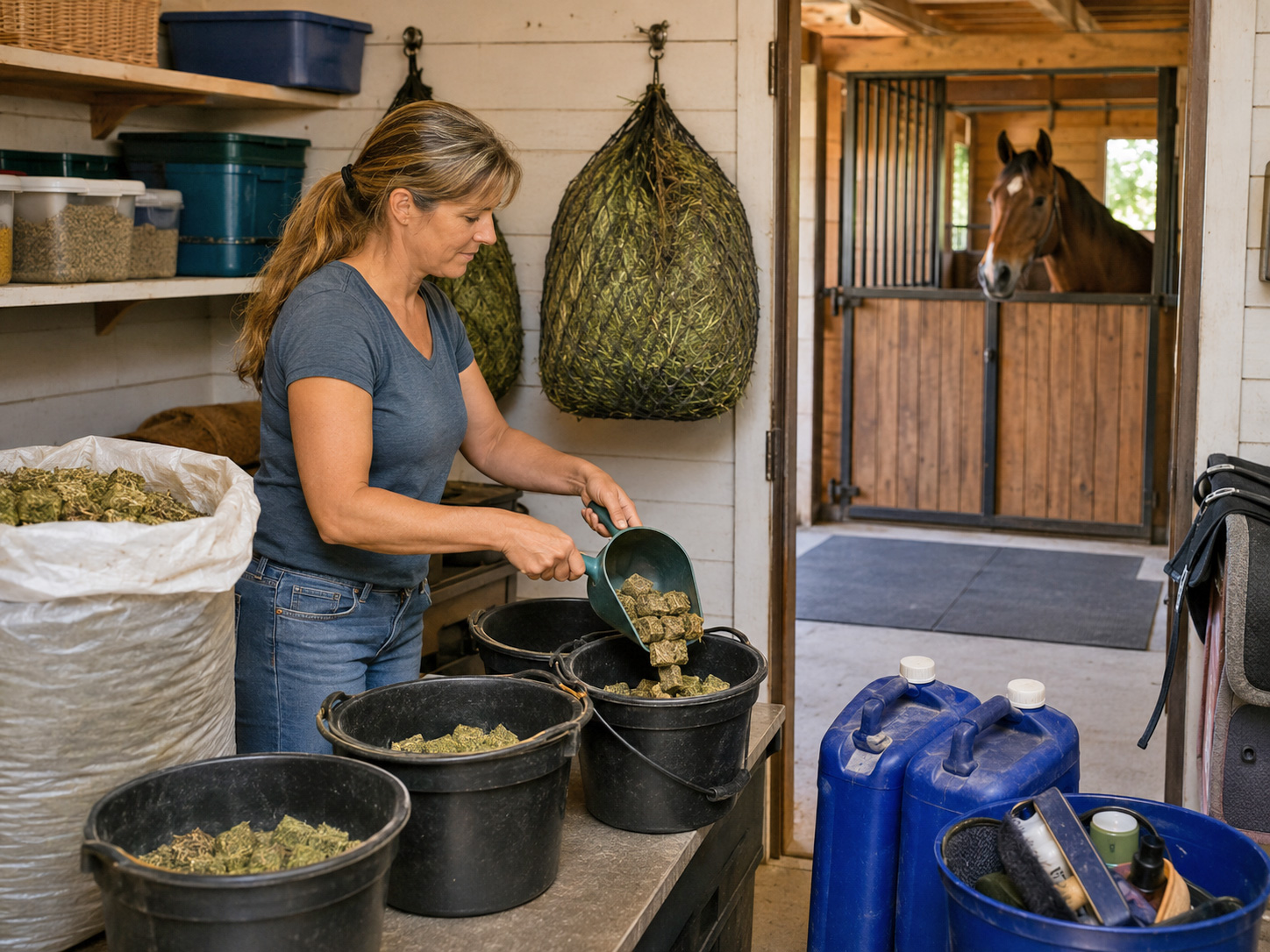
Many owners who haul frequently use hay cubes, forage pellets or a complete equine feed because a bagged product is easier to replace consistently while traveling. Others carry enough of their horse’s regular hay for the entire trip. Either method can work. The important thing is avoiding a sudden feed change while the horse is also dealing with transportation, unfamiliar surroundings and reduced water intake.
When you intend to use hay cubes or forage pellets on the road, introduce them gradually well before departure. Do not hand the horse a bucket of unfamiliar feed at the first overnight stop and hope his digestive system agrees with your travel plans.
Hay cubes should be soaked thoroughly when soaking is recommended for the horse. Give them enough time to soften completely rather than pouring a little water over the top immediately before feeding. Properly soaked forage can add moisture to the ration, but it does not replace access to clean drinking water.
Wet feed can spoil, particularly in hot weather. Mix only what the horse will eat within a safe period and clean the bucket afterward.
Will your horse drink strange water?
Some horses will drink anywhere. Others inspect a bucket of unfamiliar water as though you have asked them to drink out of a mud puddle.
Bring water from home when practical, especially for the beginning of the trip. Some owners gradually introduce a small amount of familiar flavoring before traveling and use that same flavor at the destination. Ask your veterinarian whether a small amount of apple juice, peppermint flavoring or an appropriate equine electrolyte product would be suitable for your horse.
Always offer plain water too. Horses with metabolic disease, kidney problems or other health considerations may not be good candidates for sugary flavorings or casually administered electrolyte products.
Whatever method you choose, try it at home first. The side of an interstate highway is no place to discover that your clever water-flavoring idea has caused your horse to refuse the entire bucket.
Build a Horse First-Aid Kit Before You Need It
Every horse owner should have a first-aid kit, but it becomes especially important when home, the barn and your regular veterinarian are several hours behind you.
A sturdy plastic bucket with a secure lid makes a good container. Keep the contents clean, organized and protected from heat and moisture. Tape a card inside the lid with your veterinarian’s number, an alternate veterinary contact, your horse’s identification and any important medical information.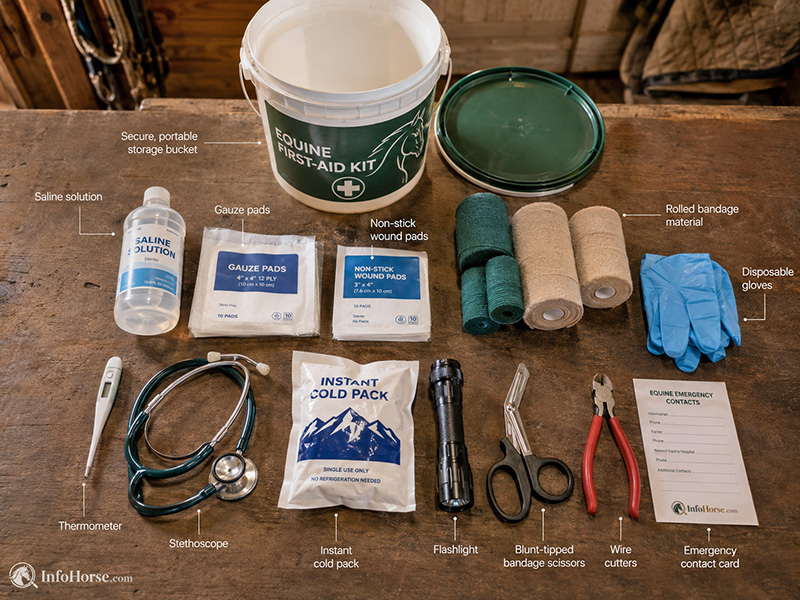
A practical travel kit may include:
- A rectal thermometer with a string attached
- A stethoscope
- Disposable gloves
- Sterile saline
- Clean towels
- Sterile gauze sponges
- Non-stick wound pads
- Sterile gauze roll
- Self-adhering bandage material
- Blunt-tipped bandage scissors
- Tweezers
- Instant cold packs
- A flashlight and spare batteries
- A sharp utility knife
- Wire cutters
- Duct tape
- Disposable diapers, which can make useful emergency pressure pads
- Lubricating jelly for the thermometer
- Fly repellent
- A temporary hoof-protection item recommended by your farrier or veterinarian
The most valuable thing in the kit may be something you cannot buy: knowing what is normal for your horse.
Take your horse’s temperature, pulse and respiration while he is healthy and relaxed. Listen to his gut sounds. Write the results down. Normal ranges are useful, but knowing what is usual for your particular horse gives you a better comparison when something appears wrong.
A typical resting adult horse often has a temperature near 99 to 101 degrees Fahrenheit and a resting heart rate generally around 28 to 44 beats per minute. Age, exercise, heat, excitement and illness can affect those numbers. When a reading concerns you, call your veterinarian rather than trying to diagnose the horse from one number.
For a superficial wound, sterile saline or plenty of clean water can be used for gentle flushing. Deep wounds, punctures, wounds near a joint or tendon, uncontrolled bleeding and injuries involving the eye require prompt veterinary guidance. Puncture wounds can be much more serious than their small surface opening suggests.
Do not pour hydrogen peroxide or another harsh product into a deep wound unless a veterinarian specifically directs you to do so. If an object is embedded in the hoof or body, photograph it and call the veterinarian before removing it. Its position may tell the veterinarian what structures could be involved.
Eye problems also deserve immediate attention. Squinting, excessive tearing, swelling, cloudiness or an obvious injury should be treated as an emergency. Do not use leftover eye medication unless your veterinarian specifically tells you to use that exact product for that horse. Some eye medications can make certain conditions worse.
Talk with your veterinarian before the trip about any prescription medications you may need to carry. Ask which medications may be given, under what circumstances and in what dose. Sedating a horse in or around a trailer can affect his balance, and pain medication may mask changes your veterinarian needs to evaluate. Do not improvise simply because medication happens to be in the truck.
Inspect the Trailer—Do Not Just Look at It
A horse trailer can appear perfectly respectable while hiding a serious problem underneath.
Begin with the floor. Lift the mats and inspect what is below them. Wood can rot from the underside, aluminum can corrode and urine or trapped moisture can damage areas that are rarely seen. A horse going through a weakened trailer floor is the kind of accident no owner forgets.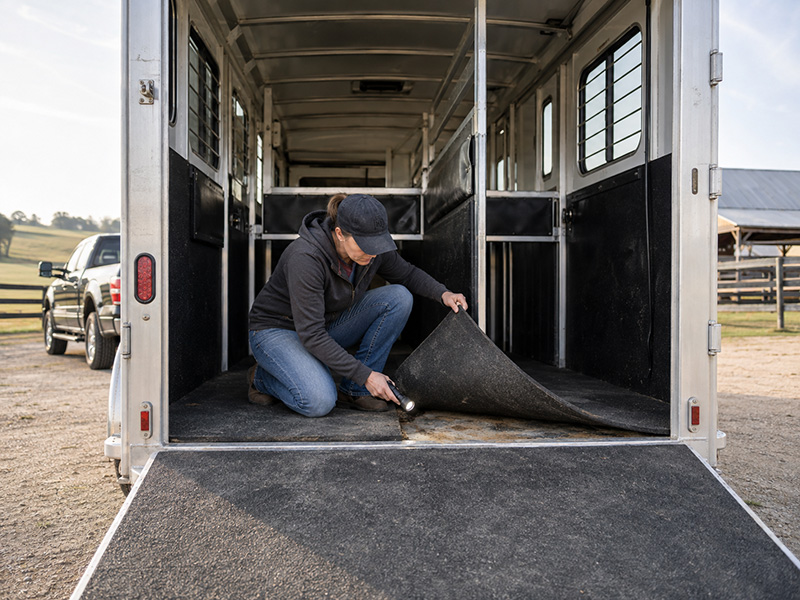
Check the following before the trip:
- Trailer tires and the spare
- Tire pressure when the tires are cold
- Tire date codes as well as tread depth
- Wheel bearings
- Lug nuts
- Brakes and brake controller
- Brake lights, running lights and turn signals
- Hitch, coupler and safety chains
- Breakaway cable and breakaway battery
- Doors, dividers, windows and latches
- Floor, mats and interior hardware
- Roof vents and other ventilation openings
- Emergency exits
- The jack and the tools required to change a tire
Trailer tires can age out while still showing plenty of tread. Sunlight, storage conditions, heat and long periods of sitting all affect them. Know their age and have them inspected rather than judging them only by appearance.
Make sure the spare actually fits the trailer. Make sure the jack can lift the trailer under realistic conditions. Finding a beautiful spare tire and an entirely useless jack beside the road does not improve the situation.
Secure loose buckets, tools, tack and equipment. Anything that can slide, swing or fall while the trailer is moving eventually will.
Is the Truck Truly Matched to the Loaded Trailer?
A truck may pull an empty trailer beautifully and still be poorly matched to the same trailer after horses, tack, hay, water and equipment are added.
Know the truck’s towing capacity, payload rating, axle ratings and hitch limits. Know the trailer’s empty weight and Gross Vehicle Weight Rating. Understand the expected tongue weight for a bumper-pull trailer or pin weight for a gooseneck.
Do not build your calculations around what the trailer weighs sitting empty at the dealership.
Add the horses. Add saddles, tack, hay, feed, water, panels and every item stored in the dressing room. Add the people, tools and supplies carried in the truck. Water is especially easy to underestimate because it weighs approximately eight pounds per gallon.
The truck must be able to pull the load, carry the imposed weight, stop it and control it in wind, rain, traffic and an emergency maneuver. “The truck can move it” is not the same as “the combination is safely matched.”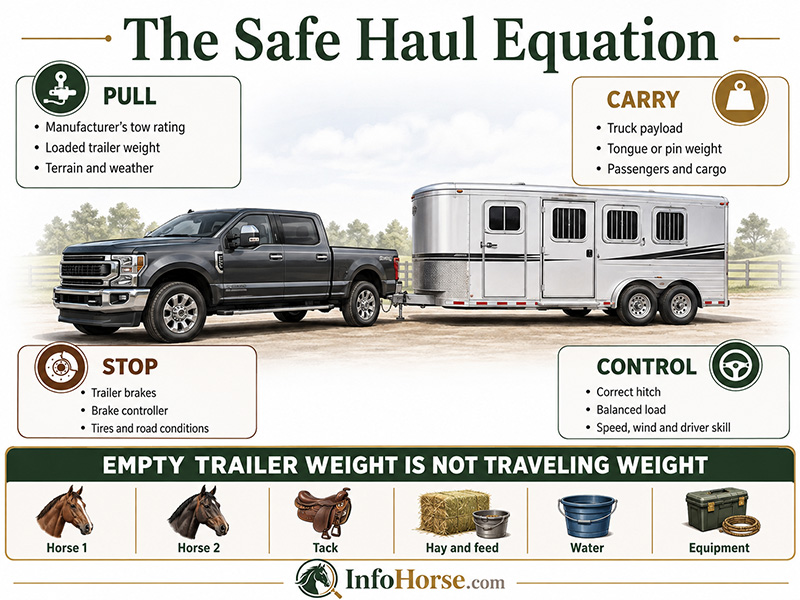
When you are uncertain, have the loaded truck and trailer weighed and ask a qualified trailer or towing professional to review the complete setup.
During the Trip
Watch the weather beyond your driveway
Do not check only the weather at home and at the destination. Look at what is expected along the entire route.
Rain may slow you down. High winds can make an otherwise manageable trailer difficult to control. Ice can turn a questionable trip into one that should never begin. Extreme heat can become dangerous inside a trailer surprisingly quickly.
During hot weather, travel during the coolest part of the day when possible. Maintain good airflow without creating an unsafe opening through which a horse could put his head. Windows should have appropriate bars or screens because road debris can injure a horse’s eyes. Never leave horses sitting in a closed or poorly ventilated trailer in direct sun. University of Minnesota Extension similarly advises hauling during cooler hours, providing ventilation and avoiding leaving horses parked in trailers under the sun.
Carry enough clean water for the horses and for unexpected delays. Offer water at safe stops. Do not leave an ordinary bucket loose inside a moving trailer where it can spill, swing or entangle a horse.
If a horse appears overheated, stop in a safe place and contact a veterinarian. Begin active cooling as directed. Unload only when you have a secure location where doing so will not create another emergency. Be careful about spraying large amounts of water inside a trailer if it will create slippery footing or add excessive humidity.
Give the horse familiar forage
Keeping forage moving through the digestive system can help support normal gut function and gives many horses something constructive to do.
Use a safely positioned hay bag or manger that the horse already knows how to eat from. It should be high enough to prevent a hoof from becoming caught but positioned, when the trailer design permits, so the horse is not forced to keep his head unnaturally elevated throughout a long trip.
Inspect the hay bag at stops. A strap that was secure in the driveway can loosen after several hours of vibration.
Let the horse lower his head when it is safe
Extended transportation with the horse’s head held high may interfere with the normal drainage of respiratory secretions. A trailer should allow a safe, natural head-and-neck position without creating an entanglement hazard.
That does not mean giving the horse enough rope to turn around, step over it or become caught. The correct setup depends on the horse, trailer design and whether the horse is tied. Ask your veterinarian, trainer or an experienced hauling professional to evaluate the arrangement before a long journey.
Use a trailer camera
Trailer cameras are no longer an extravagant piece of equipment. They allow you to see whether a horse is standing quietly, scrambling, pawing, coughing, fighting with another horse or caught in something.
Without a camera, silence from the trailer tells you very little.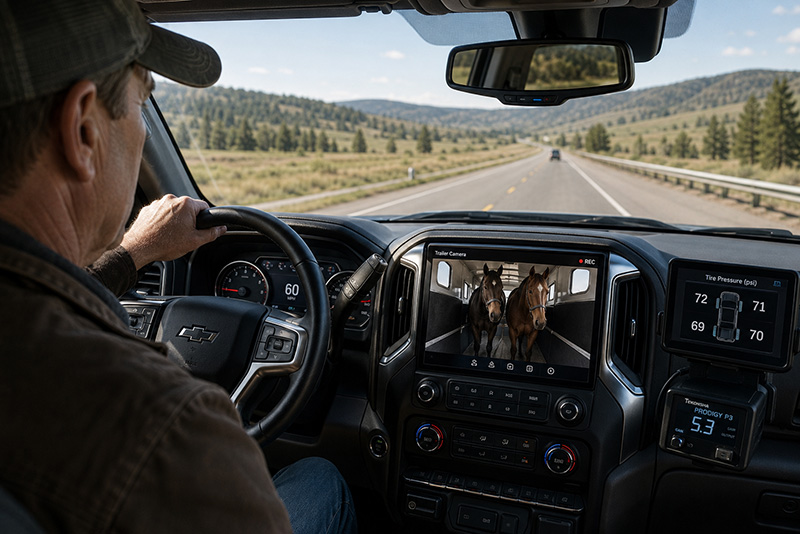
A camera does not replace stopping and physically checking the horses, but it gives you information between stops and may alert you to a problem before it becomes serious.
Plan stops before you need them
A fuel station that looks enormous from the highway can feel remarkably small once you are committed to the entrance with a truck and trailer behind you.
Plan fuel stops with trailer access in mind. Look at how you will enter, where you will turn and how you will leave. Avoid allowing the fuel gauge to become so low that you have no choice but to use the next station.
At safe stops, inspect the horses without automatically unloading them. Check their demeanor, breathing, water consumption, manure, hay and trailer temperature. Walk around the rig and look at the tires, hitch, doors and latches.
Do not routinely unload horses at highway rest areas, crowded truck stops or open roadside locations. Traffic, air brakes, dogs and unfamiliar activity can frighten even a normally sensible horse. There is also the possibility that the horse will refuse to reload.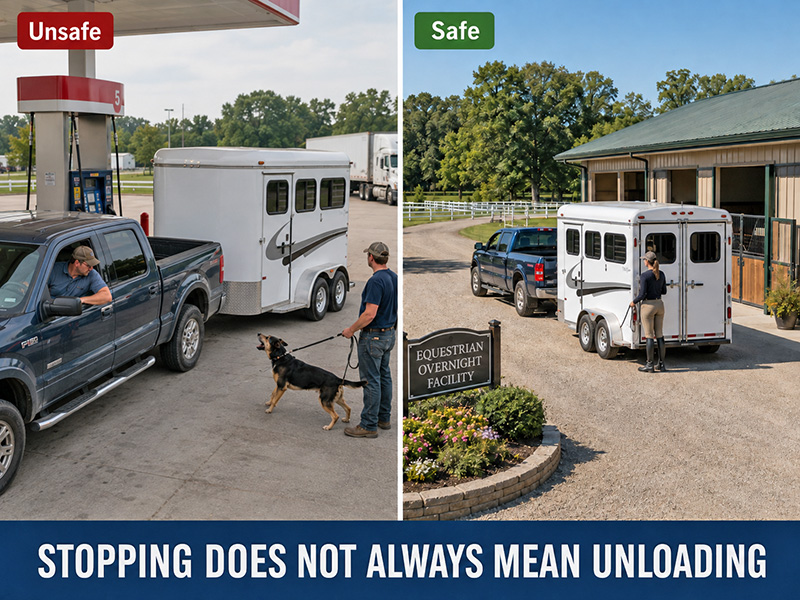
Unload only at a secure facility or designated livestock area where unloading is permitted and the horse can be safely contained.
For an overnight trip, reserve a reputable horse motel, fairground or private equine facility in advance. Ask about fencing, stall condition, trailer access, lighting and biosecurity. Bring your own buckets, hay bags, feed tubs and cleaning tools rather than sharing equipment with unfamiliar horses.
Always have a second plan
Roads close. Tires fail. Weather changes. A facility that promised an overnight stall may stop answering the telephone.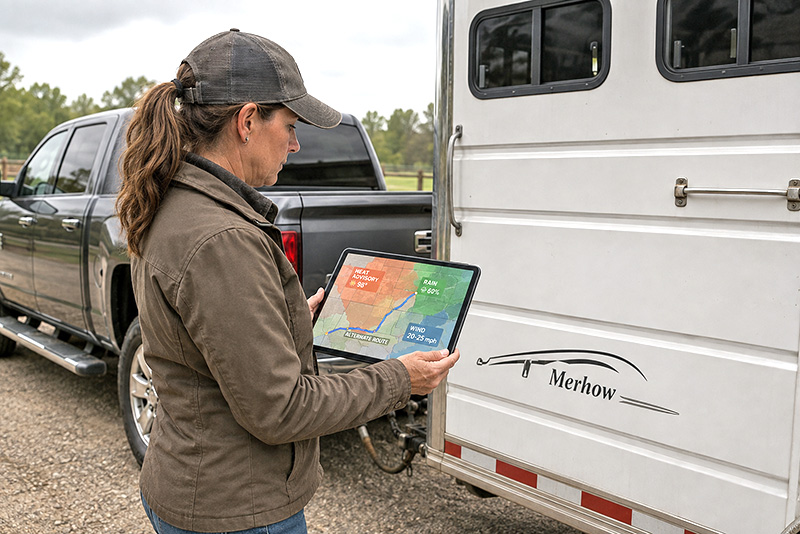
Know an alternate route. Identify a second overnight facility. Keep additional water, forage and medication available. Carry emergency roadside numbers, but make sure the service knows you are hauling live horses. Not every towing company can safely handle a loaded horse trailer.
A backup plan feels unnecessary right up until it becomes the only plan you have.
The Skills That Make the Trip Safer
Practice driving the trailer while nothing is wrong
Do not let the first difficult backing situation happen at a crowded horse show with three people giving conflicting hand signals.
Practice in an empty parking area or at the local fairgrounds. Learn how widely the trailer turns, how it tracks around corners and how quickly the combination stops. Practice backing straight and backing around a corner. Learn what the trailer looks like in the mirrors when it is correctly positioned.
Short local trips can also help a horse become accustomed to traveling without every trailer ride ending in a show, veterinary appointment or stressful new environment.
Confidence is not the same as carelessness. A calm driver who understands the rig is less likely to make a sudden correction that throws the horse off balance.
Will the horse load when you actually need him to?
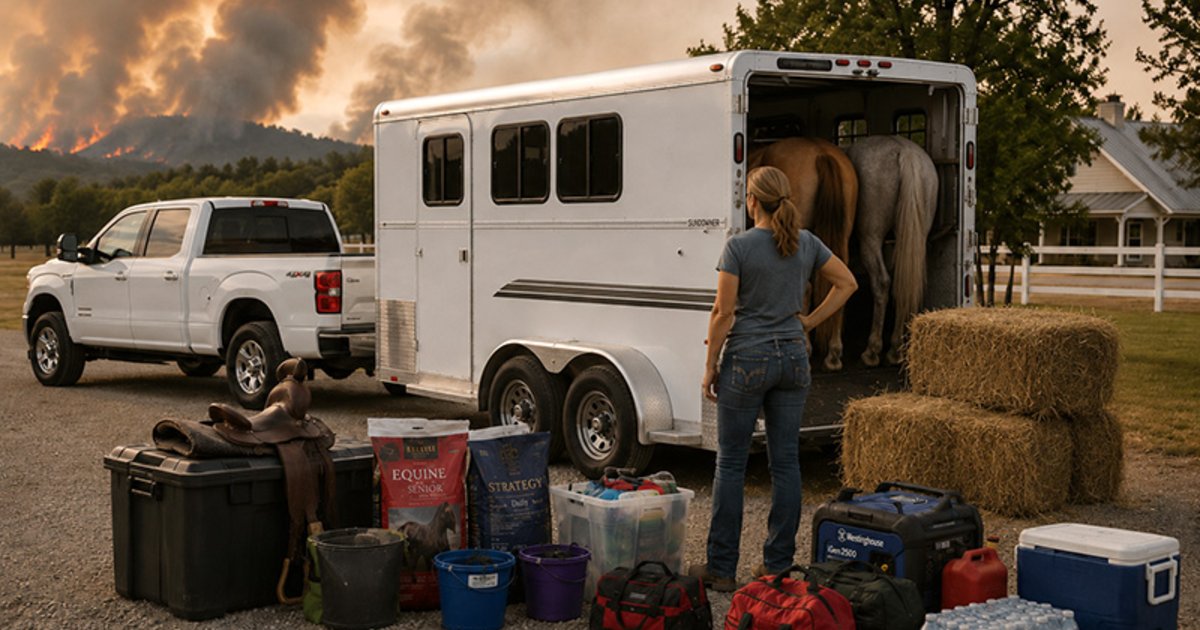
The worst time to discover that a horse does not load reliably is when a wildfire is approaching, a storm is coming or the veterinarian is waiting.
Practice until loading is an ordinary part of the horse’s education. Do not make every session a fight and do not wait until you are late.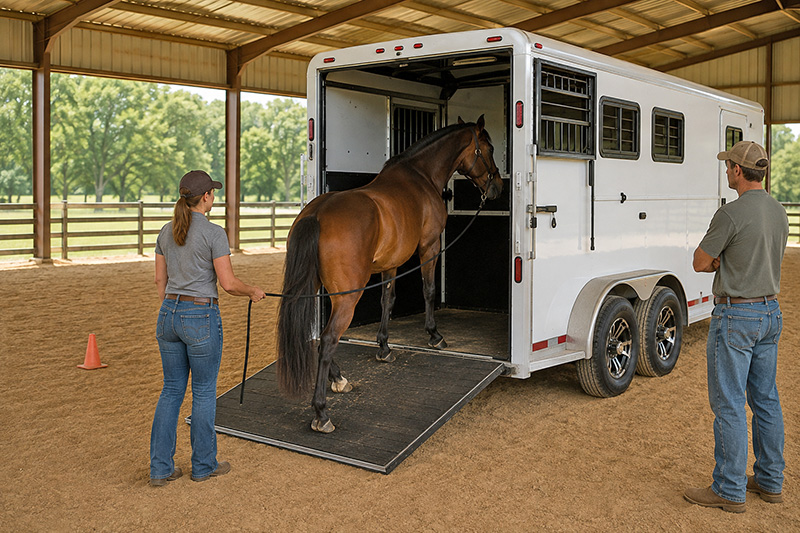
The slowest way to do anything with horses is to be in a hurry.
The moment a horse feels rushed, he becomes suspicious. Your breathing changes, your hands become less patient and suddenly the trailer he entered yesterday looks like a metal cave with bad intentions.
Take the time to teach the horse correctly. He should lead toward the trailer, pause when asked, step inside and stand without immediately trying to escape. The goal is not merely to get him behind the door. The goal is for him to understand the job.
Practice unloading even more than loading
I spend at least as much time practicing the unloading as the loading.
A horse that backs out calmly, placing one foot at a time, is far less likely to slip, scramble or injure himself. A horse that launches backward can strike his head, lose his footing or pull the handler off balance.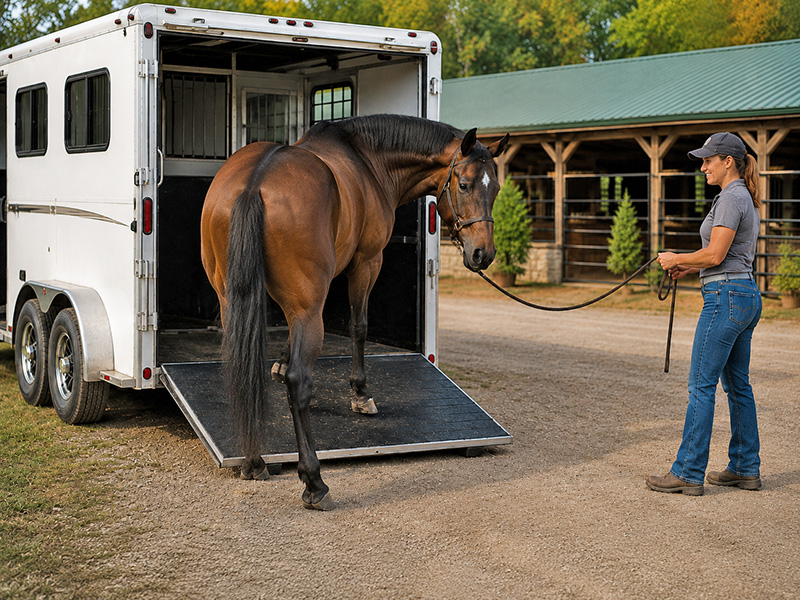
Teach the horse to wait. Open the trailer methodically. Release dividers and restraints in a safe order. Ask him to move only after you are ready.
It would be a rotten way to end a successful trip—to haul for hours without a problem and have the horse hurt himself during the final ten seconds.
After You Arrive
The trip is not over when the horse steps off the trailer.
Give him time to settle. Offer familiar water and forage. Watch whether he eats, drinks, urinates and passes a normal amount of manure. Take his temperature after a long trip and continue checking it morning and evening during the next couple of days.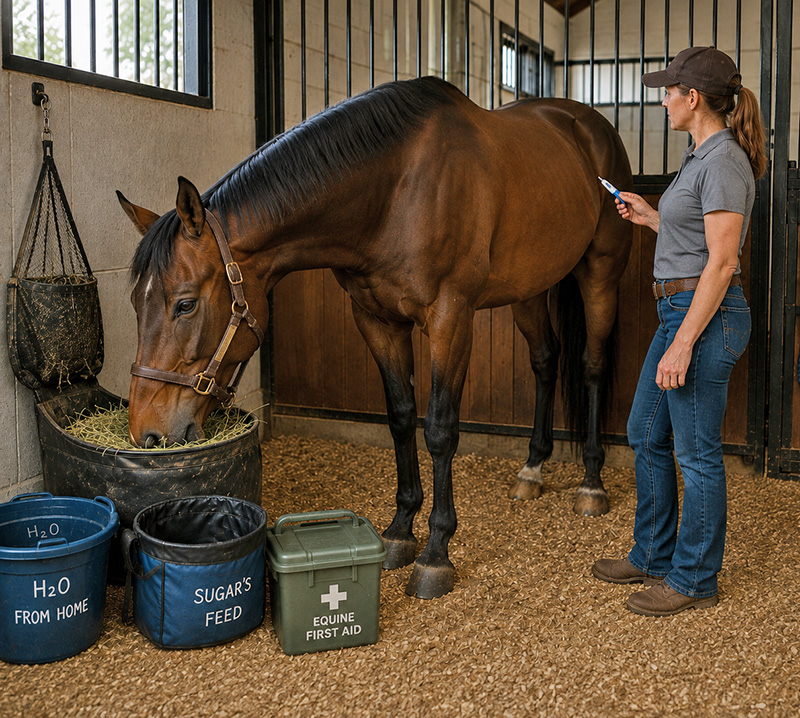
Watch for:
- Fever
- Depression or unusual quietness
- Reduced appetite
- Coughing
- Nasal discharge
- Faster or more difficult breathing
- Reduced manure
- Signs of abdominal pain
- Stiffness, lameness or reluctance to move
- Swelling, scrapes or other injuries
Respiratory illness associated with transportation does not always announce itself while the horse is still in the trailer. A horse may appear tired after arrival and then develop more obvious signs during the following 24 to 48 hours.
Do not dismiss a fever, cough, nasal discharge or loss of appetite as nothing more than travel fatigue. Call your veterinarian promptly. Early attention can make a significant difference.
Use your own buckets and equipment at the destination. Avoid nose-to-nose contact with unfamiliar horses and do not allow your horse to drink from a communal trough. Clean and disinfect temporary stalls and equipment when practical.
A Safe Trip Begins Long Before the Truck Moves
Traveling safely with a horse is not one decision made in the driveway.
It is paperwork handled before departure. It is familiar feed introduced before the journey. It is a truck and trailer matched to the real loaded weight—not the number printed in an advertisement. It is a floor inspected underneath the mats, a spare tire that fits and a route planned around places you can actually enter and leave.
It is also horsemanship.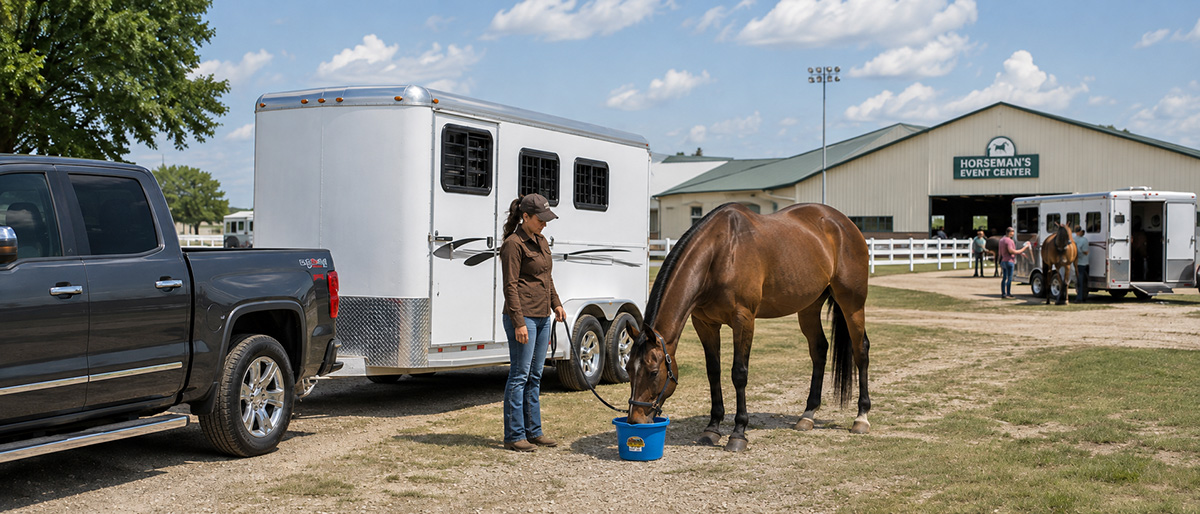
A horse who trusts you enough to load quietly, stand during the trip and wait for your cue before unloading is safer for himself and everyone around him.
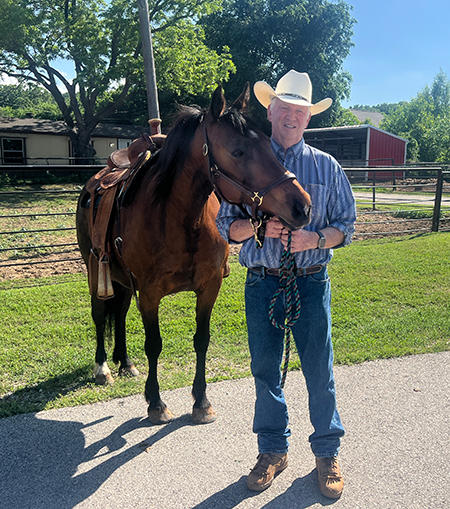 Most of the time, nothing dramatic happens. You arrive, lower the ramp and your horse steps off looking for hay.
That may not look like an accomplishment.
But when you are hauling horses, an uneventful trip is exactly the kind you worked for.
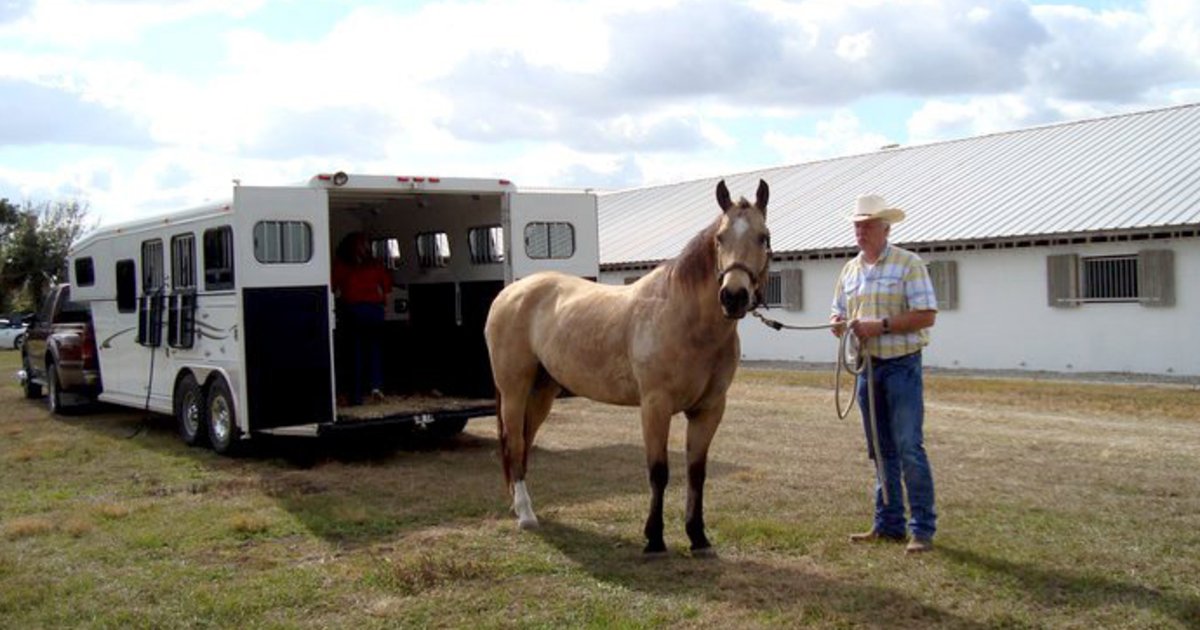
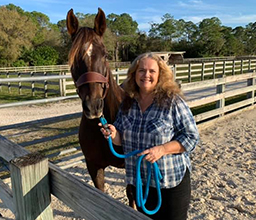
Bob and Zoey