

How To Help Horses with Thrush and Whiteline
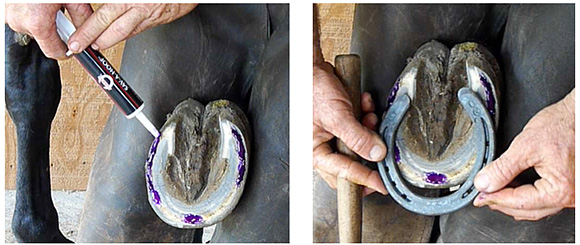
Medical gel technology is advancing treatment of white line disease, seedy toe, thrush, candida yeast, aerobic and anaerobic bacteria, mold and fungi and the repair of cell damaged hooves. by Dr Richard Shakalis-hoof researcher, and Michelle Tricca-Naples SBS Equine
Fighting thrush and white line disease comes down to contact time and formula strength—deeply rooted bacteria and fungal spores are difficult to eradicate, which is why hoof researchers are embracing medical gel technology. Gels bond to hoof protein and release their ingredients over hours or even days, increasing contact time against affected tissue by 10x more than liquids without harming the surrounding healthy tissue. Professionals recommend cleaning, picking, and brushing hooves first, then applying gel along the white line, in hoof cracks, nail holes, and the clefts of the frog.
Key Elements to Fighting Hoof Disease
Over twenty years ago Dr. Richard Shakalis and Dr. John Pautienis developed a powerful gel formula that is still recognized as a leading commercial topical preparation against chronic thrush and white line disease. It is no secret that the formula’s enduring success has been its ability to stop deeply rooted bacteria and fungal spores in hooves. The mechanism works by bonding to hoof pro- tein which promotes a longer contact time with diseased deep tissue than with traditional liquid preparations. Hoof researchers worldwide now recognize that contact time and formula strength are key elements to fighting these chronic conditions that are so difficult to treat.
Current guidelines on disinfection from the Centers for Disease Control and Prevention report that many deeply rooted infections contain spores. They are a major health issue because spores are so difficult to eradicate.
The CDC guide- lines indicate that low strength disinfection can be effective in reducing bacteria and fungi on relatively smooth surfaces with a contact time of 30 seconds, but not for spores! Apparently the deeper the infection in organic and inorganic
material, the more difficult it is to kill spores. Strong liquid preparations that can kill spores within 30 seconds near top surfaces are not as effective for deeply seated spores. New CDC guidelines recommend that high strength disinfectants need a contact time of 12 minutes or more to kill deeply rooted spores; however, they caution that some spores may still remain after the 12 minutes. To help in- crease treatment contact times and improve results, hoof researchers from many companies are embracing medical gel technology.
Warning: Hoof Soaking Can Be Hazardous
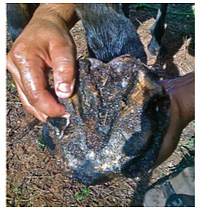
Deeply rooted hoof infections such as white line disease and chronic thrush are almost impossible to eliminate with one application of a strong liquid topical agent without harming the surrounding healthy tissue. These liquid preparations can run-off surfaces which limit their contact time with spores. Soaking hooves with liquid preparations with the aid of a soaking boot, bag or bucket can improve their contact time, but not without potential consequences over-soaking with caustic ingredients can damage hoof tissue permanently... administering soaking preparations daily is labor intensive and expensive... disposal of soaking solutions after use can be bad for the environment.
Medical Gel Kill Zone
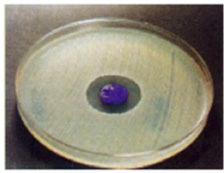
Hospital laboratory analysis has confirmed that medical gels work well at controlling the spread of bacteria and fungi without harming surrounding tissue. In field studies initiated by Drs. Shakalis & Pauteinis, diseased specimens were removed deep from within the hoof wall of horses with confirmed cases of white line disease and placed in sterile culture containers. Then these samples were sent to laboratory technicians for extensive analysis.
The agar plate shows examples of bacteria growing on the entire plate, except in the darker, clear area surrounding the sample of the blue medical gel in the center. This area is bacteria free and represents the very effective kill zone offered by the medical gel. Bacteria was unable to grow and survive in this kill zone. The medical gel provided for the analysis was Sav-A-Hoof Gel.
Benefits of Medical Gels vs Liquid Preparations
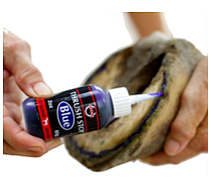
Today, hoof care products incorporating medical gel technology are being distributed in over 70 countries and have been on the market for over two decades. Manufacturers of hoof care products are actively incorporating medical gels into their new product development programs. The reasons are simple: medical gels offer many benefits that may be lacking in liquid preparations. For example, medical gel formulas are sticky and bond nicely to hoof tissue...medical gels have complex, time-release formulas which allow key ingredients to absorb into the affected tissue more uniformly and over an extended time period, sometimes lasting several hours or even days...gel formulas can improve end results by increasing contact time against affected tissue by 10x more than liquids, without harming the surrounding healthy tissue...
there is less mess and environmental waste with gels than liquid formulas resulting in a potential savings of 50% or more...long neck tips of applicator caps can dispense gel ingredients with more control, which saves time and money! Medical gels can work wonders along the white line, in hoof cracks, nail holes, clefts of the frog, and under shoes & pads.
Treating Clefts of the Frog and White Line
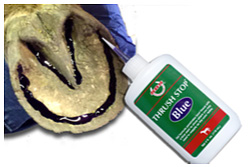
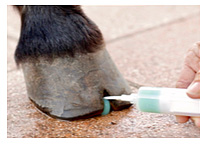
Some of the medical gel formulas are designed to stain diseased hoof tissue a dark blue color. This feature shows horse handlers where to add more gel as the blue color fades. Medical gel products are formulated to fight stubborn bacteria & fungi along white line, clefts of the frog, cracks and nail holes. The use of
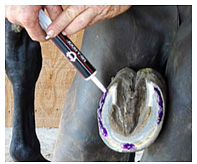
narrow flexible tips by manufacturers are designed to help control gel placement so there is less waste and run-off to the environment. Stronger medical gel formulas are frequently applied with syringe applicators or oval squeeze bottles with long neck caps. The stronger medical gel formulations are more effective at fighting deeply rooted conditions of white line disease and chronic thrush. Time-releasing medical gels can last for days when applied between horseshoes and the white line. Medical gels sticks to the hoof protein and offer long lasting protection. Professionals recommend cleaning, picking & brushing hooves before applying any chemical treatment.
Treating Infections of the Sole And Frog
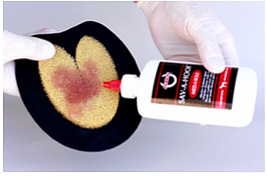
Medical gels are being used to fight infections of the sole and frog. There are formulations designed specifically for use under shoes and pads. Wool, leather, and synthetic pads are sometimes pre-treated with medical gels. Additional gel can be added by horse handlers as needed, through the gap at the heels between the sole and pad. Many farriers make their own custom hoof packing by saturating open-cell foam scraps. Gel formulas can lasts for hours and do not run off or make a mess like liquid preparations for this type of application.
Copper-Peptide Gels Advance Hoof Repair
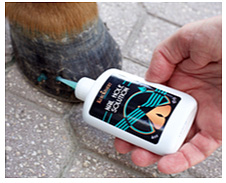
There are copper-peptide gel formulas that deeply clean and disinfect nail holes without sealing in bacteria. This technology helps to close nail holes from the inside-out without sealing in contaminants. The gel forms a permanent barrier between the environment and healthy hoof tissue copper-peptides enhance blood flow and
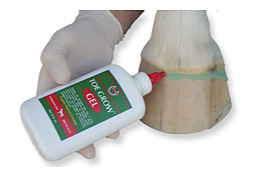
collagen production to the feet which repair cell damage copper- peptides are effective when used along the coronary band, bruised heals, hoof cracks, and damaged clefts and frog. They have been shown to increases capillary circulation and promote faster healing and cell growth they work by attaching to receptors in cells that signal the brain to heal cell damaged tissue. The technology was discovered during animal experiments using horses in the early 1990’s by Dr Loren Pickart. His work led to the discovery of copper-peptide’s amazing benefits at repairing cell damage for humans. The rapid improvement in the hoof condition of horses was observed during the animal studies.
Summary
Medical gel technology offers hoof care professionals, horse owners, and their handlers simple new options for treating major hoof problems. Medical gels are highly absorptive aqueous formulas that continually release their ingredients into hoof tissue. Petroleum jelly , salves or sealants (fats) are self-contained and non-
dispersible. They do not release their ingredients to surrounding tissue shelf life is usually longer with medical gel products than liquid formulas because there is less evaporation and separation of ingredients while packaged or in storage medical gels stick to hoof tissue longer than liquid products which improves their contact time and end results medical gel formulas are effective at treating cell damaged and a variety of pathological conditions such as white line disease, seedy toe, thrush, candida yeast, aerobic and anaerobic bacteria, mold and fungi there is less mess and waste when applying medical gels with syringes and squeeze bottles with long tip dispensers and medical gels improve prod- uct placement, which can save time and money, and help get the results you want.
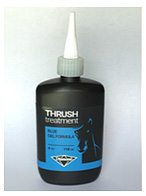
The photo images of trademarked products using medical gel technology for this article were provided by: sbsequine.com, kerckhaert.com, and diamondfarrier.com. They are Sav-A-Hoof Gel, Sav-A-Hoof Med-i-sole, Thrush Stop Blue, Diamond Thrush Treat- ment, Kerckhaert Nail Hole Solution, and Toe Grow Gel.